
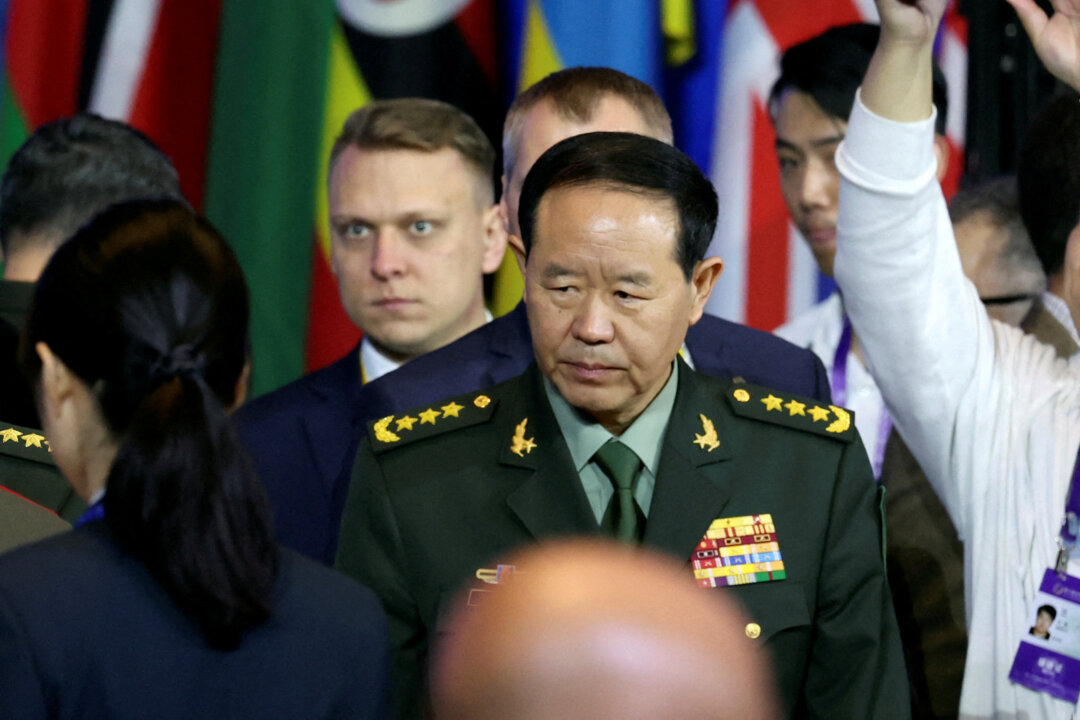
The Chinese Communist Party (CCP) has formally removed two of its most senior military leaders from their posts, completing a legal step that further consolidates regime leader Xi Jinping’s control over the military and appears to leave China’s Central Military Commission (CMC) with just two publicly listed members.
The regime’s rubber-stamp National People’s Congress (NPC) Standing Committee on Aug. 28 voted to remove Zhang Youxia as vice chairman of the CMC and Liu Zhenli as a CMC member. Zhang and Liu were placed under investigation in January. The two men were also stripped of their seats in the NPC.
The government did not announce replacements for either officer.
The formal dismissal has caused renewed unease within the Chinese military, according to regime insiders who spoke to The Epoch Times on condition of anonymity out of fear of reprisal.
An insider from within the regime, surnamed Mo, said that serving officers were angry but felt powerless to respond.
“The morale of officers and soldiers has returned to the state it was in when Zhang Youxia and Liu Zhenli were announced to have been purged in January,” Mo said. “This wave of shock is also quite significant.”
The reaction has been even stronger among retired military officers, who face fewer restrictions on expressing their views privately, according to Mo.
“It seems that retired military officers are very angry,” he said. “They are full of grievances.”
Closing the Door for Dissent
The dismissals follow months of political and military pressure against Zhang and Liu.
After their purge in January, the Chinese military’s official newspaper PLA Daily ran a sharply worded editorial accusing them of seriously undermining the system that places the military under the direct authority of the Party leader—a political charge that drew widespread attention.
The newspaper called on military personnel to align their thinking and actions with decisions made by the Party leadership.
A Chinese scholar familiar with the military told The Epoch Times that the regime had already begun preparing troops for the political fallout before the NPC formally removed Zhang and Liu.
The scholar said senior officials instructed political commissars at military units around the country to organize study sessions on editorials in the military newspaper. The sessions were intended to establish the Party’s political judgment against the two generals and ensure that officers publicly supported the leadership’s position.
“The top leadership first gave garrisons across the country a ‘preventive shot,’” he said, using a common expression in Mandarin Chinese for giving someone a heads-up before something negative or unexpected happens. “They told officers to study the central regime’s political characterization of Zhang and Liu and required them to maintain consistency with the Central Committee and the CMC.”
The distinction is significant because the Aug. 28 action was a formal state-level dismissal. The CCP and the state have separate institutional structures, but the Party’s CMC and the state CMC are effectively the same leadership body operating under two names.
As a result, removing Zhang from the state commission eliminates his remaining formal position within the top military leadership, according to Mo.
The procedure also removes a potential source of ambiguity for officers who might otherwise question whether Zhang retained any institutional authority while under investigation.
Mo said serving officers who disagree with the purge have little ability to express their views. Retired officers, by contrast, can be more outspoken in their private circles.
Zhang was one of the military officials most closely associated with Xi’s leadership. After Xi came to power, Zhang remained a prominent figure in the military hierarchy and served as one of the two vice chairmen of the CMC.
During his tenure, he approved the promotions of numerous senior officers. Some of the officers promoted under Zhang have subsequently come under investigation as the regime expanded the military purge.
The continuing crackdown has therefore extended beyond Zhang and Liu themselves, adding to uncertainty among officers who rose through the ranks during their tenure.
Military Leadership Shrinks
The latest removals also highlight the extraordinary turnover at the top of China’s military.
The CMC, formed in March 2023, originally had seven publicly listed members. Xi is chairman. Zhang Youxia and He Weidong were vice chairmen, and Li Shangfu, Liu Zhenli, Miao Hua, and Zhang Shengmin were members.
Since then, Li, He, and Miao have all fallen from power. Zhang Shengmin was subsequently elevated to vice chairman.
With Zhang Youxia and Liu Zhenli now formally removed, the Chinese regime’s published list of CMC members contains only Xi and Zhang Shengmin.
The Chinese scholar said the regime may not fill the vacancies immediately.
“It is very likely that they will maintain a two-person CMC until the end of next year’s Party Congress,” he said.
That would leave Xi and Zhang Shengmin overseeing the military during an unusually extensive period of personnel upheaval.
Xiao Bin contributed to this report.
We had a problem loading this article. Please enable javascript or use a different browser. If the issue persists, please visit our help center.