
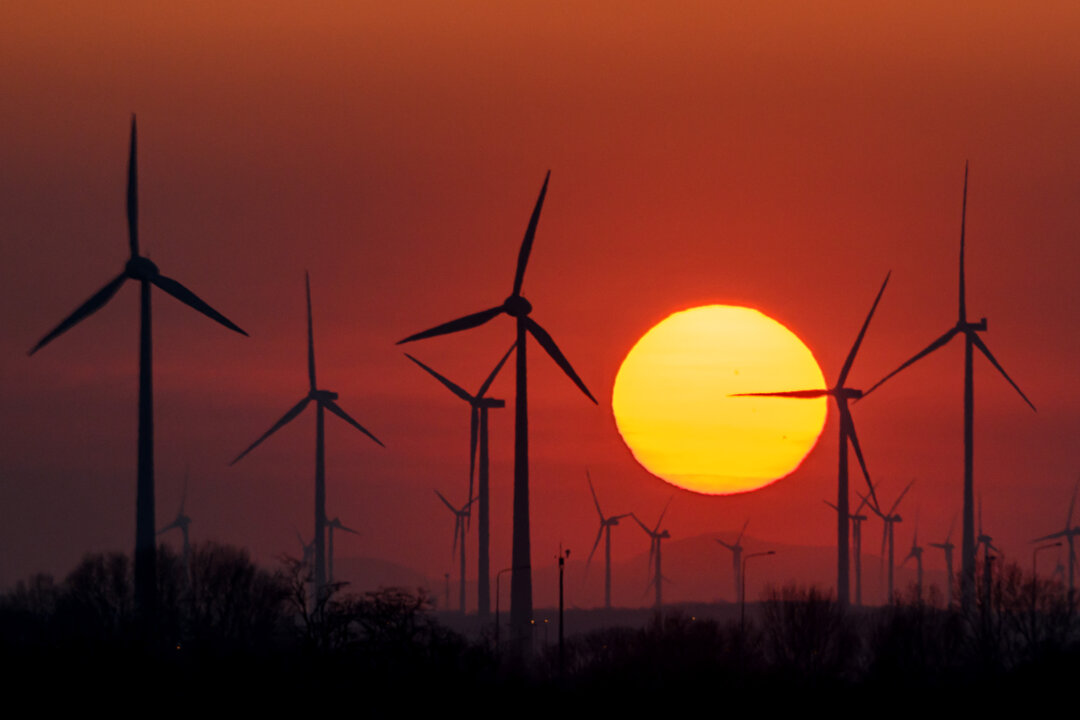
President Donald Trump issued a presidential proclamation Thursday that could curb the importation of wind turbines and turbine parts into the United States.
The Department of Commerce conducted an investigation that became the basis of the presidential proclamation.
Trump wrote that, at the conclusion of the investigation, Commerce Secretary Howard Lutnick “found and advised me of his opinion that wind turbines and their components and subcomponents are being imported into the United States under such circumstances as to threaten to impair the national security of the United States.”
Congress gave some powers over to the executive branch in the Trade Expansion Act of 1962 to limit commerce when national security concerns must be addressed.
Trump is using one of those powers, granted in section 232 of the legislation, to order U.S. Trade Representative Jamieson Greerto undertake negotiations with several nations over red flags that the presidential proclamation raises and report back on the results within 180 days.
Issues the negotiations are supposed to address are potential cybersecurity threats in the wind turbine components, the reliance on foreign firms for most turbine manufacturing, the effects of intermittency on the U.S. electric grid, and radar interference from large turbines and the problems they pose to air traffic control, weather forecasting, homeland security, and national defense missions.
Based on the results of the negotiations and the later report, Trump wrote, “I may consider alternative remedies in the future.”
That would give him the ability to tariff, prohibit, license, regulate, and otherwise limit the importation of the turbines and items related to turbines. Such actions could be challenged in the U.S. Court of International Trade, but it would be a long shot.
The trade court itself wrote in 2019 that a regulation based on section 232 “plainly unrelated to national security would be, in theory, reviewable as action in excess of the President’s section 232 authority,” but concluded that such a thing would likely have to be decided by the Supreme Court.
Judicial review by America’s highest court could take a great deal of time, as the court makes its own determinations as to what cases it will or will not take up.
By law, 180 days after the proclamation, Trump could determine that not enough progress has been made and take action.
This proclamation was the latest in a series of actions by the Trump administration seeking to rebalance America’s power supply policies from past policies pushed by the Biden administration.
It was also in keeping with Trump’s long-stated opposition to wind turbines, which he calls windmills.
“We will not allow a windmill to be built in the United States. They’re killing us. They’re killing the beauty of our scenery,” Trump said in a presser with European Commission President Ursula von der Leyen in July 2025.
Trump has also complained about wind turbines being manufactured in China.
According to a report by the Lawrence Berkeley National Laboratory, in 2024, Chinese firms made the top 10 list of wind imports to the United States at $110 million. They were narrowly beaten out by firms in Spain ($120 million) and South Korea ($125 million), but they managed to do more U.S. sales than Canadian firms’ $74 million.
German firms easily led the pack at $707 million, followed by companies in Mexico ($597 million), France ($379 million), India ($298 million), and Denmark ($260 million).
We had a problem loading this article. Please enable javascript or use a different browser. If the issue persists, please visit our help center.