
In a leafy Raleigh, North Carolina, subdivision, modest split-levels and raised ranches built in the early 1970s are razed to make way for more luxurious homes on the same lots.
The buyers then flip them for a massive profit, driving up assessed values and local tax bills for the entire neighborhood.
Ed Jones, a 91-year-old retired business owner who moved to the rapidly growing North Carolina community in 1950, said that once-affordable homes for young families and senior citizens in his neighborhood have been wiped out as the lack of affordable U.S. housing approaches critical mass.
“We’re sandwiched between all of these million-dollar homes,” Jones told The Epoch Times. “With the revaluation coming, I’m sure we’re going to have to fight hard. We want to stay here as long as we can.”
Similar complaints have been heard in Florida, where Tampa Bay-area realtor Vincent Arcuri estimates that his average customer is 41 years old, compared with 28 when he began in 1991.
As home values keep rising in the Southeast and across the nation, so does the tax revenue that local governments and school districts collect.
Lawmakers and citizens’ groups, fed up with annual increases that exceed inflation, have introduced property tax limitation ballot measures in seven states in the Nov. 3 elections.
Modest homes are replaced by luxury homes, which buyers flip for a huge profit, driving up assessed values and tax bills for the entire neighborhood.
“The anger is legitimate,” said Adam Michel, director of tax policy studies at the Cato Institute, a libertarian think tank. “Property taxes aren’t adjusting to the rest of the system. Something has to give.”
Here’s a look at some 2026 ballot initiatives.
North Carolina
The Tar Heel State’s proposed constitutional amendment, if passed by a majority of voters, would require the legislature to pass laws limiting property tax hikes.
Brian Balfour, vice president of the John Locke Foundation policy center in North Carolina, said annual caps would likely be based on inflation and population growth trends across communities.
The assessed taxable value of farmland Jones bought in the 1990s stayed at $73,000 for decades, but jumped to $330,000 in 2024.
From 2023–2024, property taxes made up 44 percent of county-level revenues and 22 percent of municipal-level (cities and towns) revenues, according to the John Locke Foundation. The money covers local services such as public safety and education.
This tax levy is based on the assessed value of a property, which traditionally is less than market value. The average North Carolina home value increased by 104 percent (compared with 87 percent nationally) between 2015 and 2024. During the same time period, home values rose to 4.9 times the state’s median household income from 3.2 times the median household income. Property taxes collected during that decade increased to $9.6 billion from $6.5 billion, the foundation reported.
This trend is not limited to homes and businesses.
Jones said the assessed taxable value of a 20.37-acre parcel of abandoned farmland he bought in the early 1990s to use as a family hunting property remained at $73,000 for decades, but “in one swoop” it increased to $330,000 in 2024. He’s appealing to the state tax commission and leads the Wake County Taxpayers Association’s efforts to promote the “yes” vote next month.
“We feel this should have been done a long time ago,” Jones said.

While there doesn’t appear to be strong opposition to this ballot measure, the North Carolina Budget and Tax Center policy organization cautions that tax caps make local governments more reliant on state funding, fees, and fines. User charges for specific services such as water and trash collection can’t fund other local functions. When property tax revenues decrease, local leaders are forced to cut hours at public libraries and community pools and other programs that are supposed to benefit the entire community.
“If lawmakers are serious about affordability, they should choose targeted relief,” the organization’s website states, “not blunt caps that shift costs and deepen inequities.”
Florida
Amendment 3, which requires approval from 60 percent of voters, would exempt primary residences from property taxes on up to $150,000 of assessed valuation in 2027 and $250,000 in 2028, with further amounts based on annual inflation rates after 2029.
Residents who buy a home in the Sunshine State after Dec. 31 of this year must live there for five years before they can qualify for the tax break. It also reduces the cap on annual property tax hikes on non-homestead parcels, including rental and commercial properties, to 5 percent annually from 10 percent. The legislation doesn’t pertain to local school taxes.
In the past decade, Florida’s population has increased by 16 percent, while wages have increased by about 52 percent and property tax revenues by 99 percent, notes the Florida Realtors organization, which is promoting the Vote Yes on 3 campaign.
The way things are going, the best shot a young couple has at getting a home here is inheriting one—if their older relatives can afford to stay in it.
Vincent Arcuri, Tampa Bay-area realtor
Arcuri said that Florida’s Save Our Homes Act, passed by voters in 1992, is no longer effective. Its 3 percent annual increase was limited to existing permanent residences. When the home is sold, he said, “the blanket is removed.”
A new property owner of a $400,000 home, for example, paid $9,000 in local taxes. By contrast, the previous resident who owned the house for decades before selling it last year paid $4,000 in 2025, Arcuri said.

High interest rates on mortgages, skyrocketing property insurance rates, and inflation have already made it difficult for potential young homebuyers; high taxes put the dream out of reach, Arcuri said.
“The way things are going, the best shot a young couple has at getting a home here is inheriting one—if their older relatives can afford to stay in it,” he said. “The amendment is also about helping people stay in their homes.”
In September 2025, the state Department of Financial Services announced that Hillsborough County spent $278 million above the amount that would account for population growth and inflation in its annual general fund budget. That amount equated to nearly $7,000 more per county resident or $27,777 more per family over six years.
In the past decade, Florida’s population has increased 16 percent, wages about 52 percent, while property tax revenues have increased 99 percent.
The county used the increased tax revenues to hire 645 employees, but it should have cut taxes instead by $408 per year for a $400,000 home and by $612 for a $600,000 home, the agency reported.
An opposition group, Vote No on 3, said the measure would cost local governments $34 billion and either cut vital services or shift the burden to wealthy homeowners, renters, and consumers across the state who would subsequently pay much higher sales tax rates.

“Squad cars, sidewalks, roads, bridges, and fire stations don’t magically become cheaper because homestead properties are cut or eliminated,” the group’s website states. “The cost shifts. And the people who decide where it lands won’t be the ones living with the consequences.”
Florida voters will also decide on a separate amendment that would exempt certain personal property on agricultural lands from taxes.
Wyoming
In Wyoming, Initiative 1 would cut property tax bills on primary residences in half.
Homeowners are eligible for the 50 percent assessment exemption if they lived in their current dwelling for at least six months and in the state for at least one year.
The initiative is expected to reduce local government tax revenues by about $92.6 million in 2028 and $95.9 million in 2029.
What is missing is not money. What is missing is a government that has ever been forced to live within its means.
Frederick Harrison, Wyoming resident
A proponent, Frederick Harrison, an attorney and former state legislator, told The Epoch Times that Wyoming already collects $2 billion annually from oil, gas, coal, and mineral extractions. Additionally, the planned $17 billion Google data center will contribute millions of dollars more to property tax coffers in the nation’s least-populated state.
He said Laramie County alone has a $147 million fund balance that’s growing by up to $37 million annually.

“What is missing is not money,” he said. “What is missing is a government that has ever been forced to live within its means.”
The main opponents in this fight are public community colleges and law enforcement agencies partially funded by local property taxes. Harrison said public employees paid by state and local tax dollars make up about 20 percent of Wyoming’s workforce.
“Everyone who is against Initiative 1 has a dog in the fight,” he said.
Other States
Georgia’s Amendment 1 would increase the amount of agricultural and timber conservation properties eligible for partial property tax exemptions to 4,000 acres from 2,000 acres.
Oklahoma’s State Question 847 would cap increased taxable assessments on primary residences and farms at 1.75 percent annually, and 4 percent for other property types.
Tennessee’s Amendment 2 would prohibit the creation of a state-level property tax but does not impose limits on existing local property tax measures.
Measures to limit or eliminate property taxes are also on the ballot in Georgia, Oklahoma, Tennessee, and Louisiana.
Louisiana has four separate propositions involving property tax exemptions for seniors, spouses of disabled veterans, low- to middle-income residents, and future caps on annual increases.
In May, Louisiana voters defeated a proposition that would have authorized parishes to reduce or eliminate property taxes collected on businesses’ inventory and production equipment.
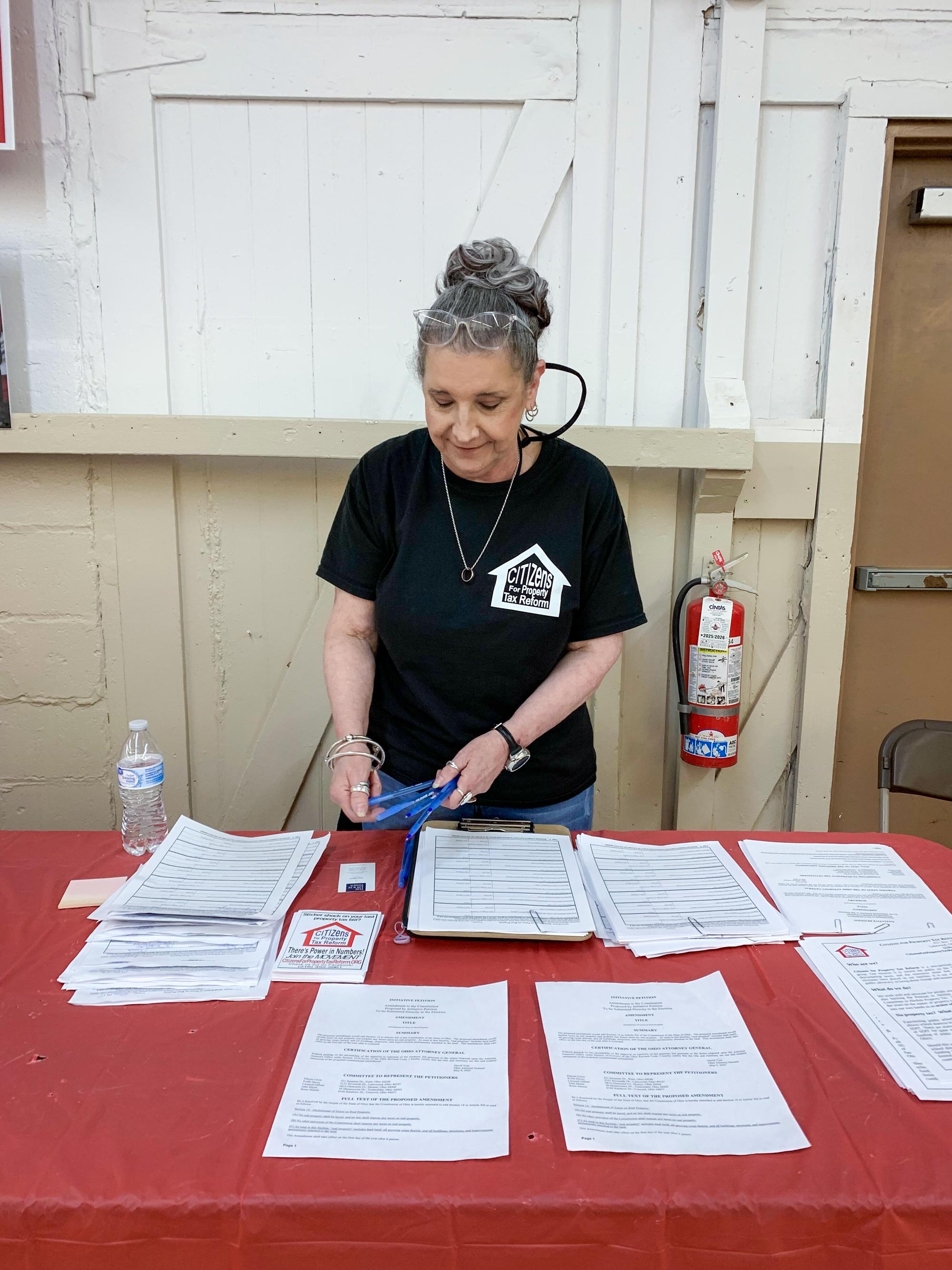
In Ohio, Citizens for Property Tax Reform is pushing for the eventual elimination of local property taxes. A proposition in the Buckeye State could be on the ballot in the 2027 elections if the group obtains enough signatures from residents by July 1. Members initially hoped to see the ballot initiative this year but opted to push it back after falling short on signatures.

What’s Ahead
Michel said the property tax reform movement is gaining momentum despite existing exemptions for seniors, veterans, and other types of homeowners in several states. Those measures increase the burden for the larger share of the population, especially younger families, he noted, saying, “It’s not good policy.”
Some states have initiated minimum efforts to contain property taxes.
In New York, where residents decide on school budgets in the vast majority of districts, annual school property tax rate increases are limited to 2 percent unless 60 percent of the voters elect to override the cap.
Public unions and special interest groups have more time and money to preserve the system that pays them, Michel said.
Massachusetts has a similar law. On April 14, the South Hadley school district in the western part of the state rejected an override proposition that would raise property taxes by up to 50 percent to maintain all current staffing and programs. The “no” vote forced district leaders to cut course offerings, curricula, and extracurricular activities.
Still, in a typical fight over property taxes, public unions and special interest groups have more time and money to preserve the system that pays them; their opponents are usually volunteer citizen groups and politicians with a variety of issues to deal with, Michel said.
Moreover, he added, local governments remain steadfast on residential property taxes because it’s easier to monitor and enforce collection measures compared with the effort involved in taxing businesses. This also exacerbates the ever-growing tax-and-spend bureaucracy, he said.
“In my view, governments are always doing far more than what they need to be doing,” he said.
We had a problem loading this article. Please enable javascript or use a different browser. If the issue persists, please visit our help center.