
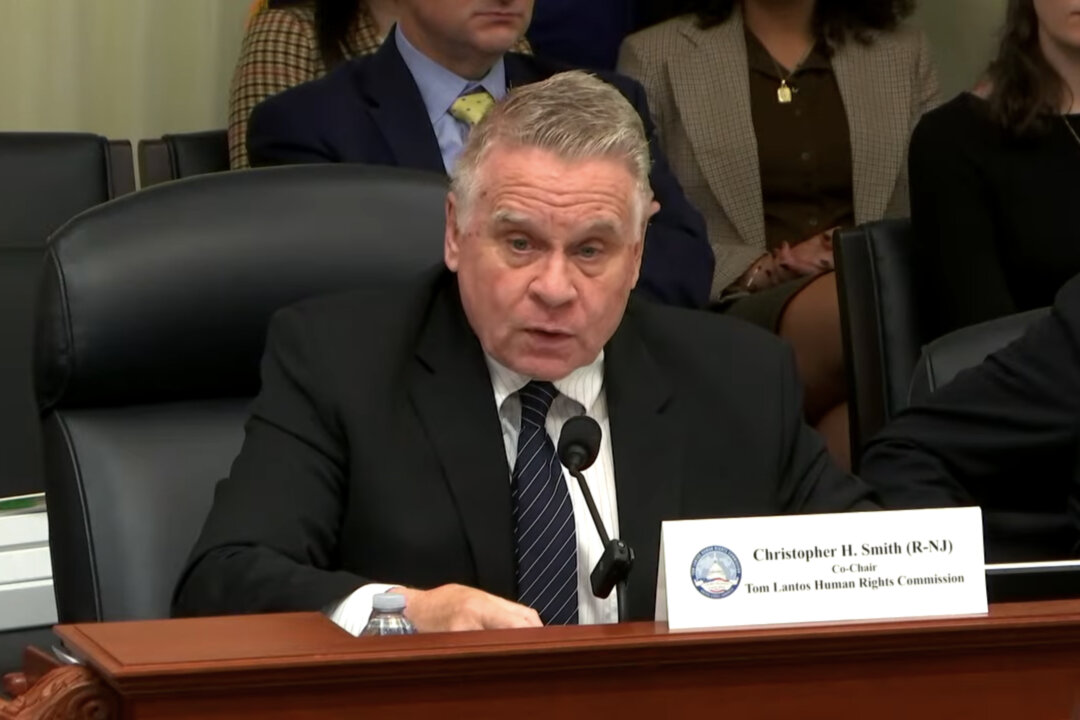
Persecution of Christians around the world is intensifying, and the United States must do more to defend religious liberty, said a Republican lawmaker as he opened a congressional hearing Wednesday.
“It was bad years ago. It’s always been bad. It is getting worse,” Rep. Chris Smith (R-N.J.) said.
Smith cochaired the Tom Lantos Human Rights Commission hearing with Rep. Jim McGovern (D-Mass.) in the Cannon House Office Building.
“In the United States, religious freedom is often called our first freedom,” Smith said. “Religious freedom is a universal human right; it belongs to every person everywhere, regardless of faith or belief.”
Announcing the session, Smith’s office said governments in many countries “discriminate against Christians and other religious minorities, and subject religious leaders and believers to surveillance, imprisonment, and other forms of repression.”
Citing the Open Doors 2026 World Watch List, Smith said more than 388 million Christians face high levels of persecution and discrimination, or more than one in seven Christians worldwide.
“Christians are among the most widely dispersed religious communities in the world. They are also among the most widely persecuted,” he said. “They face severe persecution in very large numbers of countries and on every continent.”
Recalling that he chaired a February 1996 hearing on the persecution of Christians, Smith said the commission’s concern extends to all faiths.
“Today we’re talking Christians, but in other times we have talked about the Falun Gong. We’ve talked about Jewish individuals who have been discriminated against, and all people of faith,” he said.
“Last year, we held a hearing on the worldwide persecution of Jews, because anti-Semitism is a unique and spiritual disease,” Smith added.
He said the threats are not limited to war zones and dictatorships.
“Increasingly, Christians also encounter restrictions in ostensibly neutral liberal states, where laws and regulations ostensibly designed to serve other purposes can be used to restrict religious expression, worship, and the exercise of conscience,” Smith said.
“A community can be driven out by bullets, as we all know, and bombs, but it also can be driven out by intimidation, discrimination, and coercion, and the cumulative effects of official restrictions,” he said.
Smith pointed to the International Religious Freedom Act of 1998, authored by Frank Wolf, and said its sanctions against countries of particular concern “must be meted out with no holds barred.”
“I believe we can and we must do more,” he said.
McGovern said the hearing addressed a pressing need.
“It is appropriate that this commission address violations of Christians’ right to freedom of religion and belief,” he said. He cited military airstrikes on churches in Burma and the jailing of Christian leaders in Russia.
“Human rights are interconnected and interdependent,” he said.
Witnesses described the toll on believers around the world.
David K. Trimble, president of the Religious Freedom Institute, singled out Nigeria as perhaps the most dangerous country for Christians.
“Christians face mass killings, sexual violence, torture, kidnapping for ransom, destruction of property, forced displacement,” Trimble said.
He said Nigerian authorities “have failed to hold violent perpetrators systematically accountable.”
John Eibner, president of Christian Solidarity International, cited a Vatican estimate that “5,000 Christians have been killed for their faith only last year,” adding, “I would assume that is probably an underestimate.”
Timothy Shah, distinguished research scholar in politics at the University of Dallas, cited Pew Research Center data showing Christians were harassed in 165 countries, up from 107 in 2007.
“That is a more than 50 percent increase in 16 years,” Shah said. “We are speaking of a global epidemic.”
But he stressed that “the crisis is not Christians alone; it is a multi-faith crisis that demands a multi-faith response.”
Jeremy Tedesco, senior counsel and senior vice president of Global Free Speech at Alliance Defending Freedom, said the threat extends to Western democracies.
“Christian persecution is on the rise in Europe, where governments are increasingly treating foundational Christian beliefs as crimes,” Tedesco said. “A government that can police your prayers will have little hesitation policing your speech.”
Matthew Soerens, vice president of advocacy and policy at World Relief, urged Washington to reopen refugee resettlement to persecuted Christians.
“Not just a few, zero,” Soerens said of Christian refugees resettled in fiscal year 2026 from the 50 countries where Christians face the most severe persecution.
Shah said, “Religious freedom is not an American export; it is a universal birthright.”
“Defending the persecuted is not charity; it is sound strategy, and it is who we are,” he added.
Trimble urged more humanitarian aid, recalling asking a priest in the Iraqi town of Karamlesh what his community needed most.
“He said seeds. That’s all he said. Seeds,” Trimble said, adding that humanitarian aid “is part of religious freedom.”
We had a problem loading this article. Please enable javascript or use a different browser. If the issue persists, please visit our help center.