
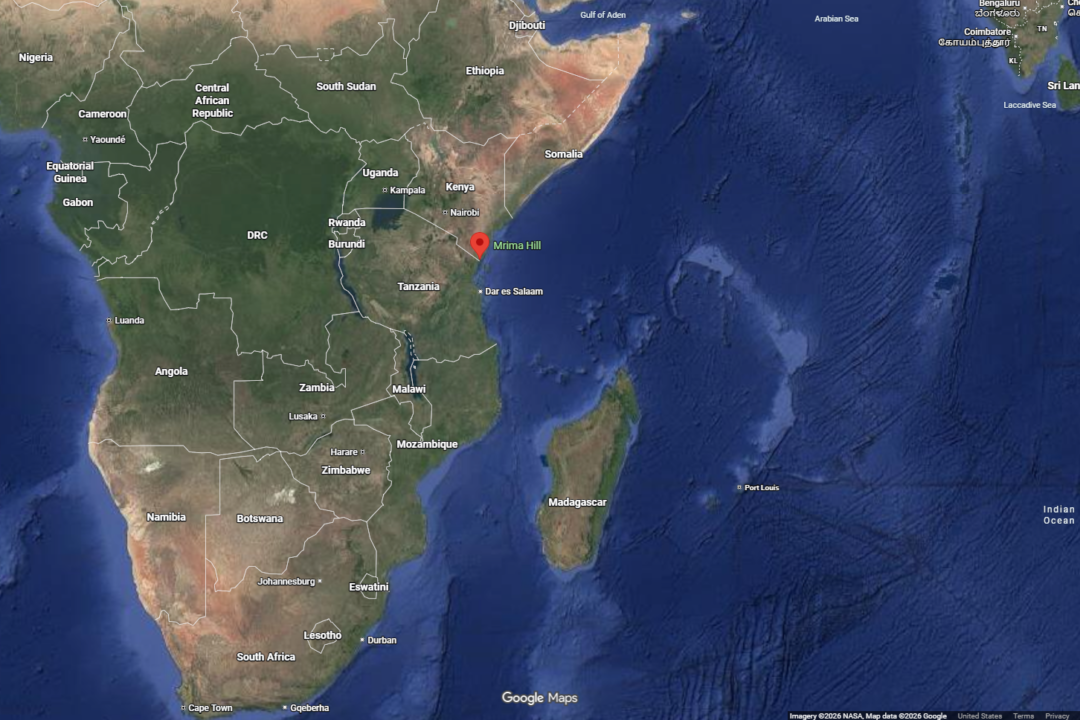
Kenya has selected a U.S.-led consortium for a major rare-earth mining project, potentially opening a new source of minerals critical to American defense and manufacturing as Washington seeks to reduce its reliance on China.
The Kenyan Ministry of Mining announced on Nov. 19 that Frontier Minerals Consortium had been chosen for the Mrima Hill deposit in Kwale County, near the country’s Indian Ocean coast. Members include American Resources Corp., ReElement Technologies, Bunker Hill Mining Corp., and Frontier Minerals LLC. The ministry issued a Notice of Intention to Award, allowing unsuccessful bidders to challenge the selection before the award is finalized.
The selection comes as the Trump administration works to secure supplies of rare earths used in powerful magnets found in fighter jets, electric vehicles, industrial machinery, and other advanced technologies.
China accounted for about 71 percent of global rare-earth mining and 87 percent of processing in 2024, according to the U.S. Geological Survey. Even minerals mined outside China often depend on Chinese processing facilities before they can be used by manufacturers.
One consortium member, ReElement Technologies, has received direct support from the Pentagon. In July, the Defense Department announced a $25 million investment to expand the company’s rare-earth and critical-mineral refining capacity in Marion, Indiana.
The funding supports ReElement’s U.S. operations, rather than the Kenyan project. Its participation nevertheless brings an American government-backed rare-earth processor into a project that could provide an alternative source of critical minerals.
US Efforts to Build Alternative Supply Chains
The Mrima Hill deposit contains rare-earth elements and niobium, a metal used to strengthen steel for aerospace and industrial applications.
Kenya’s March 27 government notice designated the minerals as strategically important and invited international companies to compete for the project.
Frontier said in its Nov. 19 statement that it plans to develop mineral processing and refining capacity in Kenya rather than simply export unprocessed material.
The consortium said ReElement’s U.S. operations would provide a model for deploying its refining technology in Kenya. Its proposed approach would give Kenya a larger role in mineral production while expanding processing capacity outside China.
The project remains at an early stage. Frontier said a feasibility study must establish how the minerals could be extracted, refined, and marketed economically before a commercial mine can be developed.
The U.S. government had already identified Kenya as a potential critical-minerals partner. In September, Assistant Secretary of State for African Affairs Frank Garcia told S&P Global that Washington was pursuing mining opportunities in Kenya and wanted to expand bilateral cooperation on critical minerals.
The U.S. government is also seeking to expand domestic processing capacity. In June, the Department of Energy selected two projects for negotiations over a combined $134 million in funding to recover and refine rare earths from industrial waste and other sources. The department said the funding was not guaranteed until negotiations were completed.
US–China Competition in Kenya
The U.S. State Department welcomed Frontier’s selection, describing it as an opportunity to expand American investment in Kenya’s mining sector.
“The U.S. Government will take every opportunity to help American businesses invest in emerging sectors and developing economies, including the mining sector,” a State Department spokesman told The Epoch Times on Nov. 19.
The spokesman said Kenya’s decision reflected a commitment to a transparent mining sector, with American technology and investment expected to create jobs and economic benefits in both countries. The assistant secretary of state for African affairs also publicly congratulated Frontier on its selection.
Although Frontier was chosen for Mrima Hill, Chinese companies secured two other mineral projects in the same Kenyan tender round.
According to the Kenya News Agency, a joint venture involving China’s Fangda Special Steel Technology and Sinohydro was selected for separate chromite and copper projects.
The results give American and Chinese companies opportunities to develop different mineral resources in Kenya, as both countries seek access to raw materials used in advanced manufacturing.
Australian mining company RareX, whose consortium with Iluka Resources finished second, has challenged Frontier’s eligibility. In a Nov. 19 stock-exchange disclosure, RareX alleged that Frontier missed an initial submission deadline and said it intends to file a procurement complaint by Dec. 10.
Frontier’s selection remains subject to the formal award process. The company would need a prospecting licence for exploration and further environmental, community, and government approvals before commercial mining could begin.
Frontier Managing Member Brad Barnett said the consortium would focus on developing the deposit while meeting Kenya’s legal and environmental requirements. The consortium plans to establish mineral processing and refining operations in Kenya using technology developed by ReElement in the United States.
We had a problem loading this article. Please enable javascript or use a different browser. If the issue persists, please visit our help center.