
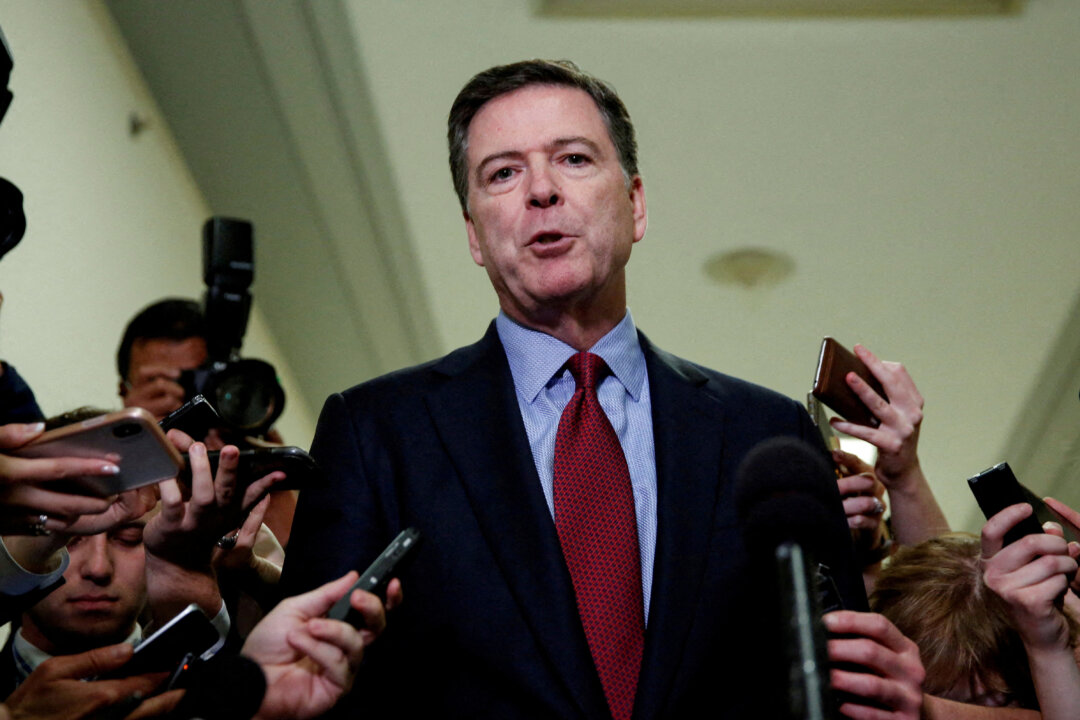
Motions to dismiss charges before a jury has a chance to consider them rarely succeed in federal court, but experts say that the Justice Department’s attempt to prosecute former FBI Director James Comey for allegedly threatening the life of President Donald Trump could be an exception.
The charges arose after Comey posted an image depicting seashells that read “86 47.” The Department of Justice (DOJ) said it was a threat to kill the 47th president of the United States. Comey has denied any violent intent and filed motions to dismiss, arguing that the prosecution was vindictive and that his post was protected by the First Amendment.
The case is still in the preliminary stages, with an arraignment scheduled but delayed past its already-postponed Sept. 30 date. It’s unclear if it will ever reach trial.
Comey has said he had no violent intent with the post and deleted it as soon as he recognized the potential interpretation. The DOJ has argued that, given his time leading the FBI, he should have known better.
“A former mob boss has informed the FBI that in his world, ‘everyone knew’ that 86 meant ‘kill,’ and given Comey’s experience as FBI Director, there is ‘no way that Comey did not know that,’” the department said in an August filing.
Skeptical, former federal prosecutor Neama Rahmani suggested that the case could have as high as an 80 to 90 percent chance of dismissal.
“I think this is one of the few cases where you can be very aggressive and go after the prosecution itself for even wasting the jurors’ time for an Instagram post,” Rahmani told The Epoch Times.
Meaning of ‘86’
The term “86” was commonly used in diners and restaurants as shorthand for removing an unruly customer or as code for an out-of-stock menu item.
Prosecutors alleged in the August filing it was a coded message to Comey’s followers “meaning ‘kill’ or ‘get rid of’ (a euphemism for ‘kill’) President Trump.”
Comey’s attorneys challenged that reading.
“The ordinary meaning of ‘86’ does not connote violence,” they wrote in a memorandum of support for the motion to dismiss. “To be sure, in more recent times, ‘86’ has on isolated occasions been used to mean ‘to kill.’ But that usage is so ‘sparse’ that Merriam-Webster does not endorse it and most dictionaries do not include it.”
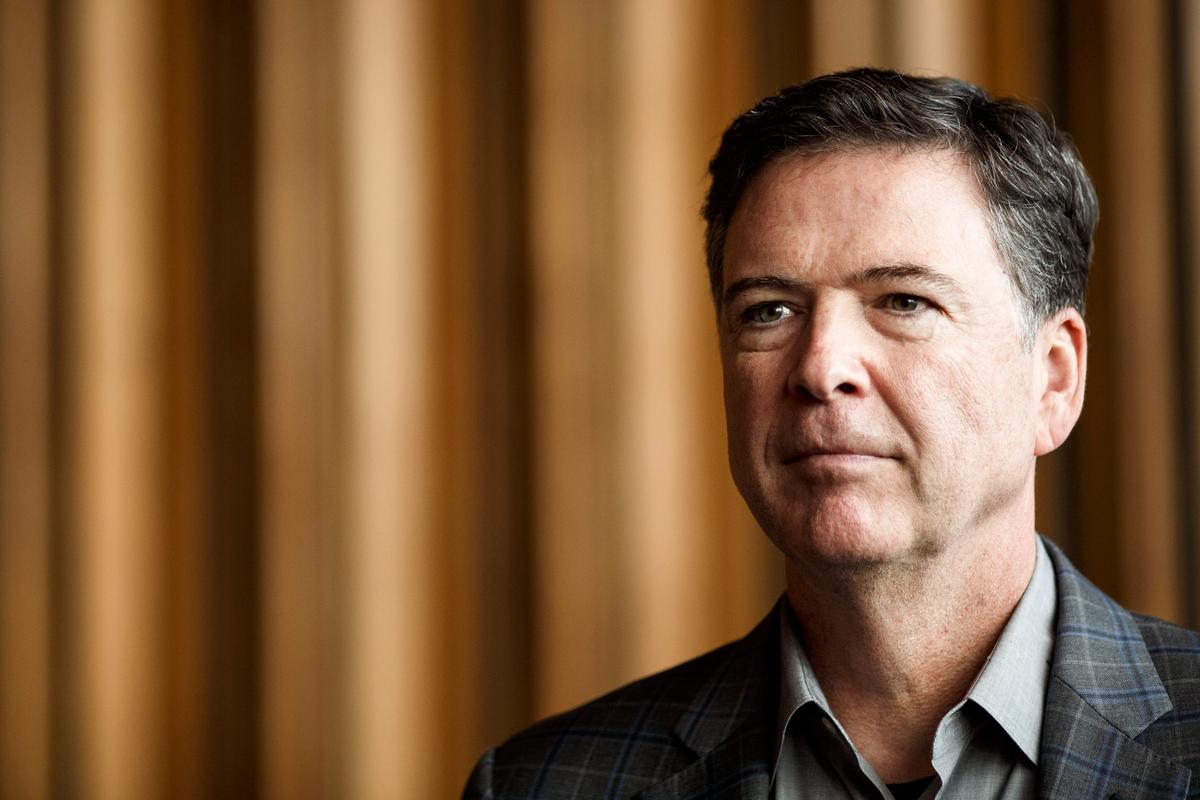
The Department of Justice announced in April that Comey had been indicted on charges relating to threatening to kill or harm Trump.
Then-acting Attorney General Todd Blanche said at the time that Comey had been charged with one count of making threats against the president. The charge is a criminal offense under 18 U.S. Code Section 871, punishable by a fine and up to five years in federal prison.
Comey was also charged with another count related to general interstate threats.
In one motion to dismiss, his lawyers argued that when he posted the photo, he was expressing a political viewpoint.
“As a matter of law, that post was protected by the First Amendment and falls outside the scope of 18 U.S.C. § 871(a) and 18 U.S.C. § 875(c),” the filing states.
The first statute provides legal penalties for anyone who “knowingly and willfully deposits for conveyance in the mail or for a delivery from any post office or by any letter carrier any letter, paper, writing, print, missive, or document containing any threat to take the life of, to kidnap, or to inflict bodily harm upon” the president or president-elect, vice president or vice president-elect, or anyone else in the first or second spot of the line of presidential succession.
The second provides a broader federal law on interstate threats, with a top penalty of a fine, five years in prison, or both.
A ‘True Threat’?
For the government to convict Comey, they must convince jurors that the former FBI director intended to make a “true threat” against Trump.
In Counterman v. Colorado (2023), the Supreme Court held that to prove a true threat, the government must show, at a minimum, that the speaker acted recklessly by disregarding a substantial risk that others could interpret the comment that way.
Comey said he found the seashells during a beach walk and interpreted them as a political message. He deleted the photo on the same day. He said that it hadn’t occurred to him that some people could associate “86” with violence, and that he took the post down because he opposed violence of any kind.
“To put it mildly, I think it would be very difficult to say that a reasonable person would have believed that Jim Comey was trying to convey a threat, or that he had a subjective belief that somebody could view this as threatening,” attorney John Malcolm said in an interview with The Epoch Times.
“As to a true threat, I doubt they will be able to clear that threshold, and they will have to prove that Jim Comey had a subjective understanding that … a reasonable person would have believed” that he was calling for an attack on the president, he added.
Malcolm is vice president of the Edwin Meese III Institute for the Rule of Law, part of former Vice President Mike Pence’s advocacy group, Advancing American Freedom.
Prosecutors charged the case in the Eastern District of North Carolina, where Comey said he found the shells.
Alleged Vindictiveness
Comey’s attorneys argued in a July 28 filing that he was the target of selective and vindictive prosecution.
“The government has singled out Mr. Comey for prosecution because of his protected speech and because of President Trump’s personal animus toward him,” they wrote.
“Such a vindictive and selective prosecution violates the First Amendment, Due Process Clause, and equal protection principles.”
Vindictive prosecution describes prosecution in retaliation for exercising a legally protected right, and such claims fall under Fifth Amendment Due Process protections.
Defendants alleging vindictive prosecution must show that the charges were brought solely to penalize the exercise of such rights and “could not be justified as a proper exercise of prosecutorial discretion,” according to a February report from the Congressional Research Service.
A presumption of vindictiveness generally arises when prosecutors increase charges after a defendant successfully appeals a conviction, though prosecutors can rebut that presumption with a non-retaliatory justification, Cassandra Barnum, a legislative attorney, wrote in the report.
A federal appeals court wrote in its 2006 ruling in United States v. Jarrett that vindictive prosecution claims are extremely difficult to prove.
This is due in part to courts’ “presumption of regularity,” or baseline presumption that public officers have ”properly discharged their official duties,” the Supreme Court wrote in the 1926 ruling in United States v. Chemical Foundation.
The DOJ challenged Comey’s claim.
“To prevail on a vindictive prosecution claim at this stage of the proceedings, Comey must show actual (as opposed to presumptive) vindictiveness,” prosecutors wrote in a response to his motion to dismiss. “That means actual, objective evidence that he was prosecuted for exercising a legal right. Comey cannot do that.”
Potential Trial
The government also said in its response to Comey’s motions to dismiss that, at this stage of the proceedings, it does not yet need to prove Comey’s post constituted a true threat.
“Rather, the issue presented is who should answer the ‘true threats’ question in the first instance,” prosecutors wrote. “Comey seeks to take the question away from the jury before the government presents any evidence.”
They argued that jurors should be able to determine for themselves whether the post constituted a true threat.
“Courts across the country have recognized that whether a statement constitutes a true threat is fact-bound, context specific, and quintessentially a matter for the jury,” they added. “This case is no different. Whether Comey’s post constitutes a true threat depends entirely on the sharply disputed factual context.”
Federal courts rarely dismiss charges before they reach a jury.
Some experts worry that successfully prosecuting Comey on these grounds would have a chilling effect, discouraging others from feeling safe expressing controversial or exaggerated political speech.
Courts consider the chilling effect—and the potential downstream effects of their actions on Americans’ willingness to exercise their rights—a critical component of their role on the federal bench.
“I think that this is a very silly indictment,” Malcolm said. “I give it about a 50-50 chance, maybe a 40 percent chance, only because it is very rare to dismiss a case, even one as flimsy as this, before the evidence has been presented before the jury.”
Rahmani said even if the case does go to trial, it has “almost no chance of getting across the finish line—by that I mean, getting a unanimous guilty verdict at trial.”

Blanche said in May that prosecutors didn’t indict Comey solely over his social media post.
“Rest assured that the career assistant United States attorneys in North Carolina, the career FBI agents, the career Secret Service agents that investigated this case didn’t just look at the Instagram post and walk away,” Blanche told NBC at the time.
“I am not permitted to get into the details of what the grand jury heard or found, as you know,” he said. “But rest assured that it’s not just the Instagram post that leads somebody to get indicted.”
Matthew Vadum and Jackson Richman contributed to this report.
We had a problem loading this article. Please enable javascript or use a different browser. If the issue persists, please visit our help center.