
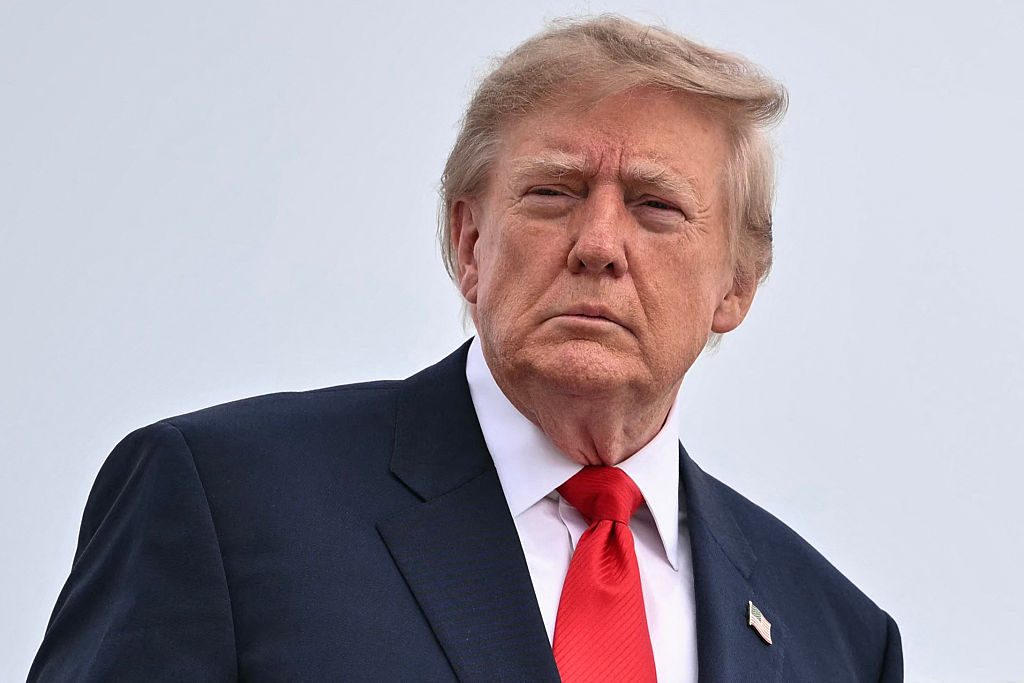
President Donald Trump said on Oct. 13 that the Iran-backed Houthi terrorist group is “behaving very badly” and appears to be trying to increase oil prices just before the midterm elections in the United States.
The terrorist group in Yemen has carried out multiple attacks over the past week on airports in Saudi Arabia, including an Oct. 10 attack on King Khalid International Airport that killed at least 13 people and injured at least 309 others.
“They’ve been silent for a long time, but now they’ve emerged again, probably at the behest of Iran, which is a Failing Nation, with No Navy, No Airforce, the World’s Worst Economy, and 301% Inflation, in a very nasty way, hitting Saudi Arabia, and purposefully trying to drive up Oil Prices, probably prior to the U.S. Elections — NOT NICE,” Trump wrote in a Tuesday statement on Truth Social.
Following the Houthi attacks in Saudi Arabia, Brent crude, the global benchmark for oil, increased to more than $106 per barrel on Oct. 12, marking the highest price for oil in over two weeks. The increase in oil prices just weeks before the midterm elections also comes amid continued disruptions to oil tanker traffic in the Strait of Hormuz.
The U.S. military conducted strikes on more than 1,000 Houthi targets from March 2025 to May 2025 in a major bombing campaign dubbed Operation Rough Rider. The operation was launched in response to repeated attacks on shipping in the Red Sea and ended with a ceasefire between the United States and the terrorist group.
As of Tuesday, the average price for a gallon of regular gasoline was $4.34, and the average price for a gallon of diesel was $6.28, compared to $3.08 and $3.65 a year ago, respectively, according to the American Automobile Association.
Trump has repeatedly said that the conflict between the United States and Iran could end shortly after the November elections and that he expects oil prices to decrease after the elections.
Last week, Trump announced that the United States would not carry out additional military strikes against Iran before the elections. He said in a Truth Social post that Washington was having “productive discussions” with Tehran, adding that Iran was in “very bad condition.”
The president also said last week that the U.S. naval blockade of ships attempting to enter or leave Iranian ports would remain in effect. As of Oct. 10, U.S. forces had redirected 135 ships and disabled four commercial vessels to ensure compliance with the blockade, according to U.S. Central Command (CENTCOM).
In addition to preventing Iran from exporting oil shipments, U.S. forces have supported the transport of more than 1.25 billion barrels of oil through the Strait of Hormuz, CENTCOM said in an X statement on Oct. 8.
While fighting between the United States and Iran has decreased in recent weeks, the conflict between the Houthis, Saudi Arabia, and the Saudi-backed Yemeni government forces has continued to widen.
After the Houthis declared a naval blockade against Saudi Arabia in the Bab al-Mandeb Strait on July 20, the terrorist group targeted multiple Saudi cities with missile and drone attacks in September. The Houthis have also targeted Saudi oil infrastructure.
In response to a Houthi offensive operation that led to the capture of Perim Island and the port city of Mokha, as well as advances along the Red Sea coastline and Bab al-Mandeb Strait, Yemen’s government forces and a Saudi-led coalition countered by attempting to reclaim the territory.
Trump indicated on Oct. 10 that the United States could potentially join Saudi attacks against the Houthis following the terrorist group’s deadly strikes on Saudi airports. The president said his administration was “going to look at it” and would “make a decision.”
“We move very quickly,” he added.
We had a problem loading this article. Please enable javascript or use a different browser. If the issue persists, please visit our help center.