
A China-led team has cleared the last major hurdle in the race to commercialise the most promising alternative to conventional silicon solar technology, paving the way for the next generation of low-cost, high-efficiency panels to be made on an industrial scale.
Researchers from China and Canada, led by Nanjing University, have developed a super-stable coating for perovskite – an ultra-thin, lightweight material that can be printed onto large surfaces – suitable for patching the tiny defects that lead to wasted electricity.
Roughly the size of a dining table, the scientists’ perovskite panel reached 22 per cent efficiency with a power output of 158.4 watts, while withstanding the heat, humidity and temperature extremes required for commercial use – a record for the technology at this scale.
According to their report, published last Wednesday by the journal Nature, the team also put the technology to the test outside the laboratory, installing a 1-megawatt perovskite system alongside a 3.5MW silicon facility at the same solar farm.
The researchers monitored performance for three months and found that, for the same installed capacity, the perovskite system consistently generated more electricity, the paper said.
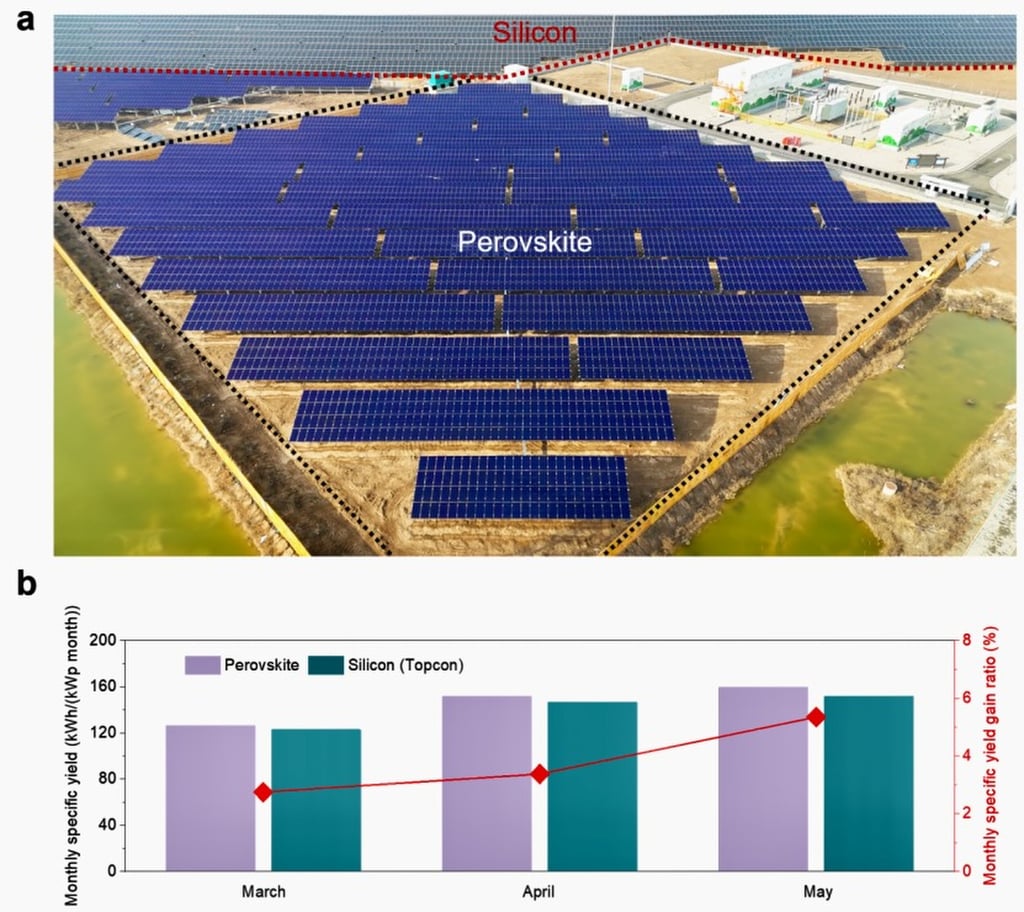
The perovskite beat silicon by 3.42 per cent in March, 3.79 per cent in April and 5.81 per cent in May, with its advantage growing as temperatures rose and sunlight became stronger.