
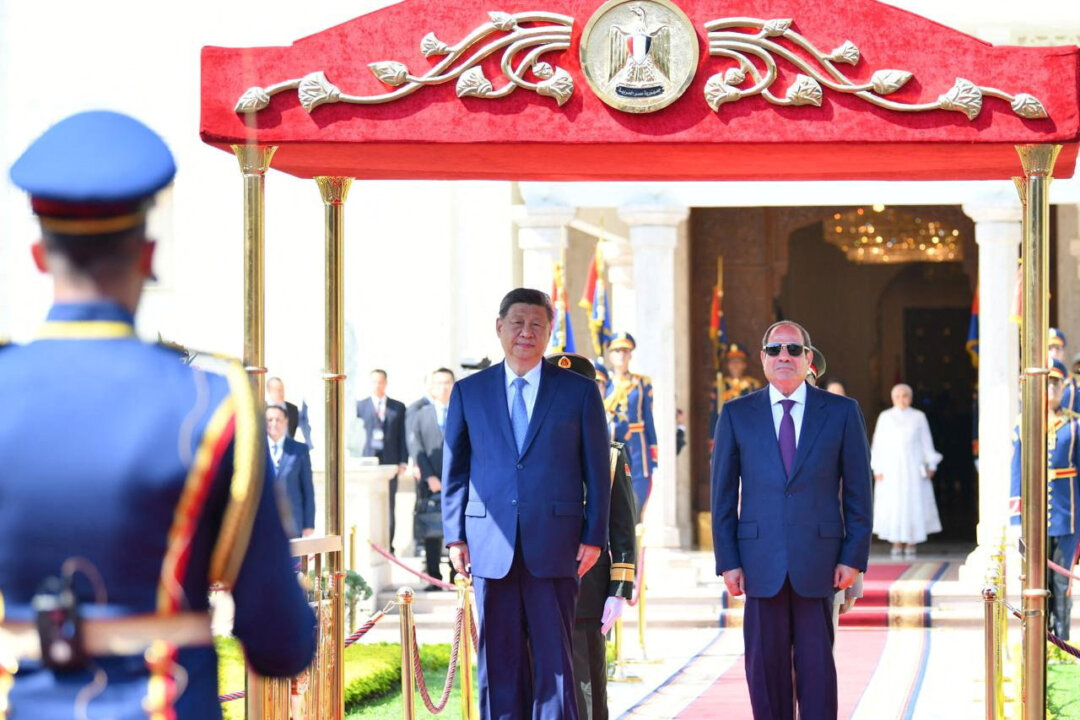
Chinese regime leader Xi Jinping laid out proposals for Middle East security during his talks with Egyptian President Abdel Fattah El-Sisi in Cairo on Sept. 2 that analysts say were aimed at undermining U.S. influence in the region while pulling Cairo into its orbit now that Iran has been weakened.
This year marks the 70th anniversary of the establishment of diplomatic relations between China and Egypt. Xi was welcomed by Sisi with a military ceremony in Cairo.
Xi said that countries in the region should be “masters of their own destiny” and explore a new regional “security architecture,” according to China’s state news agency Xinhua.
Xi also said China was ready to work with the region to safeguard shipping routes amid the U.S.–Iran conflict, which has disrupted traffic through the Strait of Hormuz.
Xi and Sisi agreed to deepen security cooperation and counterterrorism coordination, according to Xinhua. The two sides also agreed to expand cooperation in data centers, semiconductors, and critical metals supply chains and strengthen the use of each other’s currencies in trade and investment, according to a joint statement.
When Xi spoke of the people of the Middle East being “masters of their own destiny,” he was clearly aiming to drive a wedge between Middle Eastern nations and the United States, Shen Ming-shih, research fellow at Taiwan’s Institute for National Defense and Security Research, told The Epoch Times. “The Chinese regime is seeking to diminish America’s substantive influence there.”
Gaza shares a border with Egypt, Shen noted, adding, “Since the United States supports many of Israel’s actions in Gaza, there is a calculated motive behind Xi’s remarks.”
The Chinese regime aims to use narratives like “non-interference in internal affairs” or the concept of a “multipolar system” to frame the United States as a source of instability—suggesting, for instance, that U.S. support for Israel is what fuels the turmoil in Gaza, Shen said. “At the same time, it seeks to cultivate an image of the communist China as the true champion of peaceful development.”
Meanwhile, China opposes the United States and Israel taking a leadership role in the Middle East and seeks to maintain its influence in the region through deepening ties with Egypt after Iran has been significantly weakened, Yaita Akio, a renowned Chinese-Japanese journalist and the CEO and founder of the Taiwan-based Indo-Pacific Strategy think tank, told The Epoch Times.
Xi’s emphasis on safeguarding shipping routes is mainly about the Strait of Hormuz, Yaita said. “The current blockade of the strait has dealt a severe blow to China’s energy supplies. Therefore, the reason this is being proposed now is essentially a hope to restore China’s oil supply.”
China typically buys more than 80 percent of Iran’s shipped oil, according to 2025 data from Kpler, and about 40 percent of China’s crude imports pass through the strait, according to the U.S. Energy Information Administration.
Xi fears that if a conflict were to arise between the United States and the Chinese regime over geopolitical issues, such as a crisis in the Taiwan Strait or disputes in the East or South China Seas, the United States could leverage its control over the Strait of Hormuz to blockade the vital shipping lanes used for China’s energy supplies, Shen said.
During the meeting, Xi also said that the Palestine issue remains at the core of the Middle East and should not be ignored.
“This continues the Chinese Communist Party’s strategy of using the Palestinian issue to drive a wedge between the United States and Israel—or treating it as a political tool to undermine the U.S.-Israel alliance,” Shen said. “Alternatively, it allows China to position itself on the moral high ground, playing the role of a major-power balancer in response to Israel’s retaliatory actions in Gaza after Hamas.”
On Oct. 7, 2023, Hamas led a large-scale surprise attack against Israel from the Gaza Strip, killing approximately 1,200 people and abducting 251 hostages. In response, Israel launched a military campaign to eradicate Hamas.
The Chinese Communist Party (CCP) hopes to use the Gaza issue to garner support from many countries in the Global South and from Islamic nations to diplomatically isolate the United States, Shen said.
Egypt’s Balancing Strategy
With a population exceeding 110 million, Egypt is a key market for Chinese goods and investment. Data from the Egyptian government shows that the total value of goods imported from China in the first half of the year exceeded $10 billion, a year-on-year increase of more than 14 percent.
The Egyptian government said that the Suez Canal Economic Zone has attracted about $4 billion in Chinese investment. On Sept. 2, Egyptian authorities announced plans to expand a Chinese-developed industrial area in the zone, while China’s ZC Rubber Group signed a preliminary agreement to invest $500 million in a tire-making complex in the zone.
Egypt is a major U.S. defense partner in the Middle East and receives around $1.3 billion annually in military aid from Washington.
The current Sisi government pursues a policy of “strategic balance” in relations with major world powers amid growing global rivalry.
Egypt’s strategy has economic considerations, Shen said. “The CCP has come to be viewed by Egypt as a key external force capable of rescuing or revitalizing its economy.”
However, this approach by the CCP has limitations, as it is likely unable to undermine the security commitments the United States has made to the Middle East, he said.
“The United States maintains military bases in some countries across the region; should the United States withdraw, the CCP would be unable to replace the military security guarantees—such as air defense systems, intelligence sharing, military bases, and cyber capabilities—that the United States currently provides.”
Since Middle Eastern countries pursue a strategy of balancing major powers or hedging their bets, they won’t completely tilt toward China just because of something the CCP has promised, Shen said.

From Egypt’s perspective, it does not want to see Israel become too powerful, Yaita said. “With Iran now significantly weakened, Israel’s influence in the Middle East has expanded. As an Arab nation sharing a border with Israel, Egypt feels significant pressure in this regard.”
“Consequently, Egypt desires a balanced global dynamic—it does not want the combined power of the United States and Israel to gain total control over the regional and global landscape,” he said.
The United States need not worry, however, as there isn’t much China can offer, and its ties with Egypt aren’t particularly deep, Yaita said. “In the past, China offered significant aid to Iran, but it proved ineffective. Iran is currently losing influence, while China is scrambling to woo Egypt.”
US Countermeasures
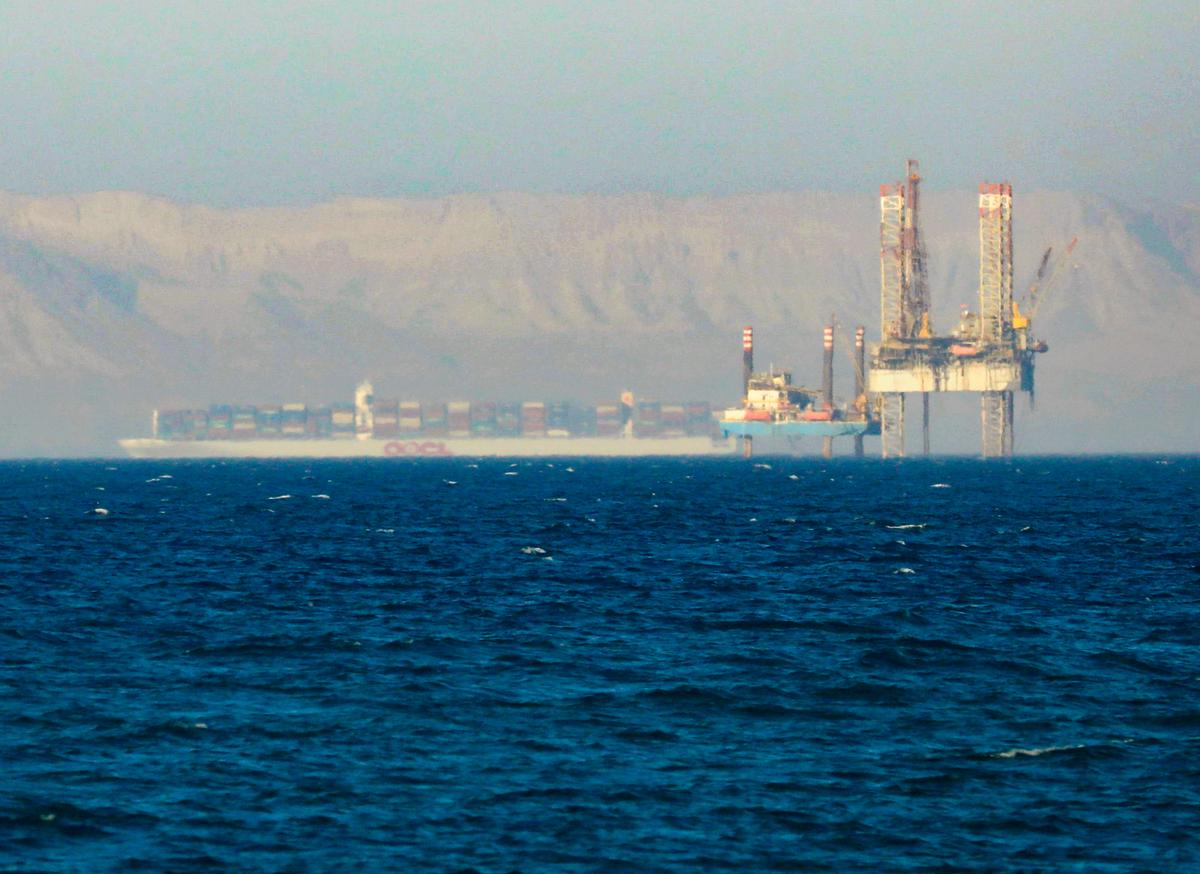
Egypt controls and operates the crucial Suez Canal that serves as a pivotal link between the Mediterranean Sea and the Red Sea.
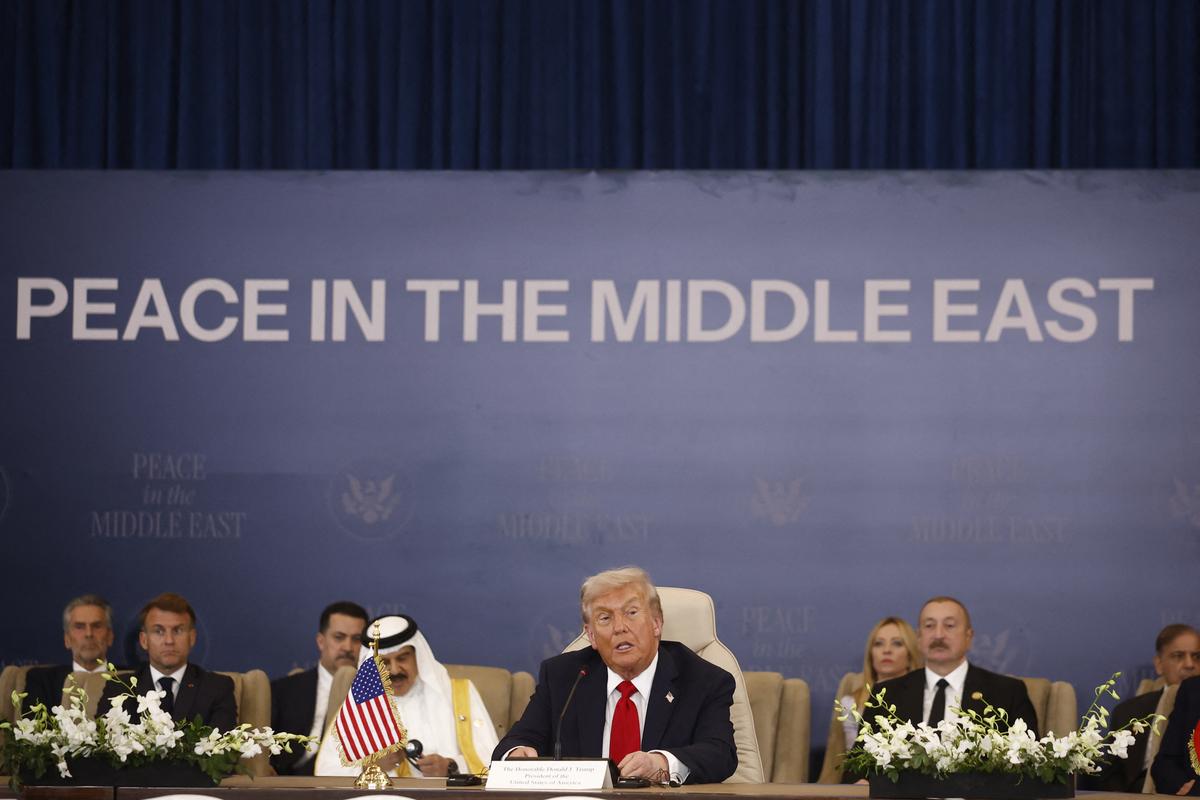
“If Egypt were to pledge control over critical infrastructure—such as ports over Suez Canal—to China due to debt issues, it would threaten the U.S. military’s global power projection capabilities,” Shen warned.
In response, the United States could take countermeasures such as linking U.S. military aid to Egypt to economic conditions or to policies aimed at curbing China—such as restricting Chinese company Huawei’s operation or denying port calls to Chinese military vessels—thereby tying these issues to national security, Shen said.
“Furthermore, the United States might mobilize allies in the Persian Gulf region to invest in Egypt or help alleviate its economic pressures, thereby diluting China’s ability to exert control over the country,” he said.
Luo Ya and Reuters contributed to this report.
We had a problem loading this article. Please enable javascript or use a different browser. If the issue persists, please visit our help center.