
WASHINGTON—Democrats didn’t just win control of the House and Senate in the 2026 midterms. They also flipped state legislatures and governors’ mansions across the United States.
Now, several key battleground states are closer to entering an agreement that could change how future presidential elections are won and lost—that is, if it survives an all-but-inevitable legal battle previewed by Attorney General Todd Blanche.
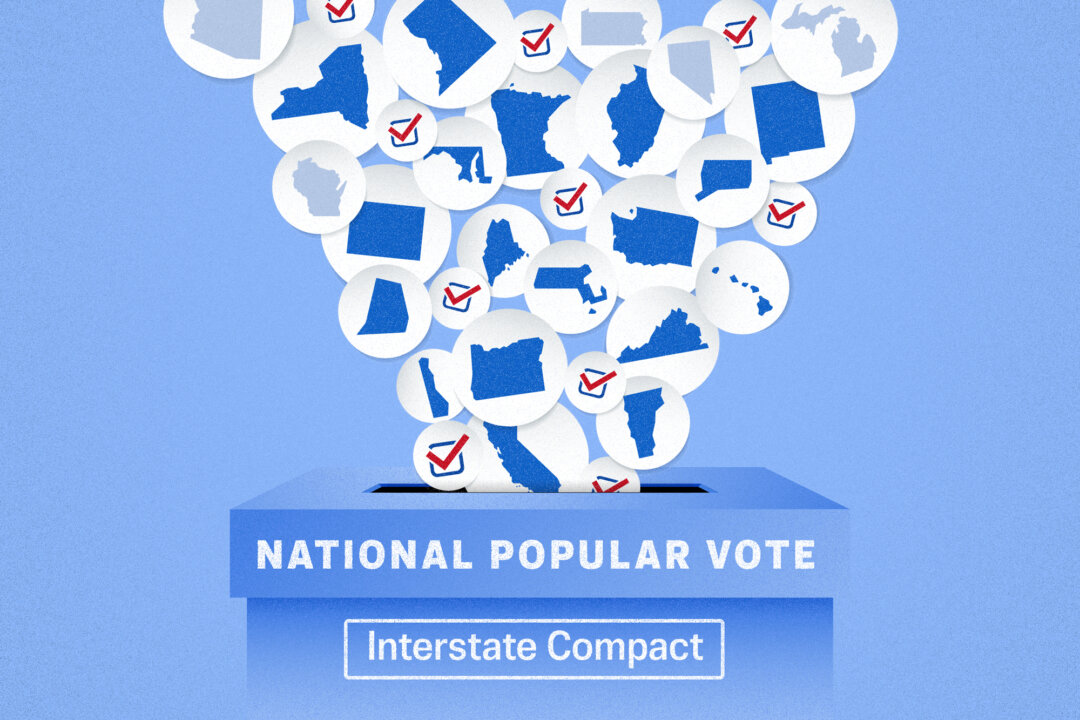
Members of the agreement, the National Popular Vote Interstate Compact (NPVIC), have committed their presidential electors to the candidate who wins the national popular vote.
After decades of advocacy, the popular vote compact now commands 222 electoral votes. The right combination of outcomes in states where Democrats won in the midterm elections could activate the compact at 270 electoral votes.
The deadline ahead of the next presidential election is July 20, 2028. That leaves a year-and-a-half for lawmakers to act once legislatures come into session in early 2027.
The likeliest paths would require buy-in from Michigan and Pennsylvania. And, at least two of three other swing states—Wisconsin, Nevada, and Arizona—would also have to join.
After that, the Supreme Court could ultimately decide whether the agreement passes constitutional muster.
If there is a judge in this country that would even let this happen for a minute, we have a big problem.
Attorney General Todd Blanche
During a Nov. 15 appearance on Fox News, Blanche said “there is no doubt” the Justice Department would challenge the compact up to that level, if necessary.
“It shouldn’t get past the district court,” he said. “I am optimistic that the Supreme Court will never have to deal with this, because if there is a judge in this country that would even let this happen for a minute, we have a big problem.”

Ian Drake, a professor at Montclair State University, told The Epoch Times in an email that he expects a challenge to the compact to reach the Supreme Court, in line with his past scholarship on the issue.
Proponents and opponents disagree on whether the plan would help or harm American presidential elections, which are carried out under a decentralized, federalist framework.
[The electoral college] works so well in the background. … It only gets noticed when people are frustrated with the outcome.
Trent England, Save Our States
Jennifer Hendricks, the Lindsley Memorial Professor of Law at the University of Colorado Law School, told The Epoch Times via email that the growing risk of presidential victors losing the popular vote—a possibility that played out in 2000 and 2016—“is increasingly untenable in a democratic world.”
“The NPV compact gives states a vehicle for reflecting the democratic preferences of their own citizens while continuing to operate within a federal structure,” said Hendricks, who wrote about the agreement in 2008, soon after the effort got off the ground.
Trent England of Save Our States, an organization created to defend the Electoral College, told The Epoch Times the compact “is uniquely dangerous when it comes to proposed changes to the Electoral College,” saying it would subvert the Founding Fathers’ vision.
“It works so well in the background, creating healthy incentives in our politics most of the time,” he said of the Electoral College. “It only gets noticed when people are frustrated with the outcome.”
The Compact
Frustration with the Electoral College mounted starting in 2000, when George W. Bush ultimately defeated Al Gore in the presidential election despite falling short in the popular vote, the first such result since 1888.

The National Popular Vote campaign began in 2006.
National popular vote is … about favoring voters over hair-splitting lawsuits in battleground state courts.
Pat Rosenstiel, senior consultant, National Popular Vote
Pat Rosenstiel, a conservative Republican and a senior consultant with National Popular Vote, told The Epoch Times he joined in 2007 after satisfying himself that the plan was constitutional.
“National popular vote is not about favoring one party over another. It’s about favoring voters over hair-splitting lawsuits in battleground state courts,” he said.
The plan has advocates on both sides of the aisle, but it has drawn the strongest support from Democrats and blue states.
18
STATES
The National Popular Vote Interstate Compact currently counts 18 states and the District of Columbia among its members.
That partisan-inflected push intensified after the 2016 presidential election, when Donald Trump received fewer votes than Hillary Clinton yet triumphed thanks to electoral math.
The first state to join the compact was Maryland, in 2007. Today, the agreement counts 18 states and the District of Columbia among its members.
In the two decades since the compact began, related bills have advanced and faltered in legislatures across the country. Now, though, a handful of states that Democrats dominated in the midterms are at the center of the conversation.
To Rosenstiel, the finish line seems close.
“People should be ready or at least have a contingency plan for a national popular vote for president in 2028, because I think it’s coming,” he said.

Pennsylvania and Michigan
The path to 270 or more electoral votes in the compact would likely involve five states where Democrats have achieved trifectas: Pennsylvania, Michigan, Wisconsin, Nevada, and Arizona.
Unless some other state, or states, enter the picture, the Electoral College math makes two of them indispensable: Pennsylvania, with its 19 electoral votes, and Michigan, with its 15 electoral votes.
Pennsylvania Gov. Josh Shapiro has signaled some openness to the plan, saying that it “makes sense” in a November discussion at Crooked Media’s annual political conference, “Crooked Con.”
The path to 270 or more electoral votes in the compact would likely involve five states where Democrats have achieved trifectas.
“I think Pennsylvania can still play a massive role even in a national popular vote,” said Shapiro, who has been floated as a 2028 presidential candidate among Democrats.
England suggested Pennsylvania’s battleground state status could swing the governor against the compact.
“If Governor Shapiro wants to appear on the Democrats’ presidential ticket, his argument is that he can win Pennsylvania for them,” he said, adding that Shapiro could afford to throw his weight behind the measure if other key states fail to advance the plan.

Rosenstiel said he believes the Keystone State could move before the 2028 election.
Pennsylvania State Rep. Heather Boyd, a Democrat, has said she intends to introduce a national popular vote bill in the coming session. Some Democrats in the state senate have also indicated a willingness to advance national popular vote legislation.
Democrats will have a slim 26–24 majority in the state senate, however, and that could narrow the path to passage.

In Michigan, another state likely to prove essential to the national popular vote push, the path may be even narrower—though one chamber, the House, passed a national popular vote bill in 2008, almost two decades ago.
The Democratic governor-elect, Jocelyn Benson, did not respond to The Epoch Times’ request for comment by publication time.
Neither did the incoming majority leader of the Michigan Senate, Darrin Camilleri, though he has signaled some hesitancy when asked by other media.
“Other states that have done this are not going to be the tipping-point states. We very well could be one of those tipping-point states, and so I want to ensure that everybody is on the same page,” he told Politico.
In Michigan, a voter referendum could short-circuit the compact. Such a referendum would suspend it until after the July 2028 deadline. Supporters could try to outmaneuver opponents by attaching the measure to an appropriations bill.

Wisconsin, Arizona, and Nevada
In England’s view, “it’s a really open question whether Michigan and Wisconsin are going to go through with this.”
Democrats’ new majority in the Wisconsin State Senate is also relatively narrow, at an anticipated 18 seats to Republicans’ 15.
The incoming governor, David Crowley, has said of the Electoral College, “We can do away with it,” adding that he hopes to speak with legislators about the issue.
Wisconsin State Sen. Kelda Roys, a Democrat, has championed the idea, saying it will be a significant early focus for lawmakers in the upcoming session. She and other advocates wouldn’t face a referendum challenging a compact bearing on Wisconsin’s 10 electoral votes.
Wisconsin’s incoming governor, David Crowley, has said of the Electoral College, “We can do away with it.”
Arizona, with 11 electoral votes, could also enter the compact, although it’s far from guaranteed.
In a Nov. 9 interview, Arizona Gov. Katie Hobbs did not clarify where she stands on the plan.
“We are working out other parts of the agenda as we head into the legislative session in the next couple [of] months,” she said.


In 2016, while in the State Senate, Hobbs cosponsored a national popular vote bill that never got a vote. Its counterpart passed the Republican-controlled Arizona House of Representatives that year.
Priya Sundareshan, who will lead the Arizona State Senate, told Politico that her caucus plans to move on the compact.
In Arizona, as in Michigan, a bid to join the agreement could be stymied by a voter referendum. Arizona’s referendum process would suspend the measure until late 2028, too late to affect the presidential election.
Nevada, which has six electoral votes, offers a clearer path forward for NPVIC advocates.
The incoming governor, Aaron Ford, now backs the national popular vote despite his previous opposition.
England pointed out that former Gov. Steve Sisolak, a Democrat, vetoed a national popular vote bill in 2019.

A constitutional amendment resolution that passed in 2023 failed to advance in 2025.
The voter referendum risk is a nullity, as those referenda in Nevada do not suspend laws that have passed until the people vote—they just approve or void existing laws.
Nevada’s State Senate meets every other year for 120 days. Barring a special session, lawmakers would have to act by the middle of 2027.
Other States
While a few new Democratic trifectas are in the spotlight, Rosenstiel noted that national popular vote legislation has been in play across various states.
“We’re going to keep our shoulder to the wheel until we have 270 or more electoral votes,” he said.
While New Hampshire is not a trifecta, Democrats flipped both chambers of its legislature.
Its four electoral votes could be pledged to the compact if lawmakers can avoid or overcome a possible veto from Gov. Kelly Ayotte, a Republican reelected in 2026.

State Rep. Ellen Read, a Democrat, has already filed a legislative service request “relative to the allocation of electoral college electors in accordance with the national popular vote.”
In Texas, with 40 electoral votes, Democrats flipped the Texas House of Representatives as well as the governor’s mansion—yet Republicans still control the Texas State Senate.
We’re going to keep our shoulder to the wheel until we have 270 or more electoral votes.
Pat Rosenstiel, senior consultant, National Popular Vote
In Alaska, a Democrat, Jonathan Kreiss-Tomkins, won the position previously held by a term-limited Republican, Mike Dunleavy. The partisan balance of the legislature remains uncertain, although bipartisan coalitions have suggested that they will maintain control.

A 2023 national popular vote bill landed in the Rules Committee of the State Senate and didn’t go further. For now, its three electoral votes are outside the compact.
North Carolina and Georgia, which have 16 electoral votes apiece, could also come into focus, though divided governments in both states make the path rockier for national popular vote advocates.
The Constitutional Debate
If the popular vote compact hits 270 electoral votes, lawyers will almost certainly spring into action.
A compact that would upend how America elects presidents could reach the Supreme Court. It’s already sparking a constitutional debate on the sidelines.
Akhil Amar, the Sterling Professor of Law and Political Science at Yale University and a critic of the Electoral College, has been credited with laying the groundwork for the national popular vote plan—yet he has attacked the compact, describing it as “a bit of a harebrained scheme” to realize a goal that would best be achieved through a constitutional amendment.
One fundamental question is whether the plan violates the Constitution’s Compact Clause.

That clause requires states that enter interstate compacts to get the consent of Congress. The courts have interpreted it to exclude compacts that don’t challenge federal supremacy.
Derek Muller, a professor at the Notre Dame Law School, has argued that the agreement would require congressional consent, saying it would empower members at the expense of states outside of it.
Hendricks argued that the compact does not challenge those outside states’ sovereignty, making it the sort of agreement among states that Congress would not need to greenlight.
I don’t think that you can use a constitutional power to destroy its constitutional purpose.
Trent England, Save Our States
“If anything, the states who sign on to the compact are being significantly more deferential to their sister states than they are required to be under ordinary principles of federalism. They are saying, ‘We would like to take your views into account when deciding how to vote ourselves,’” she said.
Drake said that “it would be constitutionally improper for Congress to approve the NPVIC, even if it were willing to do so.”
“This is because it would be tantamount to Congress approving an amendment to the Constitution through the states, or in cooperation with the states, without complying with the Article V amendment process for amending the Constitution.”
Rosenstiel said “the Supreme Court will decide whether or not we need consent.”

In England’s view, “the compact clause is a serious issue.”
He added that the compact could also raise questions about equal protection and voting rights, given the disparate ways states handle elections.
The Constitution’s Presidential Electors Clause is another point of contention.
In Rosenstiel’s judgment, precedent has made it clear that states have broad control over how they award their electors.
“What a state does with their electors is the plenary power of the legislature to determine,” he said.
England said the compact’s defenders “want people to miss the forest for the trees,” overstating what that plenary power, or exclusive authority, means in the context of an agreement that would make the Electoral College meaningless.
“The context of the Electoral College is that the Founders wanted a state-based system. They designed it that way,” he said. “I don’t think that you can use a constitutional power to destroy its constitutional purpose.”
We had a problem loading this article. Please enable javascript or use a different browser. If the issue persists, please visit our help center.