
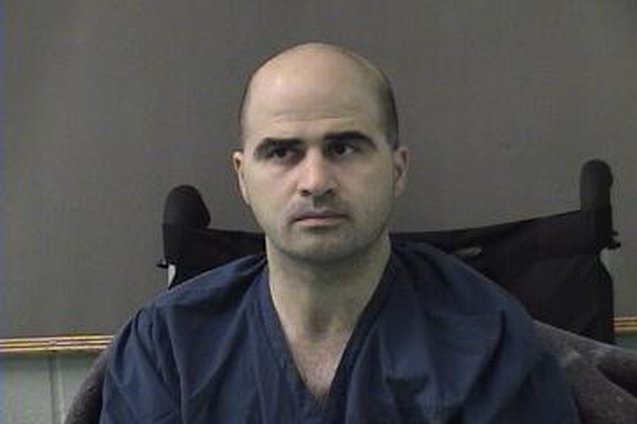
The U.S. Department of Justice (DOJ) on Nov. 27 asked a federal judge in Kansas to deny a request to stay the execution of Nidal Hasan, a former Army psychiatrist who killed 13 people in the 2009 mass shooting at Fort Hood, Texas.
The government argues that the former U.S. Army major’s eleventh-hour bid to pursue a habeas petition days before the scheduled Dec. 3 firing squad is unlikely to succeed and seeks unjustified delay.
If carried out, Hasan’s execution would be the first by the U.S. military in more than 60 years. President Donald Trump on Oct. 15 canceled a Pentagon plan to livestream the execution.
A habeas corpus petition is a federal court action in which a person in custody asks a judge to determine whether his detention or sentence violates federal law or the U.S. Constitution.
Hasan carried out the shooting, which also wounded 31, at a Soldier Readiness Processing Center in Fort Hood while shouting “Allahu Akbar”. He later described it as jihad in opposition to U.S. military operations.
A court-martial sentenced him to death. Military courts upheld the convictions and sentences, and the U.S. Supreme Court declined review in March 2025.
On Nov. 24, Hasan asked the U.S. District Court in Kansas, where he is imprisoned at the U.S. Disciplinary Barracks at Fort Leavenworth, to halt his execution so he can seek federal review of his case. He has not yet filed a habeas petition. The American Civil Liberties Union (ACLU) and the ACLU of Kansas entered appearances as standby counsel for Hasan, who is representing himself.
“There is no question that the violence committed at Fort Hood caused unimaginable pain and loss,” Anna Arceneaux, deputy director of the ACLU’s Capital Punishment Project, said when the stay motion was filed. “But the gravity of that loss does not change the government’s obligation to uphold the principles that define our justice system.”
Hasan said in his motion that he intends to argue that the military judge wrongly barred his “defense of others” theory—that the Fort Hood victims posed an imminent threat to Taliban members—and that Trump and War Secretary Pete Hegseth engaged in unlawful command influence when the execution was approved and scheduled. Unlawful command influence is the military law doctrine that a superior’s public statements or actions can improperly pressure a military proceeding.
In its Nov. 27 response, the DOJ said Hasan has offered “no justification for his delay in filing a habeas petition, nor can he establish any likelihood of success on the merits of his yet-unfiled petition.” The government argues the defense-of-others claim was already fully considered and rejected by the military courts and is frivolous.
“By Hasan’s own twisted logic, any person could unilaterally decide that a war was unlawful and engage in murderous mass shootings against U.S. military personnel with impunity, even before such personnel reached the battlefield,” the DOJ said. “That is not how the law of self-defense works.”
The government contends that the command influence claim cannot be raised in a habeas petition at all, because it challenges how the sentence is being carried out rather than the validity of the sentence itself.
Trump approved the death sentence on Oct. 2, and acting Army Secretary Adam Telle ordered on Oct. 6 that it be carried out by firing squad at Fort Hood on Dec. 3.
The government also noted that many victims’ family members will soon be traveling to Texas to witness the execution.
U.S. District Judge Anthony Mattivi has scheduled a hearing on the stay request for Nov. 30 in Kansas City, Kansas, and ordered that Hasan appear in person.
Tom Gantert contributed to this report.
We had a problem loading this article. Please enable javascript or use a different browser. If the issue persists, please visit our help center.