
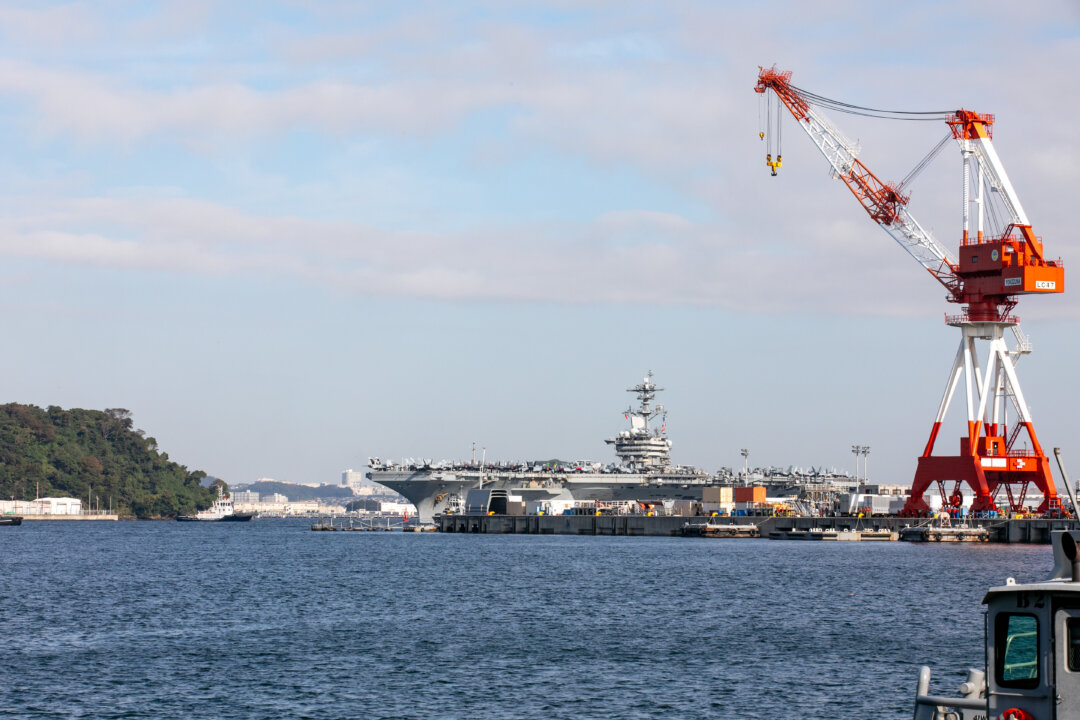
Japan and the United States began a major military exercise on Oct. 19 involving approximately 57,000 Japanese and American personnel, practicing missile deployments and joint operations near Taiwan.
The 11-day exercise, known as Keen Sword 27, involves about 45,000 Japanese and 12,000 U.S. personnel, along with approximately 45 ships and 380 aircraft from the two countries, according to Japan’s Joint Operations Command.
Forces from Australia, Canada, France, Germany, the Netherlands, New Zealand, and the Philippines will also participate. The Japanese military did not disclose personnel numbers or detailed force compositions for those seven countries.
South Korea and the UK are attending as observers, Maj. Ephesian Poinsette, a U.S. Army officer and Keen Sword 27 spokesperson, told The Epoch Times in a written response on Sept. 19.
The U.S. nuclear-powered aircraft carrier USS Theodore Roosevelt arrived at Yokosuka Naval Base on Oct. 16 ahead of the exercise. Its carrier strike group includes more than 5,000 sailors, four accompanying warships, and Carrier Air Wing 11, which operates F-35C stealth fighters, F/A-18 Super Hornets, and other aircraft, according to Poinsette.
Poinsette said the carrier strike group’s participation demonstrates the U.S. commitment to “ensuring peace through strength and credible deterrence in this strategically vital region.”
The exercise will test how the two militaries move, supply, and coordinate forces across geographically separated islands, along with anti-ship combat, missile defense, amphibious operations, cybersecurity, and military activities involving space and electromagnetic systems.
Gen. Hiroaki Uchikura, chief of Japan’s Joint Staff, said at an Oct. 9 press conference that practicing troop transportation, resupply, command and control, and joint anti-ship operations would improve the allies’ ability to deploy forces rapidly and operate together.
Island-Defense Operations
A significant part of Keen Sword 27 will take place across Japan’s southwestern islands, which extend toward Taiwan. Yonaguni, Japan’s westernmost inhabited island, lies approximately 69 miles from Taiwan.
The U.S. Marine Corps plans to deploy its Navy-Marine Expeditionary Ship Interdiction System, known as NMESIS, and Marine Air Defense Integrated System (MADIS) to Yonaguni.
NMESIS uses mobile launchers to fire anti-ship missiles at targets beyond the horizon, while MADIS provides short-range protection against aerial threats, including drones.
“The inclusion of the USMC’s NMESIS and MADIS systems aims to test how we can deploy these cutting-edge warfighting technologies and integrate them with our partner and allied forces in simulated combat situations,” Poinsette said.
According to background information he provided, NMESIS launchers can be transported by aircraft or ship for rapid deployment to remote islands, giving Marine units mobile anti-ship capabilities.
According to a Japanese Defense Ministry briefing provided to Yonaguni officials, approximately 60 U.S. personnel and 60 Japanese troops are scheduled to participate in joint island-defense coordination training. American equipment listed for the exercise includes the two missile systems and a mobile radar.
The forces plan to establish a joint coordination center on Yonaguni and practice communicating with military units on other islands. Civilian airports and ports will also be used to transport personnel and equipment.
Japan will separately deploy its new Type 25 surface-to-ship guided missile outside its home base at Kengun for the first time, with training planned at the Oyanohara training area.
Uchikura confirmed the deployment at an Oct. 2 press conference, linking the training to Japan’s efforts to strengthen its ability to strike approaching threats from greater distances. The Type 25 training will be conducted by Japanese forces rather than jointly with U.S. troops.
China’s Military Activity Near Japan
The exercise comes as Tokyo faces increased Chinese military activity around the Japanese islands and Taiwan.
Japan’s 2026 Defense White Paper identifies China’s expanding military activities as an unprecedented and major strategic challenge, citing Beijing’s military pressure on Taiwan and operations extending farther into the Pacific.
On Oct. 16, Japan’s Joint Staff disclosed that the Chinese aircraft carrier Liaoning and three accompanying warships had passed between Okinawa and Miyako into the Pacific on Oct. 14. Chinese carrier-based aircraft subsequently conducted flight operations south of Ishigaki, prompting Japanese fighter jets to scramble.
Uchikura said Keen Sword 27 was not directed at any particular country or region but stressed the importance of strengthening the U.S.–Japan alliance’s ability to respond to security challenges.
Poinsette said Keen Sword is a regularly scheduled exercise, planned more than a year in advance, rather than a response to a particular regional event.
“It is not directed at any specific nation or in response to any single regional event,” he said.
The planned deployments have also prompted local safety concerns. Yonaguni officials submitted a request to Japan’s Defense Ministry seeking precautions and measures to minimize disruptions to residents and businesses during the exercise.
At the Oct. 19 opening ceremony on Ishigaki Island, Vice Adm. Tateki Tawara, commander of Japan’s Joint Operations Command, called for closer coordination among the participating forces across land, sea, air, space, cyber, and other military operations.
Tawara said the objective was not simply to complete training, but also to develop the ability of allied and partner forces to act together when necessary and accomplish tasks that no single military service or country could achieve alone.

Correction: A previous version of this article misspelled the name of Vice Adm. Tateki Tawara. The Epoch Times regrets the error.
We had a problem loading this article. Please enable javascript or use a different browser. If the issue persists, please visit our help center.