
News Analysis
Even as U.S. President Donald Trump and Chinese leader Xi Jinping exchanged visits in the most cordial manner, a major move by the Pentagon made one thing clear: Washington’s high-stakes technology war with Beijing is running on a track entirely separate from that of high-level diplomacy.
In June, the U.S. Department of War expanded what’s known as the Section 1260H list—a roster of companies the U.S. government considers to be tied to China’s military. By adding 65 new firms while removing 10 whose U.S. presence had ended, the Pentagon expanded the total count to 188 entities.
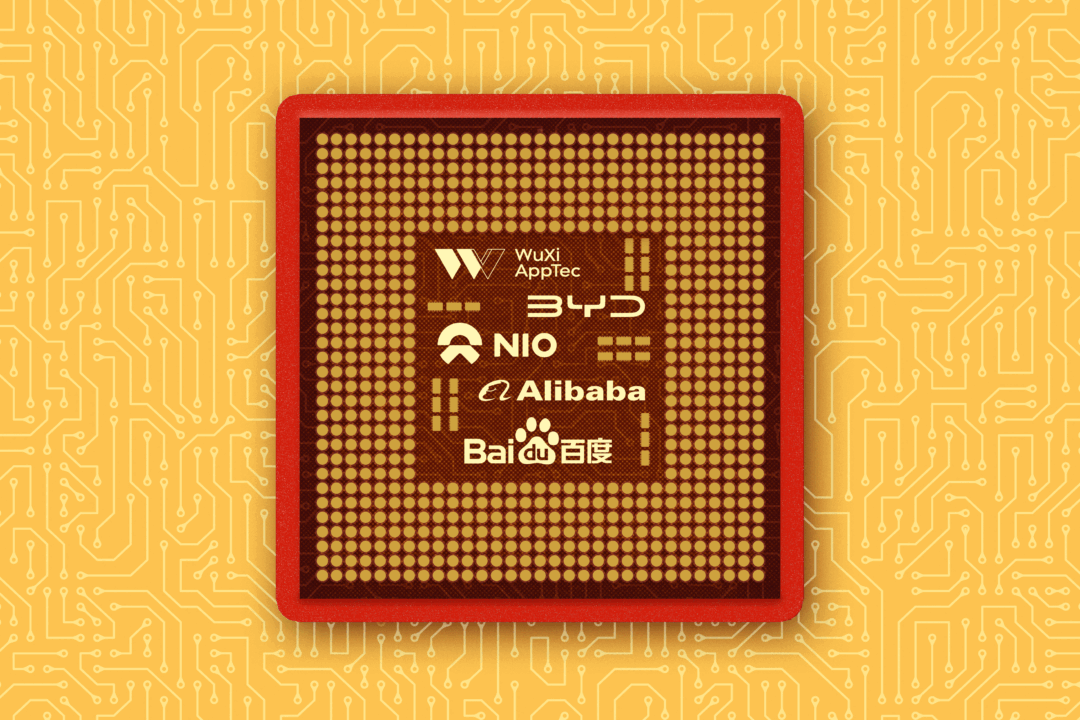
The expansion moves far beyond traditional defense contractors to target household commercial giants such as Alibaba and Baidu, electric vehicle (EV) makers BYD and NIO, and pharmaceutical leader WuXi AppTec.
This shift signals that in Washington’s eyes, the line between civilian and military technology has effectively vanished, especially when dealing with communist China, several experts told The Epoch Times. Officials increasingly view commercial innovations in artificial intelligence, cloud computing, EV batteries, and biotechnology as dual-use assets feeding Beijing’s military-civil fusion strategy.
The timing—after Trump’s China visit and before Xi’s trip to Washington—demonstrates that economic handshakes and national security policy now proceed independently. Even as the White House pursues bilateral trade stabilization, standing defense mandates continue to tighten regulatory pressure on Chinese technology.
“The President wants to improve relations but he does not want to sacrifice security to achieve it,” said Carl Schuster, a retired U.S. Navy captain and former director of operations at U.S. Pacific Command’s Joint Intelligence Center.
While security prerogatives strain U.S.–China relations, “bilateral friction is better than a security breach,” he told The Epoch Times.
Washington is increasingly looking not only at what a company sells today, but also how its technology could be used in a conflict.
Inclusion on the 1260H list does not impose general commercial trade bans or freeze consumer assets, but it has substantial impact, as it triggers mandatory procurement bans for the U.S. military and forces defense contractors to review their global supply chains. Additionally, it paves the way for broader legislative and capital-market restrictions.
The designation could also affect ordinary investors. A provision in the 2026 National Defense Authorization Act requires the president to review whether companies on the Pentagon’s 1260H list should be added to a Treasury Department investment blacklist. Placement on that list is not automatic, but if it happens, U.S. investors could be barred from buying or holding the company’s publicly traded shares.
What the Pentagon List Means
The Pentagon says the list is intended to address China’s strategy of military-civil fusion. In plain English, U.S. officials say Beijing has built a system that enables the People’s Liberation Army to systematically benefit from technology, research, and expertise developed by China’s private companies, universities, and other ostensibly civilian institutions.
That does not mean that every product made by a listed entity is a military product. It means the Pentagon believes that the company’s capabilities, relationships, or technology could support China’s military and its modernization.
“Advanced science and technology can always assist military production and lethality,” noted Anders Corr, a strategic risk analyst, principal at Corr Analytics, and contributor to The Epoch Times.
The latest expansion of the Pentagon blacklist reaches much further into the commercial economy.
The listed companies have disputed that assessment. Denying any improper military ties, Alibaba, Baidu, BYD, and WuXi AppTec announced plans to contest their designations through legal and administrative avenues. So far, WuXi AppTec and Alibaba have both taken legal action, filing lawsuits on June 11 and June 23, respectively.
WuXi announced on its website that on Aug. 7, the U.S. District Court for the District of Columbia granted the company’s motion for a preliminary injunction, thus shielding it from the immediate effects of the 1260H designation.
“We believe that the facts, as demonstrated in our court filings, will prevail in the ongoing litigation on the merits of the designation after an objective and fair judicial review,” the company wrote.

Practical Impact to Grow Over Time
The designation matters most because it ripples up the military supply stream.
Direct contracts with 1260H-listed entities are barred as of June 30, and a secondary ban taking effect one year later will prohibit the procurement of goods or services developed by listed firms. Because large defense contractors rely on multitiered global supply chains, this second phase forces contractors to audit their suppliers and phase out listed entities to mitigate future compliance risks.
For U.S.-listed giants such as Alibaba, Baidu, and NIO, inclusion on the list signals that broader capital-market restrictions could lie ahead, together with increased legal and reputational risks and strained business relationships, according to Stephen Xia, a former People’s Liberation Army engineer and contributor to The Epoch Times.

Why Companies Known for Cars, Cloud Services, and Medicine Are Included
Earlier versions of the Pentagon list focused more heavily on traditional defense manufacturers and companies with direct connections to China’s military sector. The latest expansion reaches much further into the commercial economy.
Alibaba and Baidu have major businesses in AI, cloud computing, and autonomous driving technology. BYD and NIO are leading EV manufacturers, with expertise in batteries, software, and advanced manufacturing. WuXi AppTec is a major provider of pharmaceutical research and manufacturing services.
To most consumers, these are civilian industries, but national security officials increasingly view them through a “dual-use” lens—products or expertise that can serve both civilian and military purposes.
Solomon Yue, business executive and vice chairman and CEO of the advocacy group Republicans Overseas, traced the policy shift to the Chinese regime’s restrictions on rare-earth mineral exports, implemented as part of its trade war with the United States.
“We viewed it through a national-security lens. America was facing both a commercial supply chain threat and a military high-tech weaponry production threat,” he told The Epoch Times.
President Trump was talking about bilateral trade ties, not letting China steal U.S. military technologies.
Solomon Yue, CEO, Republicans Overseas
Now, it appears that Washington is no longer evaluating just what a company sells today, but how its capabilities could be deployed in a conflict or national emergency.
AI systems developed for driverless cars can also help operate autonomous military systems or improve military logistics. High-capacity batteries can power passenger vehicles, but they can also support military equipment, bases, and energy-storage systems. Biotechnology can affect medicine and public health while also influencing a country’s ability to produce critical drugs and respond to biological threats.
Washington is not alone in performing such a calculation, Schuster pointed out.
“All countries are reviewing each other’s technological advances and trying to determine which are benign and in today’s dual-use technology world, which pose a potential threat,” he said.
“China is doing so as well. They just don’t talk about it.”

Why the Timing After Trump’s Beijing Visit Matters
The Pentagon’s announcement came less than a month after Trump and Xi met in Beijing, where both governments emphasized efforts to stabilize relations and expand economic cooperation.

At first glance, the two developments may appear inconsistent. But U.S. policy toward China is increasingly operating on two tracks. The Section 1260H list is required by Congress and has been updated periodically regardless of the status of high-level talks. Its expansion therefore does not necessarily signal that Trump’s diplomatic efforts have failed, but rather shows that better communication and economic deals are not expected to end the underlying competition, some experts said.
“Beijing’s increasingly aggressive actions in the South and East China Seas have put the U.S. and its allies on edge,” Schuster said.
“Neither Beijing nor Washington want to escalate tensions but at the same time, China’s expansionist military and territorial claims pose concerns about China’s intentions. Neither the U.S. nor its allies can afford to ignore China’s actions. Nor can they afford to be caught at a military or technological disadvantage. Yet, all want to engage in trade and maintain the peace.”
Restricting the use of China’s technologies is also meant to curb Beijing’s malign activities overseas, Yue suggested.
“President Trump was talking about bilateral trade ties, not letting China steal U.S. military technologies,” he said.
Wang He, a scholar who studies U.S.–China relations and an Epoch Times contributor, added that the Pentagon listings undercut Beijing’s effort to present recent high-level diplomatic visits as evidence of lasting stability.
“This is a blow to Xi Jinping’s diplomatic image, as it would be seen as a sign that the United States is not taking the diplomatic momentum he worked to create seriously,” he said.

Beijing Counters With Trade Restrictions
The Chinese Ministry of Foreign Affairs accused Washington of stretching the definition of national security to suppress Chinese companies and called on the United States to reverse the designations. Soon after, Beijing followed up with retaliatory trade restrictions.
The Chinese Ministry of Commerce placed 10 American industrial suppliers—including rare-earth miners MP Materials Corp. and USA Rare Earth, as well as drone makers Teal Drones and Jaia Robotics—on its export control list, barring exports of any dual-use items originating in China to the companies. In a separate statement, China’s Ministry of Finance also excluded 46 U.S. companies, mostly defense contractors, from participating in government procurement projects.
Some analysts noted that Beijing’s countermeasures appeared largely symbolic rather than a substantive escalation, as most targeted companies have little or no meaningful business exposure in China.

Technology Has Replaced Tariffs as Central Battleground
Tariffs and the trade deficit dominated much of the U.S.–China debate during Trump’s first term. Those issues remain important, but the competition now extends into semiconductors, AI, biotechnology, quantum computing, EVs, investment, and the security of supply chains.
The Pentagon list is only one part of that larger framework. The Commerce Department has imposed export controls on advanced technology, the Treasury Department has restricted some U.S. investments, and Congress has adopted procurement and supply-chain rules aimed at reducing reliance on Chinese companies in sensitive industries.
The shift creates difficult choices for American companies. The U.S. and Chinese economies remain deeply connected, and many businesses rely on Chinese suppliers, customers, laboratories, or manufacturing operations. At the same time, the regulatory risks of those relationships are growing.

A Long-Term Feature of US–China Relations
The Pentagon listings alone are unlikely to transform the U.S.–China relationship.
Paradoxically, “being tough on China is exactly what is required to improve bilateral ties as Beijing only respects strength,” Corr told The Epoch Times.
We are facing a period of friction and tensions, but not imminent physical conflict.
Carl Schuster, former director of operations, U.S. Pacific Command’s Joint Intelligence Center
Trade ties will continue even as both governments place tighter controls around sensitive technology.
“There is more to Sino–U.S. relations than security-related tensions,” Schuster said. “Our economies are intertwined, as are our scientific and academic communities. We are facing a period of friction and tensions, but not imminent physical conflict.”
The Trump administration can seek trade deals and more stable communication with Xi while the United States continues preparing for a long strategic rivalry with China.
We had a problem loading this article. Please enable javascript or use a different browser. If the issue persists, please visit our help center.