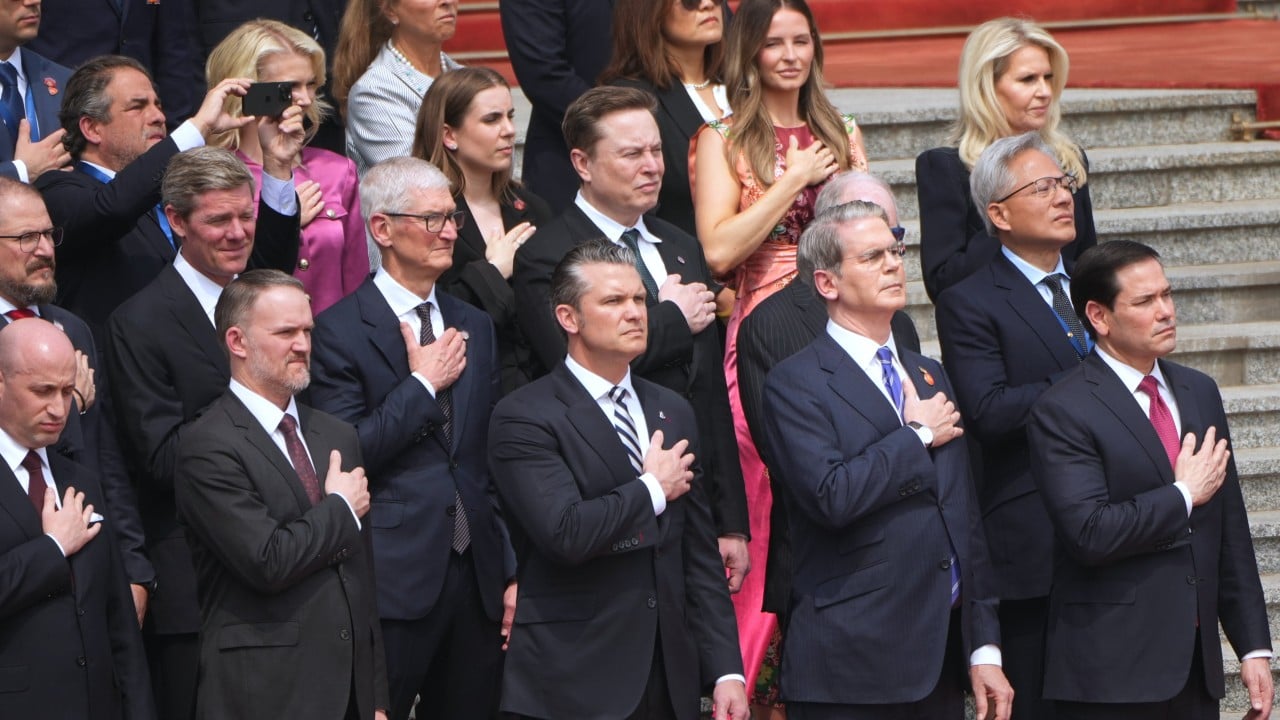
US President Donald Trump’s visit to Beijing with a delegation of leading American tech executives should not be read as a throwback to transactional diplomacy. It points to something more consequential. After years of rhetoric about economic separation, the reality is becoming harder to ignore: the United States and China are not decoupling. They are learning how to compete while remaining deeply entangled.
For much of the past decade, Washington has framed its China policy around technological denial – restricting access to advanced semiconductors, tightening controls on artificial intelligence collaboration and pressuring allies to align with US standards.
This approach rests on a clear premise: slowing China’s technological rise reduces long-term strategic risk. Yet the presence of US technology leaders in Beijing sits uneasily with that logic. It suggests that even as Washington tries to redraw the boundaries of the global tech ecosystem, it recognises it cannot fully exit it.
Advertisement
The tension is not accidental. It reflects the limits of economic statecraft in an interconnected system. For American firms, China remains both a critical market and an integral part of global supply chains. Even after export controls and investment restrictions, the architecture of production – from components to assembly – continues to run through Chinese networks. The idea that these links could be quickly or cleanly severed has always been overstated.
Trump’s approach does not resolve this contradiction so much as acknowledge it. Bringing corporate leaders into the diplomatic orbit is less about softening competition than managing it. If a full decoupling is unrealistic, then the alternative is to shape the terms of interdependence rather than abandon it altogether. Engagement, in this sense, becomes a tool of influence – not a concession.
Advertisement
Taiwan sits quietly but unmistakably at the centre of this recalibration. The island’s dominance in advanced semiconductor manufacturing, particularly at the cutting edge, makes it indispensable to the global economy. For Washington, Taiwan is both a security commitment and an economic vulnerability. Deterrence remains the primary lens through which US policy is articulated.