
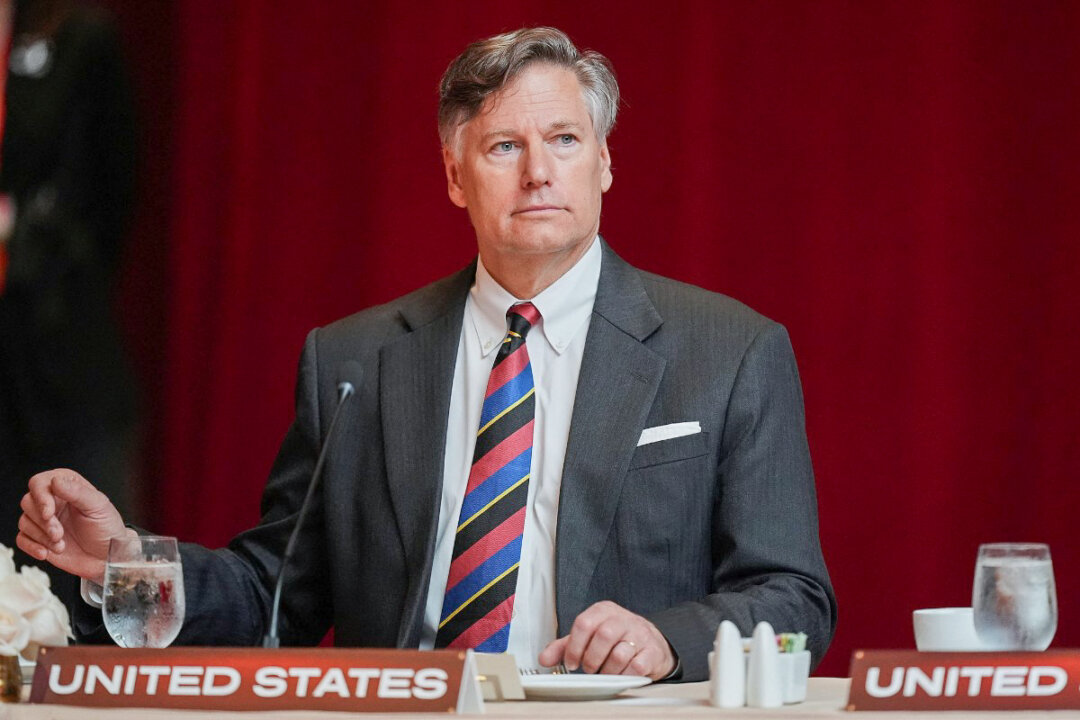
The United States announced more than $150 million in new funding for Pacific island nations at an annual summit in Palau on Sept. 1, as Washington seeks to deepen economic and security partnerships across the region.
The U.S. funding was announced by Deputy Secretary of State Christopher Landau at this year’s Pacific Islands Forum, a regional bloc of 18 members that includes Australia and New Zealand.
The announcement comes as China’s influence in the region has grown in recent years through donations, grants and infrastructure projects.
The $150 million includes $60 million to help Pacific countries address the global energy crisis by expanding fuel storage capacity and strengthening grid stability.
Another $17 million is earmarked to combat illegal, unreported and unregulated fishing in the Pacific Islands through certified training programs and the deployment of new technologies.
Another $50 million, alongside $10 million from New Zealand, will go toward upgrading a port at Penrhyn, the northernmost atoll in the Cook Islands, to improve maritime connectivity and support economic development, including potential deep-sea mining.
Penrhyn served as a strategic U.S. military base during World War II.
The U.S. funding also supports two projects in Palau in cooperation with Taiwan.
The United States, Australia, Japan, New Zealand and South Korea, along with Taiwan, will support the “development and operation of a new, modern hospital facility,” subject to a feasibility study.
Separately, the U.S. Environmental Protection Agency will work with Taiwan on a drinking water sampling project involving Palau’s water sources and wells.
Palau and Taiwan have maintained official diplomatic ties since 1999, with Taipei providing millions of dollars in development finance for healthcare, public infrastructure, and sustainable energy projects across the Pacific island nation.
The United States is expanding law enforcement cooperation in the region.
According to the State Department, the United States and Palau are set to co-chair the inaugural U.S.-Pacific Islands Conference of Police Ministers, which “will focus on maritime security, drug trafficking, cybercrime, and illicit finance.”
On Sept. 2, Palau’s presidential office announced that the country had secured a $10 million grant from the U.S. Federal Aviation Administration to improve drainage and erosion control at Palau International Airport, “further strengthening Palau’s connection to the world and ensuring long-term infrastructural resilience.”
In Papua New Guinea, the U.S. funding would support programs to strengthen information and communications technology (ICT) regulatory capacity, expand digital infrastructure, and promote secure ICT investment, according to the State Department.
The U.S. funding will also support the modernization of the Marshall Islands’ mobile phone network.
The U.S. Trade and Development Agency will carry out a feasibility study to upgrade Tonga’s “port facilities, fuel storage capacity, pipeline infrastructure and market-oriented regulatory practices,” according to the State Department.
“The United States’ continued participation in the Pacific Islands Forum reflects the importance we place on the Pacific Islands as a vital part of the Indo-Pacific region,” the State Department said.
“When the Pacific Islands are stable, secure, and prosperous, the United States is too.”
This year’s forum also put China’s influence in the region on display.
In mid-August, China issued a travel warning discouraging Chinese tourists from visiting Palau over concerns about theft and robbery, despite Palau being one of the region’s safest countries.
In response, the U.S. Embassy in Koror said China was attempting to “weaponize tourism to coerce Palau.”
In an exclusive interview with The Epoch Times, Palauan President Surangel Whipps Jr. said he pushed back against a Chinese diplomat who tried to pressure him into not inviting Taiwan to the forum.
Separately, on Sept. 2, Australian Prime Minister Anthony Albanese and Pacific leaders agreed to a Pacific-led maritime security initiative called Waqa Moana to combat illicit drug trafficking in the region, according to a press release.
Under the deal, Albanese announced an A$600 million ($430 million) support package to support the implementation of the initiative.
“The Pacific is our home and our family. That’s why it’s in Australia’s interests to work with our Pacific partners to combat organised crime,” Albanese said in a statement.
We had a problem loading this article. Please enable javascript or use a different browser. If the issue persists, please visit our help center.