
Higher interest payments and rising costs for major benefit programs pushed the U.S. budget deficit to its highest level in five years, new Treasury Department numbers show.
The budget shortfall—the gap between revenues the federal government collects and how much it spends—widened by more than $200 billion, or about 12 percent, to $1.99 trillion in fiscal year 2026, which ran from Oct. 1 to Sept. 30.
This marks one of the highest deficits in the nation’s history.
Federal revenues hit an all-time high of $5.4 trillion, rising $169 billion, or 3 percent, from $5.24 trillion in the previous fiscal year.
Outlays climbed $386 billion, or 6 percent, to a record high of $7.4 trillion, from $7.01 trillion in the prior fiscal year.
This was fueled by a record $1.36 trillion in debt-servicing payments, which climbed $144 billion, or 12 percent—higher than the Treasury’s $1.301 trillion estimate.
Social Security was the only higher budgetary item, totaling $1.667 trillion. Medicare and healthcare spending totaled $1.073 trillion and $1.026 trillion, respectively. Defense spending hit $965 billion.
Treasury Secretary Scott Bessent attributed the higher deficit to tariff refunds, higher interest rates, and the nine-month-old war in Iran.
“It is up this year because of tariff refunds,” Bessent said at Newsmax’s NPolicy Summit in Washington, D.C., on Oct. 9.
“Look, we’re in a war and interest rates are high, but it would be flat without the tariff refunds. So in that kind of environment, I think flat’s pretty good.”
He reiterated that the United States can grow its way out of the ballooning debt and deficits, noting that the deficit-to-GDP ratio was brought down to 5.8 percent last year from 6.2 percent in the previous year.
The Congressional Budget Office (CBO) estimated last week that the federal government ran a $2 trillion budget deficit in fiscal year 2026.
In its Oct. 8 Monthly Budget Review, the nonpartisan watchdog cited increases in net interest payments, major benefit programs, defense, and education.
These numbers are well above the White House’s projections. The Council of Economic Advisers forecast earlier this year that the deficit would fall to $1.7 trillion.
“Clearly, we can’t keep going like we have. Our fiscal path has been running backwards for far too long; it’s time to start working on the path forward,” Maya MacGuineas, president of the Committee for a Responsible Federal Budget, said in a statement.
Similar concerns about sizable federal deficits are partly contributing to the U.S. Treasury bond market rout.
The primary benchmark 10-year yield has risen sharply this year, from 3.96 percent in late February to as high as 5.37 percent—the highest since 2002.
Inflation, war, capital competition, and rate normalization are among other factors behind the spike in bond yields. Still, global investors continue to have a strong appetite for U.S. debt, based on last week’s Treasury auction results.
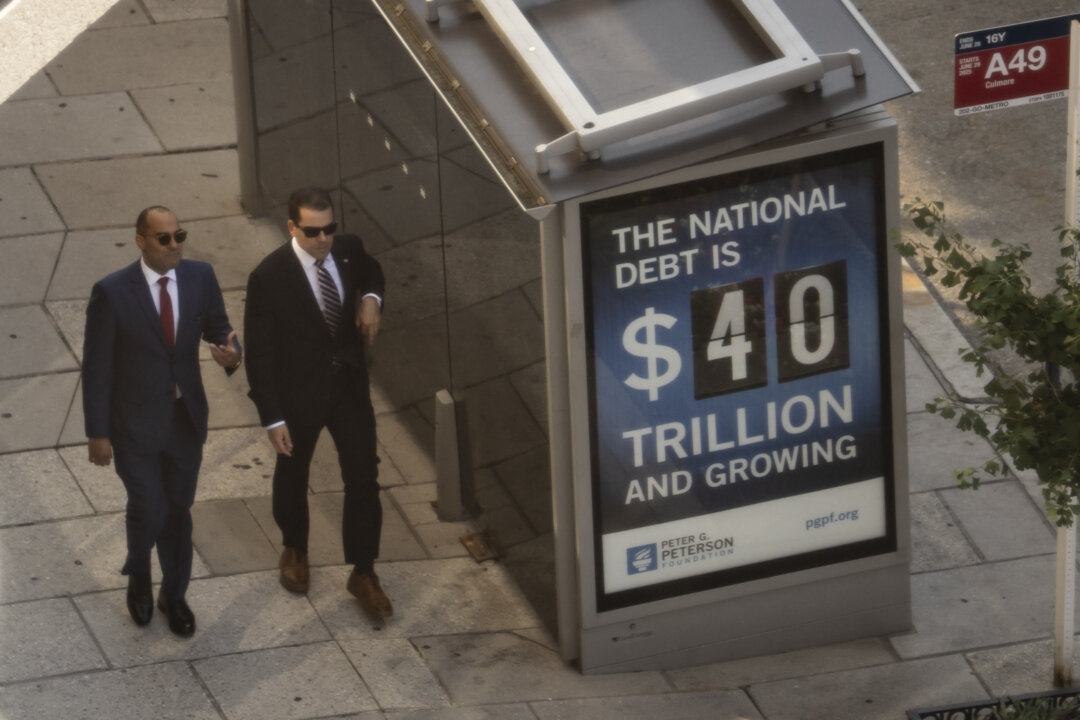
Either way, the CBO warns the current volatility could explode the national debt, which hit $40 trillion in August.
The 10-year yield is about a full percentage point above the CBO’s February estimates. Economists forecast that if rates average 50 basis points higher than those forecasts over the 10-year budget window, annual deficits would swell by nearly $2 trillion. If rates average 150 basis points above the baseline, deficits would accelerate to around $6 trillion.
New research suggests the federal government’s ocean of red ink is becoming a key issue for voters heading into the midterm elections.
The Peter G. Peterson Foundation’s Fiscal Confidence Index remained near a two-year low of 38 in September (100 is neutral). The survey found that 92 percent of voters are concerned about the national debt’s impact on inflation. Nearly 90 percent of voters also worry that the national debt is driving higher borrowing costs.
“As Election Day approaches, Americans are looking for leaders who understand that stabilizing our debt outlook is critical to addressing the affordability crisis,” Michael A. Peterson, CEO of the Peterson Foundation, said in a statement.
“Financial markets are sending a message in the form of higher interest rates, reflecting deep unease about our fiscal trajectory.”
The index also suggested that lawmakers should prioritize debt, and voters expect some progress in the future.
The new Congress will address the federal government’s fiscal challenges next year as the United States is scheduled to hit the debt ceiling.
Bessent, in an August interview with CNBC, says there is a “very good chance” the deficit has peaked under President Donald Trump.
“There’s nothing magic about the 40-trillion number,” Bessent said. “We can grow our way out of that.”
We had a problem loading this article. Please enable javascript or use a different browser. If the issue persists, please visit our help center.