
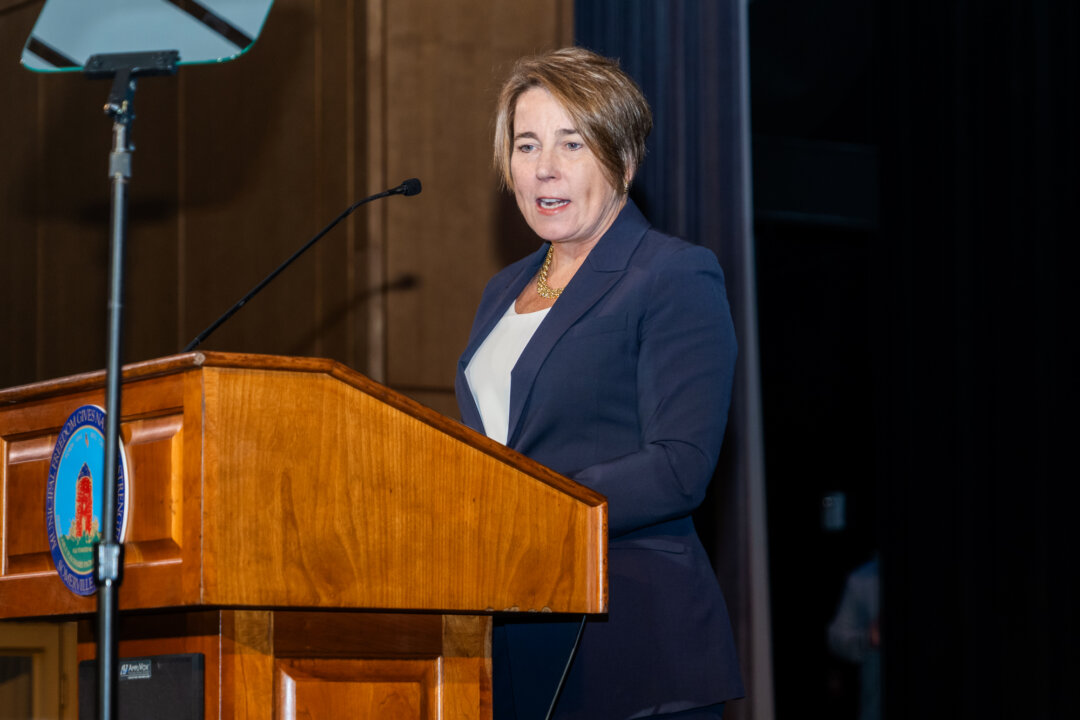
Massachusetts voters soundly rejected an attempt to repeal their state’s key gun law, but proponents of the repeal effort say they will continue to challenge the law’s constitutionality.
Two-thirds of voters who answered the question during the Nov. 3 midterm election selected “Yes” on Ballot Question 9 to retain Chapter 135, the state’s expansive gun control/gun safety measure signed into law by Gov. Maura Healey on July 25, 2024.
The law bans guns built from kits, 3D-printed guns, or other homemade guns unless they have serial numbers and are registered with the state just like commercially manufactured firearms.
It also expanded the list of people who could apply for an extreme risk protection order under the state’s “Red Flag Law” to include school administrators and health care providers.
It clarified the definition of “assault weapons,” expanding the list of firearms that qualify, and outlawed Glock switches, bump stocks, and other devices to convert semiautomatic firearms to fully automatic.
The law also prohibits licensed firearm carriers in most government buildings, polling locations, and courts.
The law was first introduced as HB 4885. Healey said it was a response to the “misguided” 2022 U.S. Supreme Court decision in New York State Rifle and Pistol Association v. Bruen.
The governor praised it as a lifesaving measure when she signed it.
“This legislation updates our firearms laws in response to the Supreme Court’s misguided Bruen decision,” Healey said in a statement at the time. “This law will save lives, and I’m grateful to the Legislature and gun safety advocates for their hard work to see this through.”
Massachusetts ballot initiatives include space for proponents and opponents to argue for the question. A group called Yes on 9 for a Safe Massachusetts stated that in the two years since its passage, the law had proven itself.
“Thanks to our comprehensive approach to gun violence prevention, Massachusetts has a gun death rate 70 percent lower than the national average. Critical elements of the 2024 law are actively being implemented; they are already helping keep our communities safe,” the group stated in its argument.
But repeal proponents say the law violates Massachusetts’ citizens’ civil rights by creating more ways to prosecute gunowners.
Toby Leary, chairman of the Civil Rights Coalition, noted that Massachusetts had a relatively low rate of gun-related deaths before the law was passed. Writing for the Civil Rights Coalition, he stated that the law doesn’t promote public safety as much as it restricts a constitutional right.

Leary calls the law an “omnibus” bill that piles on one requirement after another, reducing the number of people who would actually exercise that right. He said gun owners are the only ones subjected to restrictions on their rights.
“If you wouldn’t be okay with Congress or your state legislature putting the same requirements on any other right, then it should become obvious that it’s unconstitutional,” Leary said.
He said Massachusetts residents appear to support Second Amendment rights because his group had no trouble gathering enough signatures to force a referendum on the law in 2024.
However, Healey issued an emergency preamble that made the law effective immediately and delayed the referendum. An emergency preamble is language added to a law that explains why it must take effect immediately to preserve public peace.
When the referendum finally happened, 1.7 million voted against repealing the law, while 852,532 voted for repeal.
“I think most people failed to recognize the importance of the Constitutional issue. If government is allowed to fundamentally change our rights, then we don’t have rights, we have privileges,” Leary told The Epoch Times.
“Unfortunately, we didn’t do a good job communicating that.”
Justin Davis, director of public affairs for The National Rifle Association (NRA), said messaging is a challenge in a place like Massachusetts that has a history of strict gun control laws. He called Massachusetts’ law “one of the most extreme … eviscerations of the Second Amendment in this country.”
Davis said it’s ironic that the law was implemented in Boston, where the American Revolution began after British troops came to the area to confiscate guns. Davis said that over the years people grow accustomed to the restrictions. The NRA will challenge the law’s individual provisions in court.
“Over the last several decades, Massachusetts has eroded those Second Amendment rights, and people have become complacent with the fact that their natural rights are being taken away from them,” Davis told The Epoch Times.
Healey and other proponents of the law did not respond to requests for comment before publication time.
We had a problem loading this article. Please enable javascript or use a different browser. If the issue persists, please visit our help center.