
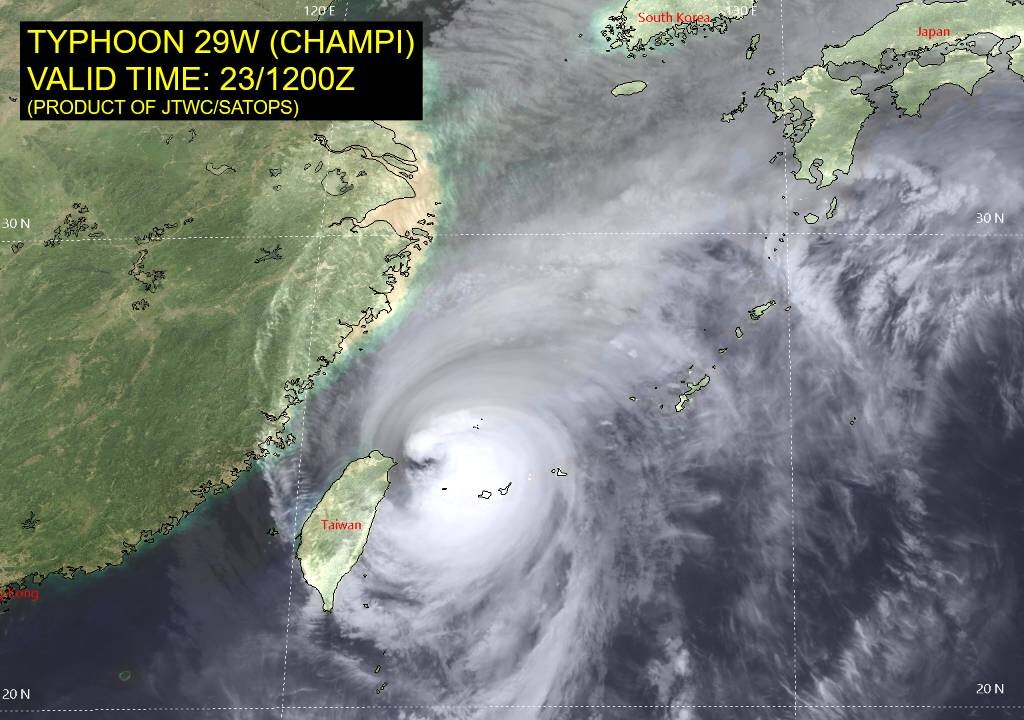
Typhoon Champi left one person dead and 350 injured in Taiwan, disrupting air and rail travel and forcing a change to a military vessel’s port schedule during a major U.S.–Japan exercise near the island.
Taiwan’s Central Emergency Operation Center reported the casualties as of 7:30 p.m. Friday, Taipei time, with no people listed as missing. The number of injured had risen from 163 six hours earlier.
The fatality involved a man swept away by waves off Pingtung County’s Liuqiu Township on Thursday. Emergency personnel recovered him and transported him to a hospital, where he was pronounced dead.
According to Taiwan’s Central Weather Administration, Typhoon Champi was centered approximately 12 miles east-northeast of Yilan in northeastern Taiwan at midnight Saturday, Oct. 24, Taipei time, moving north before turning north-northeast at about 11 mph, with maximum sustained winds of about 96 mph.
The storm’s wind field covered Taiwan, Penghu, and Matsu, bringing dangerous coastal conditions and heavy rain. The weather agency warned of torrential rainfall in Yilan’s mountainous areas overnight and into Saturday, with risks of landslides, falling rocks, and flooding in low-lying areas.
Flights Canceled, US Office Closed
Taiwan’s Civil Aeronautics Administration announced it canceled all domestic flights scheduled for Friday. Airlines also canceled international flights, particularly those connecting Taiwan with Japan’s Okinawa region.
Rail services were heavily disrupted, with Taiwan Railway suspending reserved-seat services and restricting operations on several routes, particularly in eastern Taiwan.
The American Institute in Taiwan, which handles U.S. relations with the self-governing island in the absence of formal diplomatic ties, closed its Taipei office on Oct. 23 because of the typhoon and urged Americans in Taiwan to monitor local weather and safety information.
President Lai Ching-te visited the Central Emergency Operation Center on Friday morning alongside Premier Cho Jung-tai to review preparations, according to the Presidential Office.
Lai directed government agencies to coordinate with local authorities on precautionary evacuations and shelter arrangements, prioritizing elderly residents, people with mobility difficulties, and those requiring medical care.
He also called for early evacuations of communities at risk of isolation due to road closures, particularly where helicopter access is difficult. Authorities were instructed to prepare emergency supplies and backup communications, while the military was to remain ready to assist with disaster relief.
With the typhoon coinciding with a holiday weekend, Lai urged residents to avoid beaches, mountains, and streams and comply with evacuation orders.

Storm Alters US–Japan Military Exercise
The storm also affected Keen Sword 27, a large-scale U.S.–Japan military exercise involving more than 56,000 personnel and running from Oct. 19 to 29.
Nishinoomote City, on Japan’s Tanegashima island, announced that the transport vessel Natchan NEO’s planned use of Nishinoomote Port had been brought forward because of the approaching typhoon.
The vessel had originally been scheduled to use the port from Oct. 23 to 25. The revised plan called for its arrival at 3 p.m. on Oct. 21, according to information supplied by Japan’s Kyushu Defense Bureau.
Separately, Kagoshima Prefecture announced on Oct. 20 that it would reduce some planned training on Tanegashima, including exercises to defend against troops landing from the sea, because U.S. forces had difficulty securing transportation. The announcement did not identify the typhoon as the cause of those transportation difficulties.
US and Allied Forces Continue Training
U.S. and allied forces continued naval, air, medical, drone, and cyber training during Keen Sword 27, according to military releases and photographs documenting activities across Japan and the Philippine Sea.
In the Philippine Sea, the nuclear-powered aircraft carrier USS Theodore Roosevelt conducted flight operations on Oct. 21, observed by Japanese Maritime Self-Defense Force sailors. The carrier also hosted personnel from the Australian frigate HMAS Stuart on Oct. 22 for an exchange that included a visit to the ship’s electrical repair facilities.
At Marine Corps Air Station Iwakuni, U.S. personnel demonstrated unmanned systems, including an unmanned surface vessel practicing interception techniques on Oct. 21. Marines and Navy personnel also conducted medical training, including instruction on intravenous procedures.
On Okinawa, the 3rd Medical Battalion practiced treating casualties in a field medical setting.

American and Japanese airmen also conducted joint refueling operations at Hachinohe Air Base from Oct. 19 to 21, involving F-35A and F-16 fighters. Crews practiced refueling aircraft while their engines remained running, allowing them to return to flight operations more quickly. The training continued despite rainy conditions.
Separately, about 80 cybersecurity personnel from Japan, the United States, Australia, Canada, and New Zealand began an exercise scheduled for Oct. 22–28, according to an Oct. 23 news release emailed to The Epoch Times by U.S. Forces Japan.
The teams are defending simulated airports, hospitals, seaports, and fuel depots against cyberattacks. The training supports Keen Sword’s broader field operations, allowing simulated cyber incidents to affect participating military units.
“Our mission in cyberspace directly supports troops on the ground,” said Royal Australian Air Force Flight Lt. Caro-Lynn Wong, a cyber detachment commander.
Meanwhile, Kagoshima Prefecture’s Oct. 23 operational report documented joint command and landing-defense exercises at Kirishima, along with mine countermeasure and shoreline obstacle clearance training on Tanegashima.
We had a problem loading this article. Please enable javascript or use a different browser. If the issue persists, please visit our help center.