
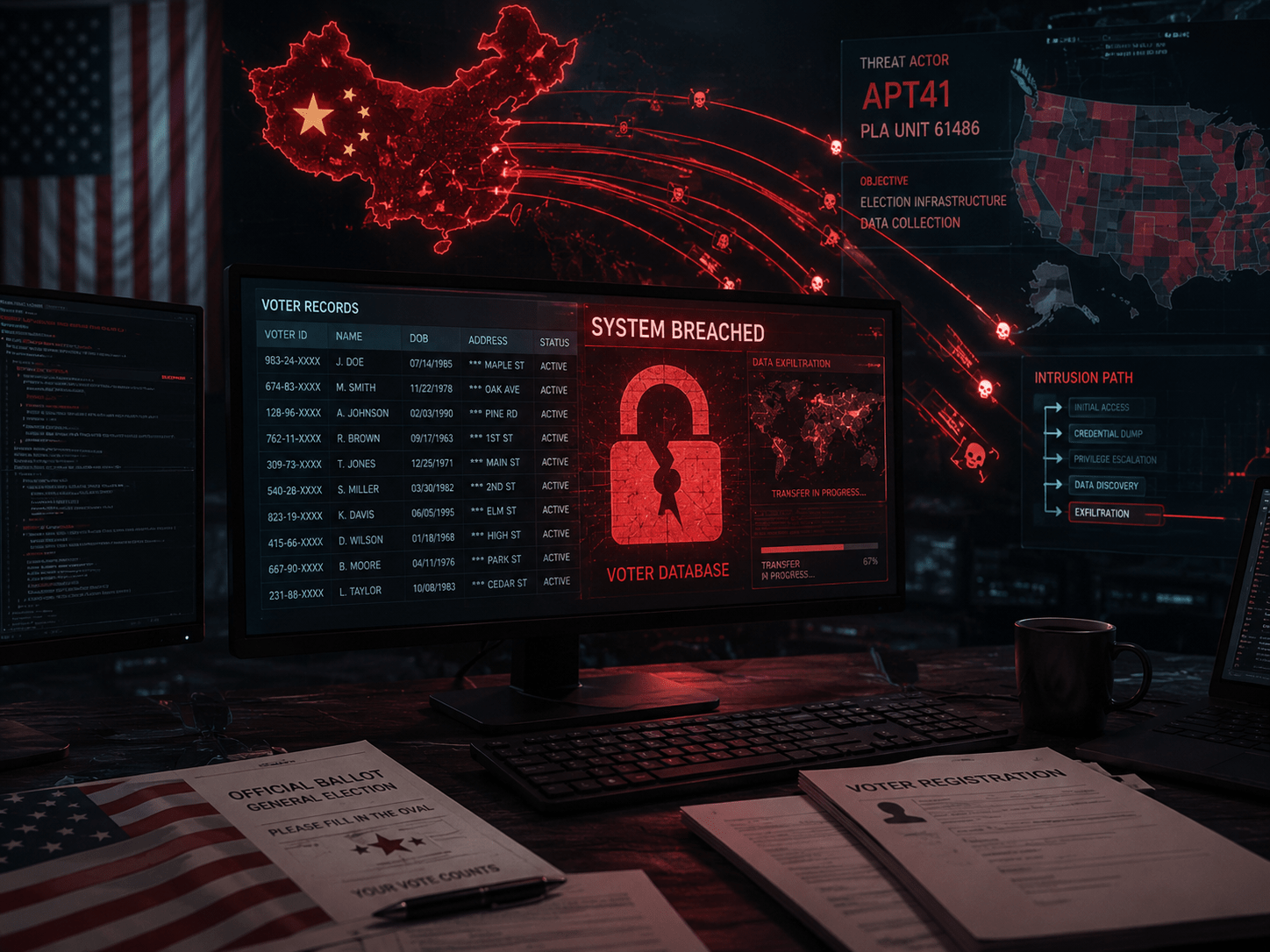
In July 2026, the U.S. government declassified a stack of intelligence records that should worry every American voter — and every American, period. Buried in the redactions is a simple, ugly fact: the People’s Republic of China spent years quietly vacuuming up the personal data of hundreds of millions of U.S. voters. Here is what the documents actually say, why it matters, and what it tells us about trusting Beijing.
What was released
On July 3 and July 10, 2026, the Trump administration’s newly created Government Transparency Task Force released a batch of declassified intelligence products under the heading “China’s Acquisition and Exploitation of American Voter Data.” The files are heavily redacted, and on many of them the originating agency’s name has been blacked out and replaced with a placeholder. But even through the black bars, the picture is clear enough.
According to the White House task force’s own public statement, the declassified intelligence indicates that voter registration rolls from at least 18 states were compromised by the PRC, and that separate reporting describes more than 200 million voter records being obtained. The states named in the release include Alaska, Arkansas, Colorado, Connecticut, the District of Columbia, Florida, Georgia, Iowa, Kansas, Maryland, Michigan, New York, North Carolina, Ohio, Oklahoma, and Rhode Island.
The quiet harvest: what China actually collected
This was not a single dramatic hack. It was a patient, years-long collection effort, and the documents lay out the mechanics:
- Bulk voter files. One assessment describes a PRC-held catalog of leaked and compromised datasets that included a batch of 204,822,241 U.S. voter records — names, ages, phone numbers, and addresses. Additional entries listed individual state voter databases running into the millions of records each.
- State-by-state targeting. A separate cyber advisory documents a Chinese actor downloading public voter data for six states — Colorado, Connecticut, Florida, Michigan, Oklahoma, and Rhode Island — in January 2022, pulling historical records stretching back to 2013. The same actor tried and failed to grab an Ohio voter file from a state government site the same day.
- It kept going. Reporting from 2023 shows continued interest, with voter data from cities across seven states — Arkansas, Colorado, Connecticut, Florida, Ohio, Michigan, and North Carolina — and inquiries about obtaining Connecticut and Massachusetts data.
- Not just voters. One memo notes the same collection effort swept up U.S. consumer databases and a registered military-personnel database, alongside a medical database of some 28 million Americans that included Social Security numbers.
The intelligence is explicit about the purpose: the data was to be used to match and identify U.S. citizens, build detailed personal profiles, and feed public-opinion analysis ahead of U.S. elections. This is raw material for identity matching, targeting, and influence — not idle curiosity.
It was never just about data
The same release makes clear that data collection was one arm of a broader effort. A CIA note summarizing sensitive reporting from 2018 to 2020 describes a Chinese Communist Party objective to prevent a U.S. president’s reelection — including directing tariff pressure at his supporters, cultivating American academics and former officials to get them “hooked on China,” and even paying U.S. journalists to write more negative coverage.
A summary of Chinese influence planning describes intentions to exploit America’s deepest social fault lines — racial tensions, the COVID-19 response, immigration, gun politics — and to amplify them across TikTok, Facebook, Twitter/X, and YouTube through both open and hidden influencers. And a President’s Daily Brief item from June 2020 describes what analysts called a credible blackmail threat: Beijing signaling it held damaging “black materials” on a U.S. official to pressure him into going easy on China.
A word about the most explosive claim
In fairness to my readers — and because you will see it elsewhere — the release also includes an FBI field report from September 2020 alleging that China manufactured fake U.S. driver’s licenses to generate tens of thousands of fraudulent mail-in ballots. It is important to be straight about this one: the FBI itself labeled that report raw, single-source, and uncorroborated, attached an internal comment poking holes in it, and recalled it the same day it went out. I’m not going to hand Beijing’s apologists an easy talking point by treating an unverified, recalled report as gospel. The documented data theft is damning enough on its own, and it doesn’t need embellishment.
Why this matters — even if not a single vote was changed
Here is the part too many people miss. You do not have to believe a single ballot was flipped to understand why this is dangerous. The threat is what stolen voter data enables over time:
- The data never goes stale. A voter file stolen in 2016 or 2022 is still useful in 2028. The personal details used to request an absentee ballot or change a registration — name, date of birth, address, partial Social Security or driver’s license numbers — don’t change much. Once a hostile power holds them, it holds a permanent option.
- It is a targeting map. Combine voter rolls with consumer, medical, and military data and you can profile, message, and manipulate specific American communities with precision.
- It corrodes trust. The mere knowledge that a foreign adversary holds this data — and that Washington sat on the intelligence for years — is itself an attack on public confidence in elections.
Why China cannot be trusted
Step back and look at the pattern the documents describe: covertly harvesting the personal data of hundreds of millions of Americans; building tools to profile and influence them; leveraging economic pressure and blackmail against U.S. officials; and running influence operations designed to turn Americans against one another. This is not the behavior of a rival that plays by rules. It is the behavior of a regime that treats another nation’s open society as an attack surface.
That is the core lesson of these files. Beijing’s public assurances mean nothing next to its documented conduct. A government that quietly catalogs 200 million of your citizens’ records while smiling across the negotiating table has told you exactly what it is. The only rational response is to stop extending trust it has never earned — and to harden the systems it has spent a decade probing.
What should happen now
- States must treat voter registration databases as critical infrastructure — with offline backups, multi-factor authentication, and real network segmentation.
- Public-facing voter data hosted on commercial sites needs the same protection as government systems; that is where much of this was scraped.
- Voters should verify their own registration status directly with their state and report anything they didn’t initiate.
- And Washington owes the public faster, fuller transparency — this intelligence should not have taken years to reach the people it concerns.
This post is based on U.S. intelligence records declassified and publicly released in July 2026. The documents are heavily redacted, and some reporting within them is explicitly labeled unverified; where that is the case, I’ve said so. The pattern of bulk data collection, however, is stated plainly across multiple independent products.