
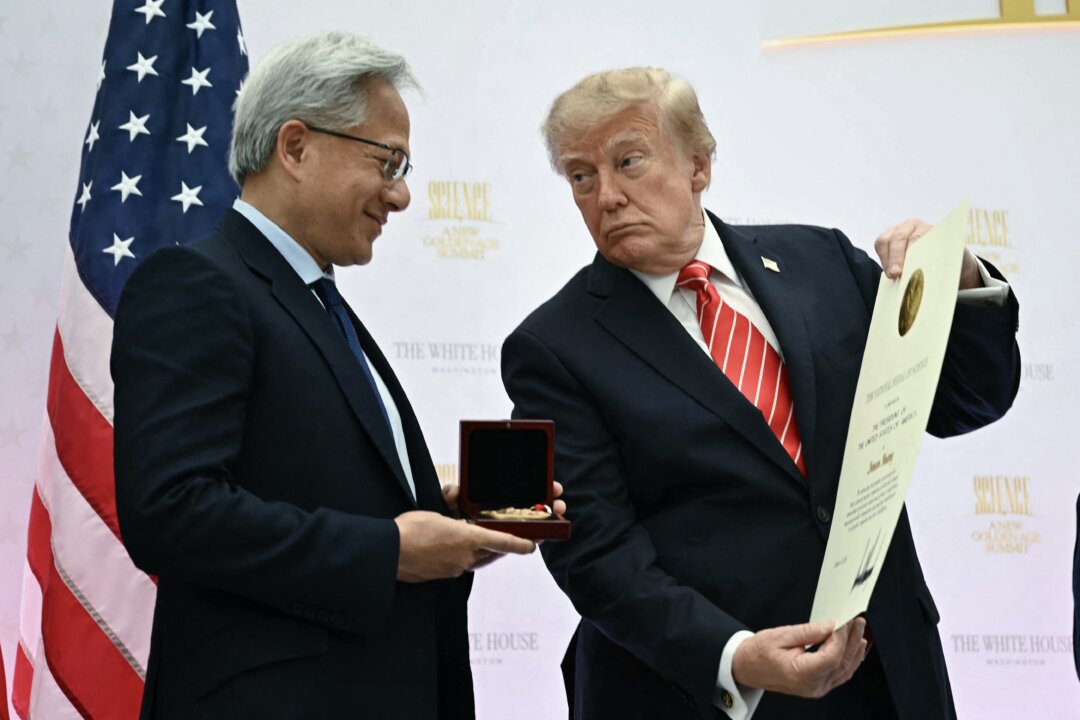
WASHINGTON—After President Donald Trump urged Nvidia’s board over the weekend to reinstate Jensen Huang as CEO—a rare executive branch intervention in the corporate governance of a public company—the board agreed.
Trump framed the move as essential to protecting America’s “geniuses” amid an intense tech rivalry with China, while lawmakers from both parties quickly pushed back. Nvidia and its newly reinstated CEO now face intense bipartisan scrutiny on Capitol Hill in early December.
On Nov. 23, Nvidia announced that its board unanimously voted to reinstate Huang as president, CEO, and board member, concluding that he is capable of leading the company. The decision came less than two weeks after Huang resigned due to multiple reports of extramarital affairs, including a New York Times report that alleged a relationship with a suspected Chinese spy.
Sen. Tom Cotton (R-Ark.), chair of the Senate Intelligence Committee, warned that Huang’s return does not free Nvidia from scrutiny.
“The controversy with Nvidia and Megaspeed is just the tip of the iceberg, and it’s not resolved because Jensen Huang has his job back,” Cotton wrote in an X post on Nov. 23. “Congress has much to investigate and we will pass overwhelmingly bipartisan chip export-control bills.”
The New York Times reporting alleged that the Nvidia co-founder had a relationship with Alice Huang, a former executive at Singapore-based data-center firm Megaspeed, and that she was suspected by U.S. intelligence officials of having ties to Chinese intelligence. Megaspeed is currently under federal investigation over allegations that it circumvented U.S. export controls to ship large quantities of advanced Nvidia chips to China. The company has said it “conducts legitimate and lawful business.”
Cotton said he had previously warned the administration about the Chinese Communist Party (CCP) obtaining advanced American chips through both smuggling and remote access.
China Hawks Raise Security Alarms
Soon after Nvidia’s announcement, Trump took to Truth Social to welcome the company’s decision.
Although stock futures were already rising, Huang’s comeback gave the broader market a significant lift, with Nvidia shares surging more than 30 percent on Nov. 23 before pulling back roughly 6 percent the next day.
Following the announcement, Trump joined a live CNBC program on Nov. 23 and spoke for an hour, explaining why he urged the board to bring back the co-founder despite Nvidia having previously stated it would not reinstate him.
Repeatedly calling Huang a genius, Trump said he feared China would poach the executive to lead its own cutting-edge artificial intelligence (AI) development.
“It’s a threat to lose him,” Trump said. “Jensen could take the next plane to China, and I guarantee you, they would give him whatever he wanted.”
Trump acknowledged the decision was not easy for Nvidia’s board, noting that directors sought assurances about potential national security risks before agreeing to reinstate him.
“And we gave them assurance, at least with everything we know, and we know a lot,” Trump told CNBC.
China hawks in Washington, however, remain unconvinced.
Gordon Chang, a China expert who has recently criticized the administration’s China policy, argued that Jensen Huang’s actions put U.S. national security at severe risk.
“I think President Trump owes an explanation to the American people why he feels there’s no risk. Maybe Trump is right, but he owes that explanation,” Chang told The Epoch Times.
He warned that U.S. technology could fall into the hands of the Chinese military, citing Chinese leader Xi Jinping’s “military-civil fusion” policy, under which any technology held by Chinese individuals or companies can be funneled directly to the People’s Liberation Army.
Congressional Scrutiny
Trump’s backing of Huang has united unlikely allies on Capitol Hill, where a bipartisan coalition is demanding rigorous oversight. Lawmakers want to determine whether Nvidia knowingly violated export controls and whether any Cabinet members turned a blind eye to the sales.
Senate Minority Leader Chuck Schumer (D-N.Y.) on Nov. 23 wrote on X that Democrats would use their “full power” to investigate any wrongdoing by Huang, other Nvidia executives, and the administration.
In another post on Nov. 24, Schumer accused the Nvidia CEO of shipping “extremely advanced chips to China,” likening the move to selling rocket engines to the Soviets during the Space Race.
On NBC’s “Meet the Press” on Nov. 22, Sen. John Kennedy (R-La.) said he intends to question Commerce Secretary Howard Lutnick and Treasury Secretary Scott Bessent. He suggested the Commerce Department may have allowed the CCP to bypass export controls and said he wants both officials to testify under oath before a committee.
GOP lawmakers oppose exporting advanced chips to China and are preparing a major legislative pressure campaign in the coming weeks.
Sen. Kevin Cramer (R-N.D.) argued that Nvidia’s decision to reinstate Huang threatens national security and requires immediate congressional action.
“Congress should immediately pass the strictest export controls possible. I hope it’s not too late,” Cramer wrote on X on Nov. 23.
Meanwhile, House Foreign Affairs Committee Chairman Rep. Brian Mast (R-Fla.) revealed in a recent statement that the Commerce Department had approved export licenses for nearly 880,000 AI chips to China. The approvals included companies such as Alibaba and Tencent, which are designated as “Chinese military companies” by the Pentagon.
Mast, House Select Committee on the CCP Chairman John Moolenaar (R-Mich.), and House Intelligence Committee Chairman Rick Crawford (R-Ark.) on Nov. 23 issued a joint statement demanding answers.
“The NVIDIA board’s brief internal investigation and reinstatement of Jensen Huang do not erase the national security threats and questions that must be addressed,” the lawmakers wrote.
“We remain committed to getting answers on the mass smuggling of NVIDIA products, their diversion for Chinese military purposes, and their key role in advancing our foremost adversary’s AI capabilities.”
A packed testimony schedule regarding the crisis is already set for early December.
On Dec. 1, Jensen Huang will appear for a closed-door transcribed interview conducted jointly by the House Foreign Affairs, CCP, and Intelligence committees.
On Dec. 2, Nvidia General Counsel Tim Teter will sit for a closed-door transcribed interview with the same three House committees.
On Dec. 3, Jensen Huang will testify before the Senate Banking Committee in an open livestreamed hearing.
On Dec. 10, Lutnick is scheduled to testify before the Senate Banking Committee in a separate session.
In a Nov. 24 interview with The New York Post, Trump said he would be willing to pardon Huang if needed, though he added, “It’s always an option, I guess, but I don’t think it’ll be necessary.”
He also urged Huang to “tell the truth” to Congress.
Despite the growing backlash, Trump expressed confidence that most Republicans will ultimately fall in line behind him.
“They’re going to be great. When I speak to them, they’re going to be great. They’re good people,” he told CNBC on Nov. 23.
Ongoing Investigations
Trump spoke with several officials, including Attorney General Todd Blanche, over the weekend before recommending that Nvidia’s board reinstate Huang.
Blanche said the Department of Justice found no evidence of wrongdoing by Huang or Nvidia.
Still, Nvidia and its reinstated CEO face multiple federal, state, and corporate-level investigations.
On Nov. 23, the Department of Commerce added Megaspeed to its trade blacklist. Lutnick had received bipartisan criticism for delaying this action.
On Nov. 16, the Department of Commerce and the Department of Justice (DOJ) also issued a joint statement confirming an ongoing investigation into Megaspeed.
The Commerce Department first opened an investigation into the Singaporean firm in 2024 for potential export control violations, and the DOJ later took the lead in the criminal probe.
Megaspeed told The Epoch Times that Alice Huang left the company in August 2025 and said it has hired external legal counsel to investigate media reports concerning its supply chain.
In early November, Nvidia’s board also announced an independent investigation after recent reporting said Jensen Huang has been the target of a foreign intelligence effort. The board said that it had “no reason to believe that either national security or NVIDIA secrets were compromised.”
Speaking on CBS’ “Face the Nation” on Nov. 22, Bessent said Nvidia’s committees are working swiftly to provide answers.
“I think we have to see where the buck stops,” he said. “Were these malicious actors down at the bottom of the company who were responsible for the noncompliance?”
The Securities and Exchange Commission has opened a probe into Nvidia’s accounting practices, Reuters reported on Nov. 20, following an earlier report by The Wall Street Journal that first revealed the SEC investigation.
Meanwhile, California Attorney General Rob Bonta announced last week that his office is investigating whether Nvidia’s advanced chips or confidential information reached China and whether the company misled investors and the public.
Debate Over Government Role
Beyond national security, Trump’s direct involvement in a private company’s boardroom decision has renewed debates over government overreach.
John Berlau, a senior fellow at the Competitive Enterprise Institute, says companies—not the government—should pick CEOs. He points out that Trump is hardly the first president to get involved.
In 2009, the Obama administration told GM’s top boss, Rick Wagoner, to step down. And in 2008, as the financial crisis hit, the Bush administration pushed out AIG’s CEO, Robert Willumstad, as part of the massive $85 billion bailout.
“It should be up to the shareholders who choose through their board of directors who the CEO is, and the government shouldn’t weigh in for or against a CEO candidate,” Berlau told The Epoch Times.
Since taking office in January 2025, Trump has steadily expanded federal involvement in sectors deemed critical to U.S. national security. His administration has taken equity stakes in various companies, including semiconductor giant Intel, rare-earth element producer MP Materials, minerals miner Trilogy Metals, and Lithium Americas, a Canadian mining company that is developing one of the world’s largest lithium mines in Nevada.
Last year, Trump also reached unprecedented revenue-sharing deals with Nvidia and Advanced Micro Devices (AMD).
Nvidia agreed to pay the U.S. government 15 percent of its revenue from sales of its H20 AI chips to China in exchange for export licenses, while AMD struck a parallel 15 percent deal for its MI308 chips.
When CNBC pressed him on why a president should weigh in on who leads a public company, Trump kept it simple: “Well, it’s a good question … I’m doing it for the country.”
We had a problem loading this article. Please enable javascript or use a different browser. If the issue persists, please visit our help center.