
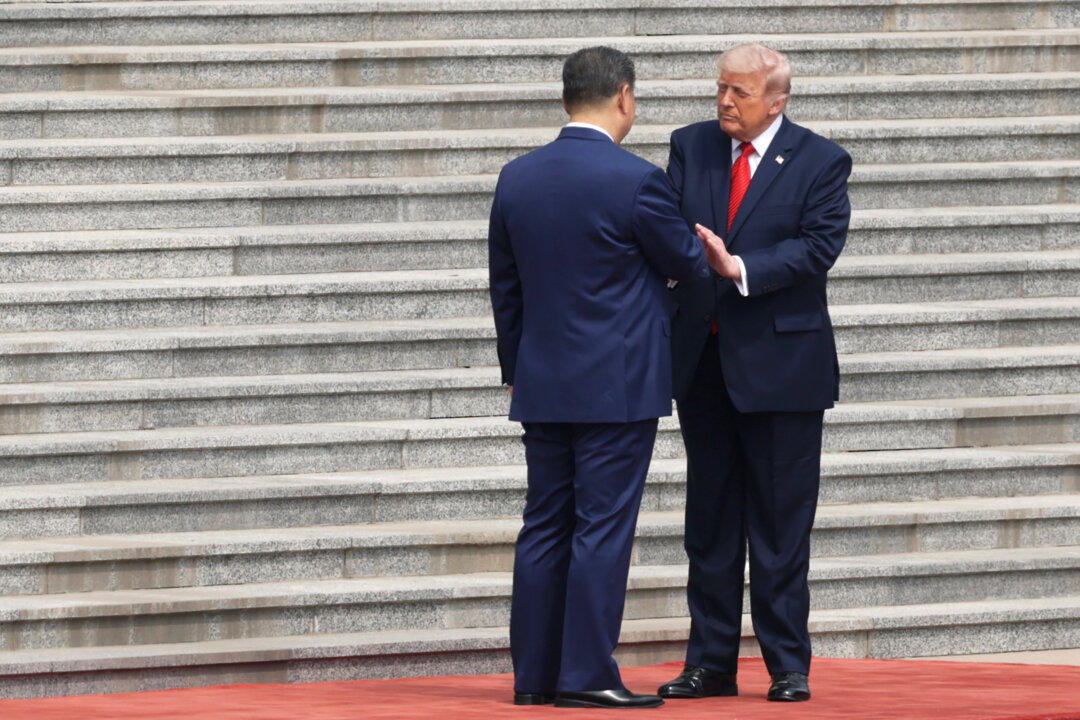
President Donald Trump said China had been “relatively inactive” during the conflict with Iran, including over the Strait of Hormuz, one day before Chinese leader Xi Jinping held brief talks with Iranian President Masoud Pezeshkian at a regional summit.
Trump made the remarks at the White House on Aug. 31 while discussing Xi’s expected visit to Washington later this month.
“He’s coming in a couple of weeks. He looks forward to it; I look forward to having him,” Trump said.
“Even with the Strait of Hormuz, he’s relatively inactive. He’s been relatively inactive by comparison to what he could have been,” Trump added.
Asked by The Epoch Times what Chinese actions or restraint Trump was referring to and whether the administration had received any commitments or assurances from Beijing regarding Iran or the Strait of Hormuz, White House spokesperson Anna Kelly referred to Trump’s comments and provided no additional details.
Trump and Xi had previously discussed Iran during their May meeting in Beijing. Trump said afterward that the two leaders shared an interest in preventing Iran from obtaining a nuclear weapon and keeping the Strait of Hormuz open.
On Sept. 1, Pezeshkian and Xi held what Iran’s presidency described as a brief meeting and conversation on the sidelines of the Shanghai Cooperation Organization (SCO) summit in Bishkek, Kyrgyzstan.
Neither Beijing nor Tehran announced a formal bilateral meeting or released a substantive account of talks between the two leaders.
The limited public interaction differed from their meetings at recent major gatherings.
Xi held a formal meeting with Pezeshkian in Beijing during the 2025 SCO summit. The Chinese Foreign Ministry said the two discussed bilateral relations and cooperation in trade, investment, clean energy and connectivity.
Xi said at the time that Beijing placed relations with Iran “high on its diplomatic agenda in the Middle East.”
The Chinese readout also referred to their previous meeting in Kazan, Russia, during the 2024 BRICS summit.
By comparison, Chinese authorities released a detailed account of Xi’s Aug. 31 meeting with Russian President Vladimir Putin on the sidelines of this week’s SCO summit.
SCO Backs Iran Diplomatically
The limited Xi–Pezeshkian interaction came as China joined the other SCO members in approving a declaration backing Iran on several points.
The SCO said its leaders approved 28 documents at the Sept. 1 summit, including the Bishkek Declaration.
The declaration expressed deep concern over developments involving Iran and reiterated the organization’s position condemning military strikes on Iranian territory, saying the attacks caused civilian casualties and economic damage.
It also backed Iran’s sovereignty and territorial integrity and called for the conflict to be resolved through political and diplomatic means.
The SCO in a July foreign ministers’ statement said it condemned military strikes on Iran and favored a political and diplomatic settlement.
The declaration did not announce a collective military commitment to defend Iran. The SCO Secretariat described the organization after the summit as maintaining a “peace-loving, non-bloc character.”
That distinction is consistent with limits Beijing has placed on its security relationship with Tehran.
A March assessment by the congressionally created U.S.-China Economic and Security Review Commission said Tehran has sought deeper strategic alignment with Beijing, while China has avoided formal defense commitments.
The commission said Beijing was unlikely to take significant action in support of Iran beyond diplomatic backing and dual-use supplies, while seeking to preserve its broader relationships in the Middle East.
It also said China appeared not to participate in the 2026 iteration of a recurring China–Iran–Russia naval exercise despite earlier reports that the drill would be held around the Strait of Hormuz.
US Sanctions China, Hong Kong Networks
China’s limited direct military role has not ended its importance to Iran’s economy.
The same USCC assessment said China buys roughly 90 percent of Iran’s exported oil and estimated that Chinese purchases generated about $31 billion for Tehran in 2025.
Washington has continued targeting Chinese and Hong Kong entities that help Iran move oil, money, and military-related goods.
On Aug. 24, Treasury launched Operation Economic Outcast, a broader campaign aimed at cutting off Iran’s financial connections worldwide.
The accompanying sanctions targeted networks operating across China, Hong Kong, and other jurisdictions. Treasury said Hong Kong- and China-linked companies helped transport Iranian oil, move funds through front companies. and support procurement tied to Iran’s military programs.
Earlier in August, Treasury also sanctioned multiple networks that used Hong Kong shell companies to move hundreds of millions of dollars through Iran’s clandestine banking system.
Xi Expected to Visit US Sept. 24
Trump invited Xi to visit Washington during their May summit in Beijing.
In July, Trump said Xi would visit the United States on Sept. 24, adding that artificial intelligence would be among the issues discussed.
The Congressional Research Service also listed a Sept. 24 Washington visit as planned in its Aug. 26 overview of U.S.–China relations.
We had a problem loading this article. Please enable javascript or use a different browser. If the issue persists, please visit our help center.