
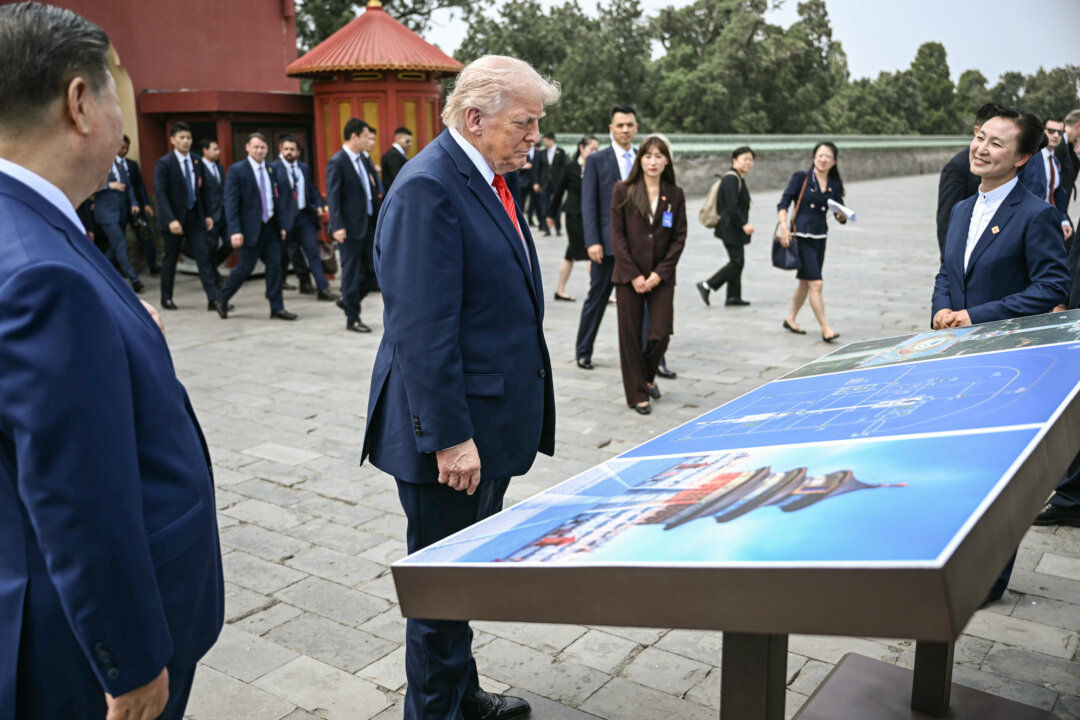
As Chinese leader Xi Jinping’s visit to the United States approaches, U.S. President Donald Trump has downplayed tensions between the two countries in his recent remarks.
Analysts who spoke to The Epoch Times said it showed Trump’s diplomatic maneuver to secure big orders from China.
Trump told reporters on Sept. 4 that he will hold a formal state dinner in honor of Xi on Sept. 24 when the Chinese Communist Party (CCP) leader visits Washington later this month.
“We’re going to have a state dinner, and we’re gonna—we do great things with China, we’ve been doing very well with China,” Trump said.
“They’re a competitor and all of that, but we have a very good relationship with … Xi.”
Trump also praised China at the White House on Sept. 1 for remaining “relatively inactive” during the Strait of Hormuz crisis amid the Iran war and said he had “a lot of respect” for Xi and believes that the feeling is mutual as their planned summit in the United States approaches.
Before Trump made these remarks, U.S. Treasury Secretary Scott Bessent unveiled a plan to target Iran’s “enablers” with secondary sanctions. He did not mention the Chinese regime, but it is Tehran’s top trading partner.
Liu Ning, a Chinese political scholar based in Japan who used a pseudonym out of fear of reprisal, told The Epoch Times: “While Trump praises Xi Jinping, he retains the authority to impose tariffs and implement financial sanctions against China.
“The praise is merely a way to let Xi Jinping save face. For Trump, securing orders from China is what matters most.”
Following the meeting between Trump and Xi in Beijing in May, China agreed to purchase 200 Boeing passenger aircraft and pledged to buy at least $17 billion in U.S. agricultural products annually from 2026 to 2028.
This figure does not include previous commitments to purchase U.S. soybeans.
Li Bin, a Chinese scholar based in Heilongjiang Province specializing in international trade who used a pseudonym out of fear of reprisal, told The Epoch Times that Trump aims to turn the Chinese market into a source of orders for American farmers and jobs for industrial workers.
Xi hopes that Washington will ease sanctions and maintain an ambiguous stance on the Taiwan issue, Li said.
“Xi Jinping wants to reduce external pressure ahead of the Fifth Plenary Session of [the] CCP, while Trump is seeking orders for agricultural products and Boeing aircraft, as well as U.S. jobs,” Li said.
“Both sides speak of mutual respect, but ultimately, it comes down to how much Beijing buys and how many concessions the United States makes.”
The Fifth Plenary Session of the 20th CCP Central Committee is scheduled to be held in Beijing in October 2026, right after Xi’s U.S. visit.

Independent Chinese scholar Yang Zhaokang, who used a pseudonym out of fear of reprisal, told The Epoch Times that he believes that Xi’s upcoming visit to the United States means more to the leader than a routine return visit.
“The CCP is set to hold its Fifth Plenary Session next month, and Xi cannot afford to let U.S.-China relations spiral out of control at this juncture,” Yang said. “He needs time to continue with his military purges and to deal with domestic economic issues.”
The Chinese regime’s Standing Committee of the National People’s Congress recently officially removed Gen. Zhang Youxia and Gen. Liu Zhenli from their posts on the Central Military Commission.
Yang said that this move may also be intended to demonstrate to Trump that Xi retains firm control over the military ahead of their summit.
Han Sicong, a Chinese scholar who studies the history of the CCP and used a pseudonym out of fear of reprisal, told The Epoch Times that Xi is further concentrating diplomatic decision-making power in his own hands.
“Xi Jinping has attached great importance to personal diplomacy since he came to power,” Han said. “Chinese Foreign Minister Wang Yi has repeatedly talked about ‘head of state diplomacy’ and ‘big country diplomacy.’ This should be what Xi Jinping means.”
Han said that the “head-of-state diplomacy” entails Xi retaining the power to make decisions and define the narrative regarding China–U.S. relations, and then converting the outcomes of these talks into personal political capital.
The Taiwan issue would likely remain a key focus of the talks, according to Han.
“Xi Jinping might ask Trump to halt or reduce arms sales to Taiwan and also hope that Washington leaves some leeway when imposing sanctions on Chinese banks and energy companies,” he said.
Han said that following the Trump–Xi summit, Beijing might frame the meeting as an achievement for Xi in “safeguarding world peace” and “stabilizing China–U.S. relations,” thereby building momentum for power arrangements ahead of the CCP’s top meetings.
“Beijing is all about saving face. In Xi Jinping’s view, as long as the United States makes concessions on the Taiwan issue, he is willing to compromise in other areas—including easing restrictions on rare-earth exports,” Li said.
“However, Beijing has underestimated the fact that the United States has already seen the Chinese regime as a strategic rival. That reality will not change, regardless of who is president.”
Shi Youliang contributed to this report.
We had a problem loading this article. Please enable javascript or use a different browser. If the issue persists, please visit our help center.