
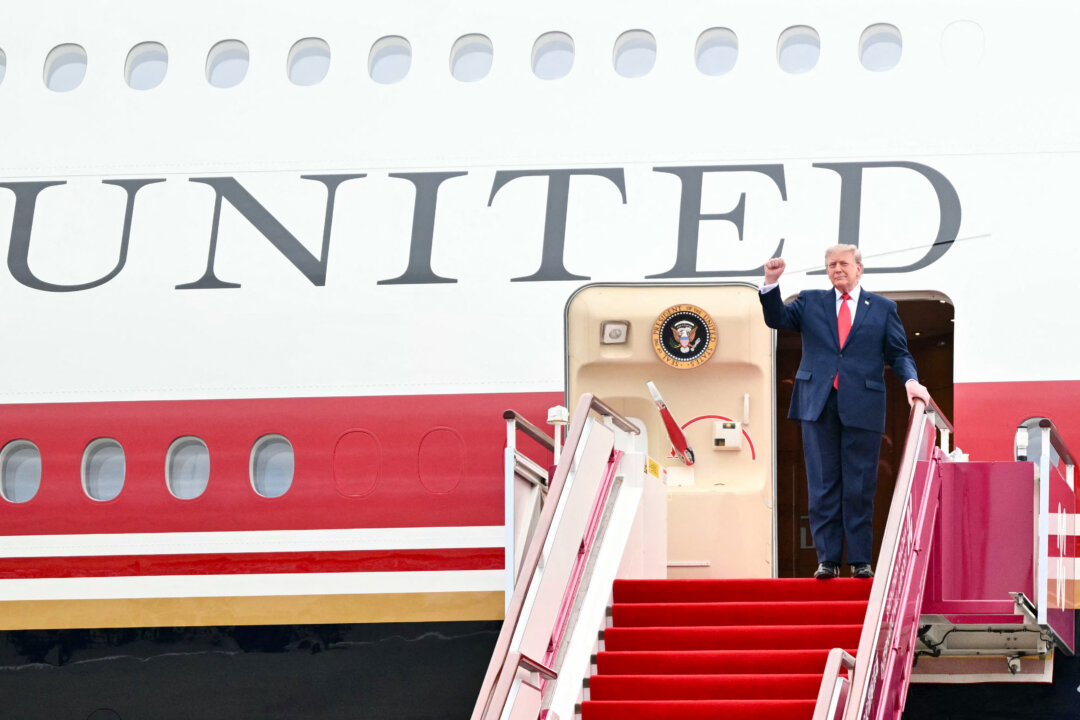
U.S. President Donald Trump arrived in China on Nov. 18, a day ahead of his highly anticipated trilateral meeting with Russian President Vladimir Putin and Chinese leader Xi Jinping.
Xi welcomed Trump at Shenzhen Bao’an International Airport in the southern Chinese tech hub, where Beijing is hosting the annual Asia-Pacific Economic Cooperation (APEC) summit, a gathering of 21 economies across the region.
On the sidelines of the APEC summit, Trump is also scheduled to hold a bilateral meeting with Xi on Thursday, local time.
Before heading to China, Trump stopped in the Philippines, which hosted the Association of Southeast Asian Nations (ASEAN) summit. There, he participated in the U.S.–ASEAN special summit and took part in the seventh Quad leaders’ summit with the prime ministers of India, Japan, and Australia. He also met other world leaders, including Thai Prime Minister Anutin Charnvirakul, with whom he signed a joint trade statement.
Trump also held a bilateral meeting with Philippine President Ferdinand Marcos Jr., during which he said Washington was expanding its defense cooperation with its treaty ally and suggested working with Manila on a major civilian nuclear energy project. At a subsequent state luncheon, Trump said the two countries had just concluded a major trade deal.
The Philippine presidential office later said the two sides had reached an understanding on areas of economic cooperation, without mentioning a trade deal, and Jose Manuel Romualdez, the Philippine ambassador to the United States, said nothing had been signed.
In a post on Truth Social, Trump called the trade deal “a true landmark,” and said it would be great for U.S. farmers and those in the energy sector.
Before Trump’s arrival, Xi and Putin both delivered speeches at the opening ceremony of the APEC CEO summit on Wednesday, local time.
In his speech, Putin said he expected a “big potential benefit” from Thursday’s trilateral summit.
Xi said in his speech that China remains committed to seeking cooperation, including under the Belt and Road Initiative (BRI), which is a Chinese foreign policy aiming to build geopolitical clout by financing infrastructure projects throughout Southeast Asia, Africa, and Europe.
U.S. Rep. John Moolenaar (R-Mich.), chairman of the House Select Committee on the Chinese Communist Party, has criticized China for forcing developing countries into debt and leveraging its financial influence over them under the BRI.
Putin and Xi also held a bilateral talk on Wednesday, local time. According to Russia’s state-run news agency TASS, the two leaders talked for more than two hours and discussed “prospects for further economic cooperation” between the two neighboring countries.
On Thursday, Trump, Putin, and Xi are expected to discuss a range of issues in their first-ever trilateral meeting, including nuclear arms reduction and the war in Iran, with the war in Ukraine also potentially on the table.
Guo Jiakun, spokesperson of China’s foreign ministry, said during a daily briefing on Wednesday that the three leaders would “have an in-depth exchange of views on important issues bearing on global peace.”
Heather Williams, director of the Project on Nuclear Issues and senior fellow at the Washington-based think tank Center for Strategic and International Studies, expressed low expectations for the three-way summit in a video posted on social media platform X on Nov. 17.
“An ambitious denuclearization deal seems pretty unlikely to come out of this potential trilateral meeting. China has been a little bit nervous, it seems, about whether or not they should even participate in this meeting. The reason for that is that China has consistently said that they aren’t ready for the types of arms control that the U.S. and the Soviet Union, and then the U.S. and Russia, did,” Williams said.
“So, just the fact that these three are meeting and might talk about nuclear issues—it could be a little too much for Beijing.
“The other reason is Russia. Russia has a pretty poor track record of compliance with arms control agreements. They haven’t shown a lot of interest in new arms control in recent years, and, to be clear, Vladimir Putin is really just interested in the war in Ukraine right now.”
Williams also said ending without an agreement isn’t a failure and that the meeting itself is “a step forward.”
Trump will return to the United States after his visit to China.
Reuters contributed to this report.
We had a problem loading this article. Please enable javascript or use a different browser. If the issue persists, please visit our help center.