
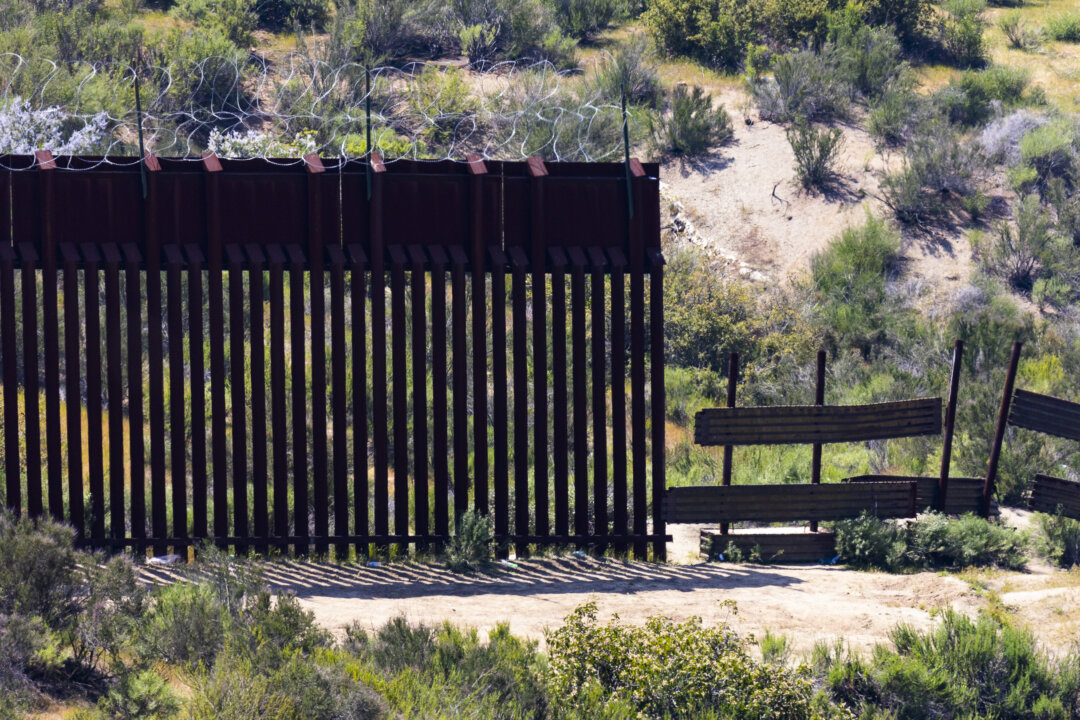
The Trump administration has petitioned the Supreme Court to allow border wall construction to resume in the Big Bend area of Texas.
In an emergency application filed with the high court on Oct. 21, lawyers for the federal government asked the justices to lift a lower court order halting construction of President Donald Trump’s key project that began during his first term in office.
In the Oct. 3 order, U.S. District Judge Kathleen Cardone sided with environmental groups who claimed the work was unconstitutional, breached the separation of powers, and took land from residents.
“This case involves a baseless injunction that halts a major portion of the construction of the border wall,” U.S. Solicitor General D. John Sauer wrote in the emergency application. “Leaving a 300-plus-mile gap in border defenses would act as a dangerous magnet for cartels and other bad actors to exploit as other routes close off.”
The Trump administration argued that continuing construction was crucial because the Big Bend region encompasses nearly one-quarter of the U.S.–Mexico border.
Between fiscal years 2021 and 2025, Customs and Border Protection (CBP) apprehended more than 89,000 foreign nationals attempting to enter through the Big Bend sector, according to the emergency application, “and those are just the aliens who were detected.”
According to CBP data, there were 11,823 apprehensions in the region during 2023 and 3,096 in 2025.
CBP has seized increasing amounts of illegal narcotics across the southwest border, and the Sinaloa and Juarez cartels, which operate south of the Big Bend area, continuously seek to exploit any vulnerabilities in the U.S. border to further drug, human, and weapons trafficking, Sauer stated.
He argued that Cardone’s order, if allowed to remain in place, would lead to a number of harms for the federal government, including a disruption of its ability to secure a large portion of the southern border against cartel incursions and activity in addition to irreversible delays, costs, and operational harms from halting already-begun construction.
Sauer accused Cardone of misbalancing the equities and harms in her ruling.
The judge had conceded the federal government “will experience at least some degree of irreparable harm” because of her block. Nonetheless, Cardone “illogically concluded” the environmentalist groups’ harms outweighed the government’s, Sauer said.
“The notion that respondents’ interest in ‘escaping from modern life’ in the ‘wild spaces in the Big Bend Sector’ and preserving ‘the spiritual, recreational, and aesthetic value of the area,’ surpasses the United States’ paramount interest in preventing a quarter of the border from becoming a magnet for cartel exploitation defies credulity,” the solicitor general wrote.
Plans for border construction in the Big Bend region were announced in January, with administration officials waiving environmental laws to speed up the building.
The plaintiffs, the Center for Biological Diversity, nonprofit Friends of the Ruidosa Church, and Rio Grande river guide and landowner in the Big Bend area Danny William Miller, filed suit in April over the Department of Homeland Security’s (DHS) waiving of regulations. By early October, Cardone had sided with the groups.
But Sauer argued in the emergency application that she never had jurisdiction to issue such a ruling.
He cited a section of the Illegal Immigration Reform and Immigrant Responsibility Act of 1996.
Through that legislation, Congress granted authority to the attorney general and secretary of DHS to construct border security measures while making it “harder for federal judges to block those critical national security endeavors.”
Congress also allowed the DHS secretary to waive legal requirements he deemed necessary to ensure speedy construction of roadways and barriers.
To further guard against delays of border wall construction, Sauer said, Congress “stripped federal courts of jurisdiction to hear any non-constitutional challenges to” a DHS secretary’s waiver decisions.
Under that authority, Homeland Security Secretary Markwayne Mullin issued three waivers in 2026 to expedite construction on border walls and roadways in Big Bend.
“The President received a mandate from the American people to build a wall, defeat the cartels, and stop the flow of illegal aliens and dangerous drugs like fentanyl into our country,” DHS General Counsel James Percival wrote in a post on X. “[Cardone’s] order is as unprecedented as it is flawed, and we look forward to the Supreme Court’s expeditious consideration of this important question.”
CBP Commissioner Rodney Scott said he expects the border wall to be completed by the end of 2027.
Lawyers for the environmental groups suing over the construction did not immediately respond to a request for comment.
We had a problem loading this article. Please enable javascript or use a different browser. If the issue persists, please visit our help center.