
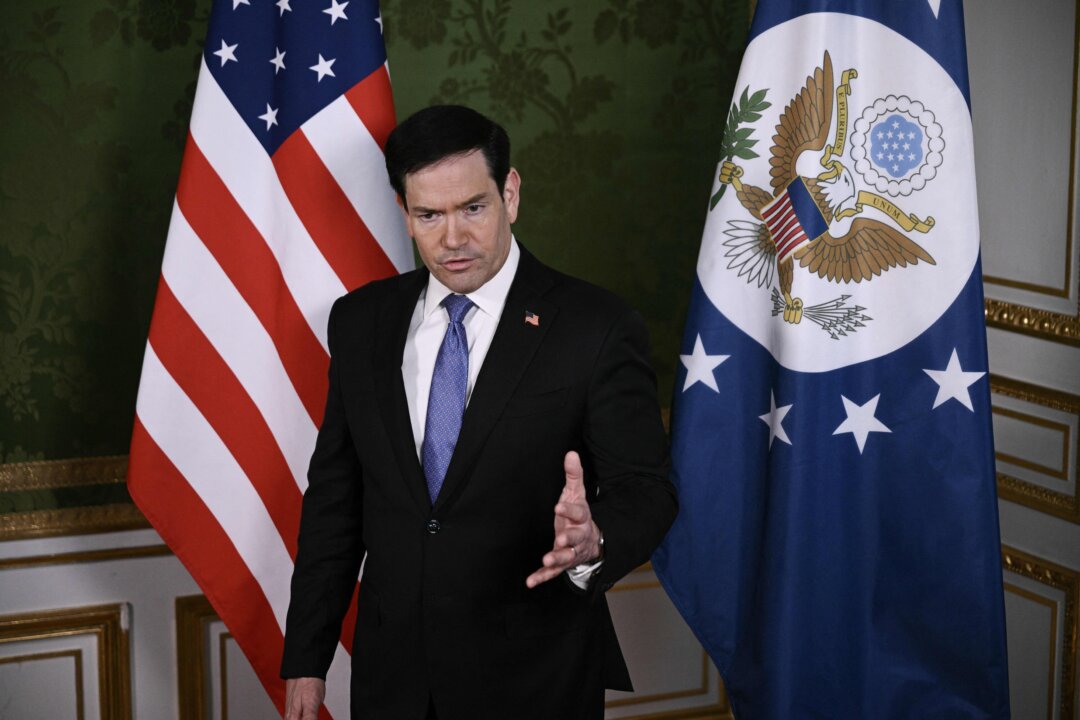
U.S. Secretary of State Marco Rubio and Chinese foreign minister Wang Yi spoke by phone on Nov. 11, setting the stage for a meeting between the leaders of two top economies later this month.
During the call, Wang and Rubio discussed “bilateral relations and interactions between the two countries’ heads of state,” according to a summary of the call issued by China’s foreign ministry, which described the talks as “positive and constructive.”
The State Department didn’t immediately respond to a request for comment.
The conversation came roughly a week before the Asia-Pacific Economic Cooperation (APEC) Leaders’ Meeting, scheduled for Nov. 18 to Nov. 19 in Shenzhen, the southern Chinese city bordering Hong Kong.
U.S. President Donald Trump is expected to sit down with Chinese leader Xi Jinping on the sidelines of the summit.
Trump and Xi last met in Washington in late September, when they approved an extension of the U.S–China trade truce until mid-January. The deal was formalized earlier this week after Beijing announced it would suspend, for two months, an additional 24 percent tariff on U.S. products, port fees on U.S.-linked ships, and rare-earth export controls.
Treasury Secretary Scott Bessent has said the two-month economic détente was to provide more time to see what could be accomplished “on the economic front.”
“There are some deliverables that have not been perfect on the Chinese side,” he told Fox News in September, before Xi’s state visit to the United States.
On Nov. 10, Bessent called for a more balanced economic relationship between the United States and China.
Speaking at an event in New York, Bessent said the U.S. economy has grown “too dependent on foreign supply,” while China’s has “become increasingly reliant on foreign demand.”
“In other words, the United States must produce more of what we consume, while China must consume more of what it produces,” he said.

Concerns have grown among China’s major trading partners, particularly in the European Union, that an influx of subsidized cheap exports from China threatens local businesses and jobs.
Despite mounting international calls to rebalance its economy, Beijing has increasingly relied on exports to sustain economic growth, especially amid the long-running property crisis that has left millions of Chinese tightening their purse strings.
With two months still to go in the year, China’s trade surplus has already topped $1 trillion this year, according to customs data posted on Nov. 10.
Trump has indicated openness to a trilateral summit involving Xi and Russian President Vladimir Putin on the sidelines of next week’s APEC leaders’ meeting.
“One of the meetings, I think, will be with President Putin and President Xi, and that’ll be interesting. We’re talking a lot of things, including denuclearization, but we’ll be talking a lot of things. We’re trying to end the war in Iran,” Trump told reporters on Nov. 8.
A Kremlin spokesman said on Nov. 3 that discussions over a three-way meeting were underway. The following day, a Chinese foreign ministry spokesperson confirmed Beijing is in contact with “relevant parties regarding a meeting between the three heads of state.”

Rubio, speaking in Paris after a Group of Seven meeting on Nov. 10, said the countries have “an intent” to have such a summit, though there is nothing to announce.
“The president wants that meeting to happen if it’s possible—we think it should be possible—and that among the topics he believes that should be discussed is the status of nuclear weapons in the world, which the president thinks its proliferation is very dangerous,” he said.
The Chinese regime has shown little interest in joining such arms-control efforts.
Last month, Foreign Ministry spokeswoman Mao Ning reiterated a rejection of a proposal for China to join nuclear disarmament negotiations with Washington and Moscow, calling it “neither reasonable nor realistic.”
We had a problem loading this article. Please enable javascript or use a different browser. If the issue persists, please visit our help center.