
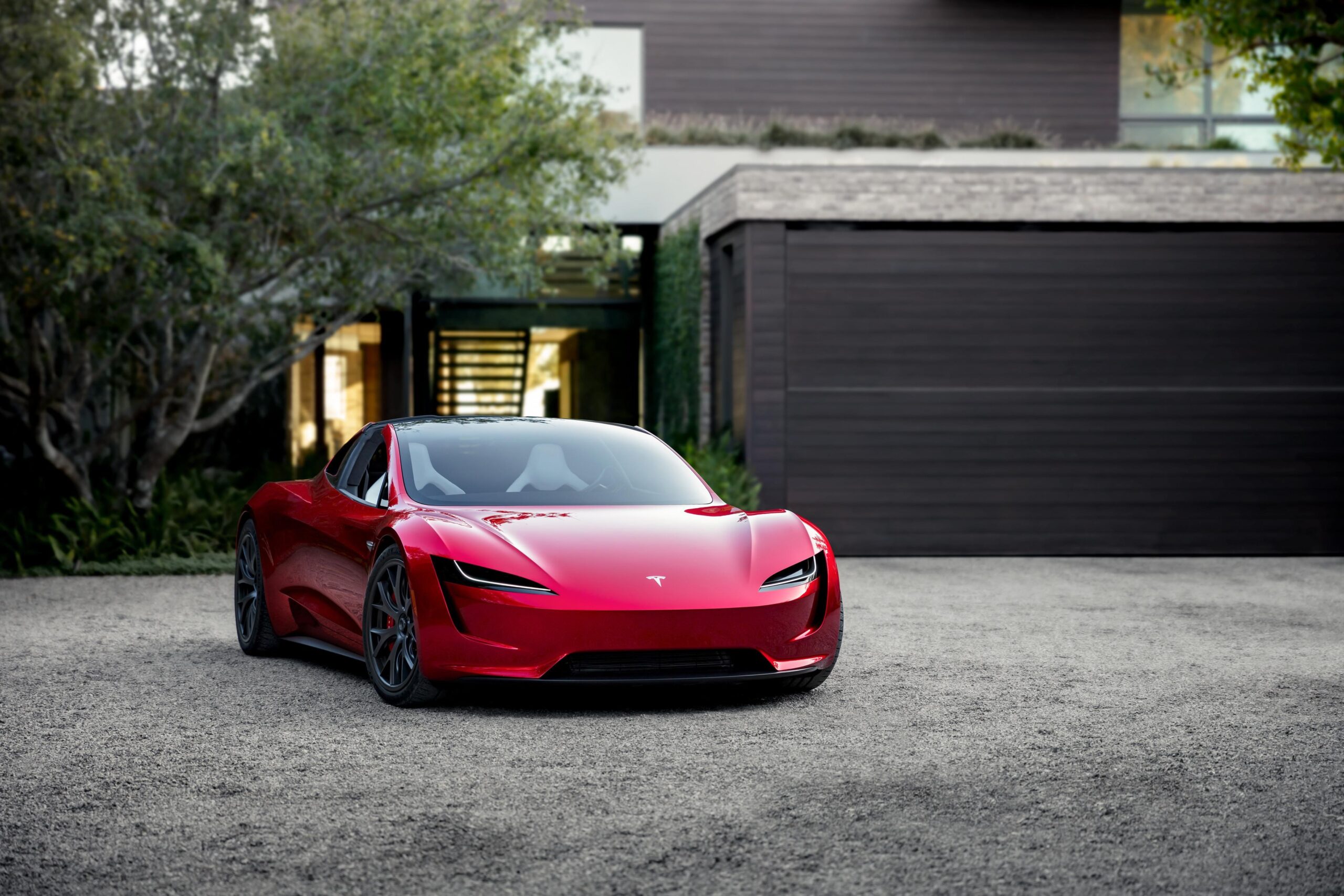
It took nearly a decade for Tesla’s next-gen sports car to arrive, but it’s finally here. The timing couldn’t be worse.

It took nearly a decade for Tesla’s next-gen sports car to arrive, but it’s finally here. The timing couldn’t be worse.
For a car that’s supposed to be one of the fastest ever made, the new Tesla Roadster certainly took its sweet-ass time getting here.
It’s been nearly a decade since Elon Musk made the surprise announcement about plans to build a next-gen Roadster. Now, the Tesla Roadster is finally expected to make its production-ready debut at an event in Waco, Texas — and the timing couldn’t be worse.
The new Roadster is set to arrive in an EV market beset by high energy prices, political turmoil, and consumer uncertainty. The tax-credit-fueled exuberance of the post-covid years has since given way to slower sales and fewer options. Automakers are scaling back their EV plans as sales stall in the US. Even Tesla, the market leader that has weathered its own share of chaos, is still struggling with shrinking demand and lowered expectations.
But the Roadster isn’t your average EV. It’s the ultimate status symbol, defined by its outrageous promises and elusiveness. Musk has said the Roadster can accelerate from 0–60mph in less than two seconds, will have a top speed over 250mph, and will come with an optional “SpaceX package” that adds cold-gas thrusters, enabling it to “fly a little.”
The Roadster isn’t a compelling product because it might be able to briefly hover (although that would be pretty impressive). In the years since it was first announced, it’s become defined by its unattainability. It’s vaporware in the extreme. After years of missed deadlines, it seemed likely that the Roadster would go the way of the solar roof tiles, battery swapping, robot charging, and other Tesla projects that were once promised but never delivered. Several reservation holders, like OpenAI CEO Sam Altman and YouTuber Marques Brownlee, canceled their orders under the assumption that the Roadster would fail to launch. For the average buyer, it was double-locked behind broken promises and an astronomical price tag.
Like a broken clock, Musk occasionally delivers on his outrageous promises — or at least a scaled-down version of the original promise. Tesla’s robotaxi service may not cover 50 percent of the US population, but dozens of its steering-wheel-less Cybercabs currently roam the streets of Austin, Texas. The Cybertruck may not be able to float in water, but it definitely exists. I’m told you can even buy one, though weak demand suggests few people want to.
Now that we know that some version of the next-generation Roadster is going into production, the question shifts to why it even exists. Musk, who has been pushing for Tesla to become less of a company that makes cars and more of a company that makes robots, has said that the Roadster will be the last Tesla vehicle built for human driving. Everything else will be autonomous. The company recently ended production of its original flagship models, the Model S and X, to make room for production of its humanoid Optimus robots. Musk is openly mulling the idea of merging Tesla with his other company, SpaceX, as a way to accelerate in the race for AI. The Roadster has been relegated to relic status before it even reaches a single customer.
The Roadster loses even more of its luster once you realize Tesla has already achieved some of its claimed performance goals. Tesla’s Model S Plaid was released in 2021 with a claimed 0–60mph time of 1.99 seconds (minus a 1-foot rollout), which was later confirmed by independent tests. When Tesla demonstrates its likely very quick Roadster on Thursday, some observers would be forgiven for feeling as if they’ve seen this movie before.
But Tesla watchers have been suffering from déjà vu all year. The company that used to reveal new products every year has since taken to rereleasing products it’s already shown off. This year saw the rereveal of the Cybercab (first announced in 2024), the Semi (2017), and now the Roadster (also 2017). In fact, the Cybertruck is the only new consumer vehicle Tesla has delivered in the last five years — and it’s been a noticeable flop.
Once it enters production, the Roadster will face fresh challenges. When the vehicle was first revealed, Tesla didn’t know that the electric hypercar market would be so chilly. Since then, there have been several automakers that have attempted to make two-door EVs at that price point and performance level, without any success. While hyper-EVs like the Rimac Nevera, Pininfarina Battista, and Lotus Evija achieved impressive engineering feats, they faced low sales volumes, severe production delays, and weak demand.
It turns out the super rich that can afford exotic cars that cost upwards of $1 million overwhelmingly prefer internal combustion engines. The appeal is rarely rooted in utility or straight-line 0–60mph numbers. Instead, it relies on brand loyalty, mechanical characteristics, engine noise, and manual or dual-clutch gear shifting. Bugatti CEO Mate Rimac has noted that despite setting dozens of world records with the 1,900-plus-hp Rimac Nevera, the company struggled to sell its planned run of 150 units. He compared high-end electric hypercars to high-tech smartwatches — capable of incredible feats, but lacking the emotional prestige of a handcrafted timepiece.
Ferrari opted for four doors when it designed its first EV and still faced near universal ridicule when the Luce was finally revealed. Porsche delayed pure-EV replacements for the 718 Cayman and Boxster multiple times. Even Lamborghini abandoned its planned pure EV in favor of an all-hybrid lineup.

It’s not even clear that the Roadster’s performance capabilities — 0–60 under two seconds, or even less than one second in certain configurations, if Musk is to be believed — will help bring in customers. When the original Tesla Roadster arrived in 2008, sub-four-second 0–60 times were reserved for high-end exotics. Today, the physics of electric motors make extreme straight-line acceleration relatively easy to achieve across different form factors. There are other limiting factors, like weight and thermal mechanics, that could blunt the Roadster’s ambitions. Two-door sports cars are built to be light, agile, and engaging around corners. But battery packs are heavy and can weigh down a sports car on twisty roads or racetracks.
The Roadster doesn’t need to be a huge success in order to be a win for Tesla. The company has had two generationally successful products — the Model 3 and Model Y — that will define its legacy going forward. The Roadster is likely to be a limited-run, ultra-high-end supercar where success is measured not by sales volume, but by scarcity. It may be the case that selling only a handful of Roadsters plays directly into to Tesla’s strategy.
While Tesla builds human-driven sports cars as a legacy afterthought, Musk’s eyes are fixed on low Earth orbit, where SpaceX plans to launch solar-powered orbital data centers to fuel his AI ambitions. Tesla has already moved on to AI and autonomous tech, rendering its own human-driven halo car obsolete before it launched. The last time a Tesla Roadster captured the world’s collective imagination was when Musk launched one into space in 2018. That car is still drifting millions of miles away with a dummy “Starman” astronaut in the driver’s seat.
Eight years later, the next-gen Roadster likely arrives as a grounded, earthbound artifact of a future Tesla has already left behind.