
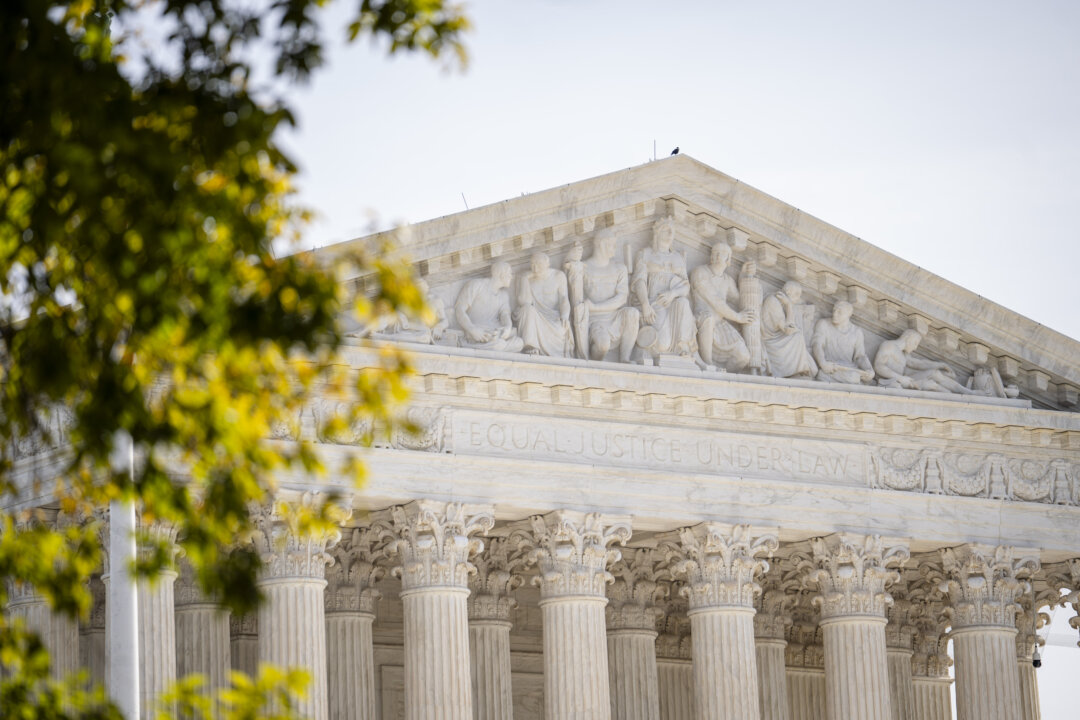
The Supreme Court granted an emergency stay blocking the Federal Communications Commission (FCC) from having to rule immediately on a Democratic challenge to a policy that lets political party committees and joint fundraising committees buy broadcast ads at low candidate rates.
The order keeps the policy in effect through the midterm congressional elections scheduled for Nov. 3.
The ruling in FCC v. Brown was issued late on Oct. 14.
Justices Sonia Sotomayor and Ketanji Brown Jackson said they would have denied the emergency application. They did not explain why.
The federal Communications Act provides that in the 45 days before a primary election and 60 days before a general election, broadcasters must charge legally qualified candidates no more than the lowest rate offered to their most favored customers. The rule does not apply to streaming and social media ads.
Democratic candidates contested an FCC Media Bureau public notice that told broadcasters the lowest unit charge discount had to be given to political party committees and certain joint fundraising committees, not just candidates themselves.
The Democratic candidates argued that the Communications Act requires that the cheap airtime rate be given to candidates, not political parties. They said a party or joint fundraising committee buying an ad is spending its own money, so it should pay the regular rate.
On Aug. 25, a U.S. Court of Appeals for the Fourth Circuit panel voted 2–1 to set aside the FCC notice, finding it unlawful, and holding that the lowest unit charge should be reserved for candidates alone, not parties or joint fundraising committees with non-candidate members. Judge J. Harvie Wilkinson dissented, saying the appeals court should not have reviewed the notice while it was still pending at the FCC and that barring parties from the discount rate restricted political speech on the eve of an election.
The Supreme Court stayed the panel’s Aug. 25 ruling on Sept. 4. The high court said the Democratic candidates challenging the notice asked the Fourth Circuit to intervene before the FCC had even ruled on their request to review the notice. The court also said the National Republican Congressional Committee and the National Republican Senatorial Committee had demonstrated that they would likely experience irreparable harm if a stay were not granted.
Then on Oct. 7, the same Fourth Circuit panel issued a writ of mandamus and ordered the FCC to decide the candidates’ still-pending challenge to the guidance by noon on Oct. 9. Mandamus is an extraordinary, rarely granted court order that forces a lower court, government official, or public agency to take a specific action that they have either refused or failed to do.
The panel held the FCC “delayed agency review in an obvious effort to preclude judicial review prior to the November 3 election.” Wilkinson dissented, saying mandamus was “uniquely inappropriate” given the “timeline of this litigation.”
In the application filed Oct. 8, Solicitor General D. John Sauer said that the Fourth Circuit’s order was “a flagrant abuse” of the mandamus process, and “a baseless effort to circumvent a prior stay entered by this Court.”
This is a developing story and will be updated.
We had a problem loading this article. Please enable javascript or use a different browser. If the issue persists, please visit our help center.