
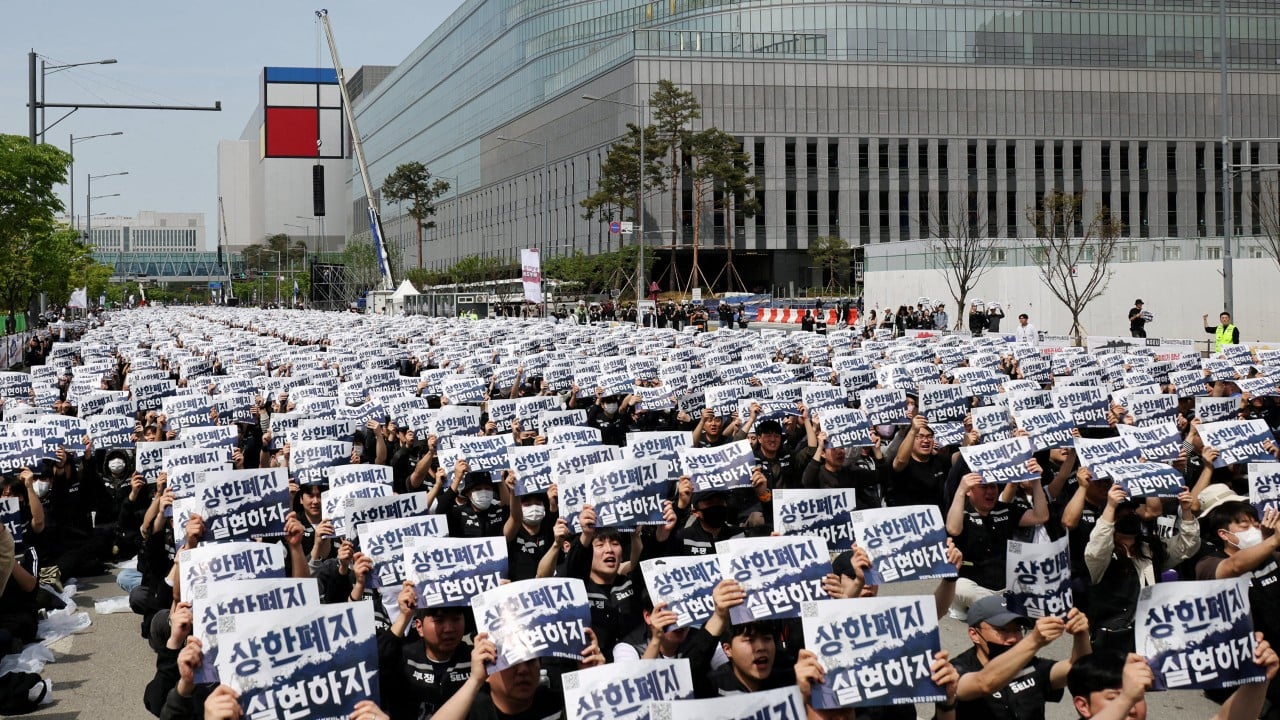
South Korea will pursue all options, including emergency arbitration, to avoid a labour strike at the country’s biggest employer Samsung Electronics and to minimise any damage if one does occur, its prime minister said on Sunday.
The world’s largest memory chipmaker and its South Korean labour union will resume pay talks on Monday with a government mediator, in a move that could ease concerns over a potentially disruptive strike at the tech giant that accounts for nearly a quarter of the country’s exports.
“Just one day of suspension at Samsung Electronics’ semiconductor factory is expected to incur direct losses of as much as 1 trillion won (US$667.68 million),” Prime Minister Kim Min-seok said after an emergency meeting with ministers on Sunday.

“What is more concerning is that a temporary pause on semiconductor manufacturing lines leads to months of inactivity,” Kim said, adding there were worries about economic damage ballooning to as much as 100 trillion won if materials had to be disposed of due to a strike.
Advertisement
An emergency arbitration order, which can be invoked by the labour minister if the country deems a dispute is likely to harm the economy or daily life, immediately prohibits industrial action for 30 days while the National Labour Relations Commission conducts mediation and arbitration.
It has rarely been invoked and would represent an extraordinary step for a union-friendly administration.
Advertisement
The union said on Sunday it would not give in to pressure on arbitration and would not agree to a pay deal should the company offer a less favourable proposal.
Samsung accounts for 22.8 per cent of South Korea’s exports and 26 per cent of the domestic stock market, employing more than 120,000 people and working with 1,700 suppliers, Kim said.