
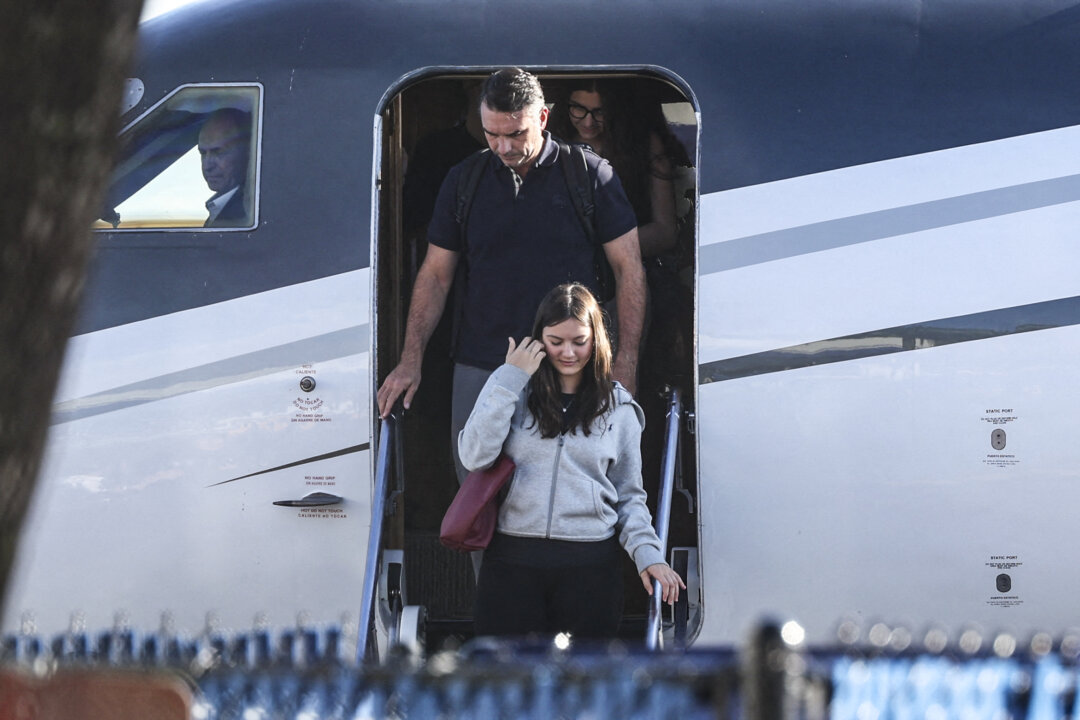
Secretary of State Marco Rubio said Saturday that the United States did not directly help Brazilian presidential candidate Flavio Bolsonaro leave Brazil for the United States after his election loss.
“The U.S. government was not involved directly in any of the moves that were made,” Rubio told reporters in Atlanta on Saturday.
Rubio said Bolsonaro had previously held a U.S. visa and President Donald Trump allowed him entry.
Trump said Oct. 31 that Bolsonaro could remain in the United States indefinitely and criticized Brazil’s election.
Trump said he had no plans to meet with Bolsonaro while he was in Florida.
“No plans to meet, but I think he got treated very shabbily. … He can stay here as long as he wants,” Trump said in a video posted on X. “The election was a disgrace.”
Bolsonaro left after Brazilian authorities ordered him to surrender his passport as part of an ongoing criminal investigation.
Bolsonaro faces an investigation into alleged corruption, including money laundering. Police considered him a flight risk.
Brazilian President Luiz Inácio Lula da Silva won reelection Oct. 25, defeating Bolsonaro in a presidential runoff after Bolsonaro won the first round of voting.
Brazil’s electoral court announced that Lula received 51.8 percent of the vote, finishing nearly 4.4 million votes ahead of Bolsonaro.
Bolsonaro said he will seek to have the results annulled after Supreme Court Justice Cristiano Zanin extended voting by two hours nationwide. Lula requested additional time following reports of problems with buses transporting voters in São Paulo and Salvador.
Bolsonaro’s team also sought a local extension because heavy rains hindered voters in some regions.
The nationwide extension prompted questions about whether polling stations that had already closed could reopen. Bolsonaro alleged that inconsistent implementation resulted in unequal treatment of voters. He also alleged that the electoral court removed his party’s poll watchers from its secure counting room.
“It looked terrible to me,” Trump told reporters of the Brazil election. “I thought it was terrible. I didn’t take sides, but it looked like another rigged election, frankly. It was a terrible look for the world.”
Bolsonaro, the son of imprisoned former President Jair Bolsonaro, led the first round with 47 percent of the vote, ahead of Lula’s 45 percent.
Trump’s ties to Flavio Bolsonaro drew scrutiny during Brazil’s presidential campaign, prompting Democratic lawmakers to accuse his administration of interfering in the election.
Trump hosted Bolsonaro at the White House in May and praised him publicly in June.
Lula’s government denied visas to two State Department officials in July. Some Brazilian officials said they suspected the visit was intended to influence the election and undermine confidence in Brazil’s voting system.
The State Department rejected that characterization, saying the officials planned routine meetings concerning election integrity, religious freedom, and freedom of expression.
In a Sept. 24 letter to Rubio, 30 House Democrats and Sen. Bernie Sanders (I-Vt.) said U.S. tariffs, sanctions, and diplomatic pressure threatened relations with Brazil and its democratic institutions.
The Trump administration accused Brazil of unfair trade practices. A yearlong investigation by the U.S. Trade Representative found that Brazilian policies burdened or restricted U.S. commerce.
Aldgra Fredly, Emel Akan, Chris Summers, and Reuters contributed to this report.
We had a problem loading this article. Please enable javascript or use a different browser. If the issue persists, please visit our help center.