
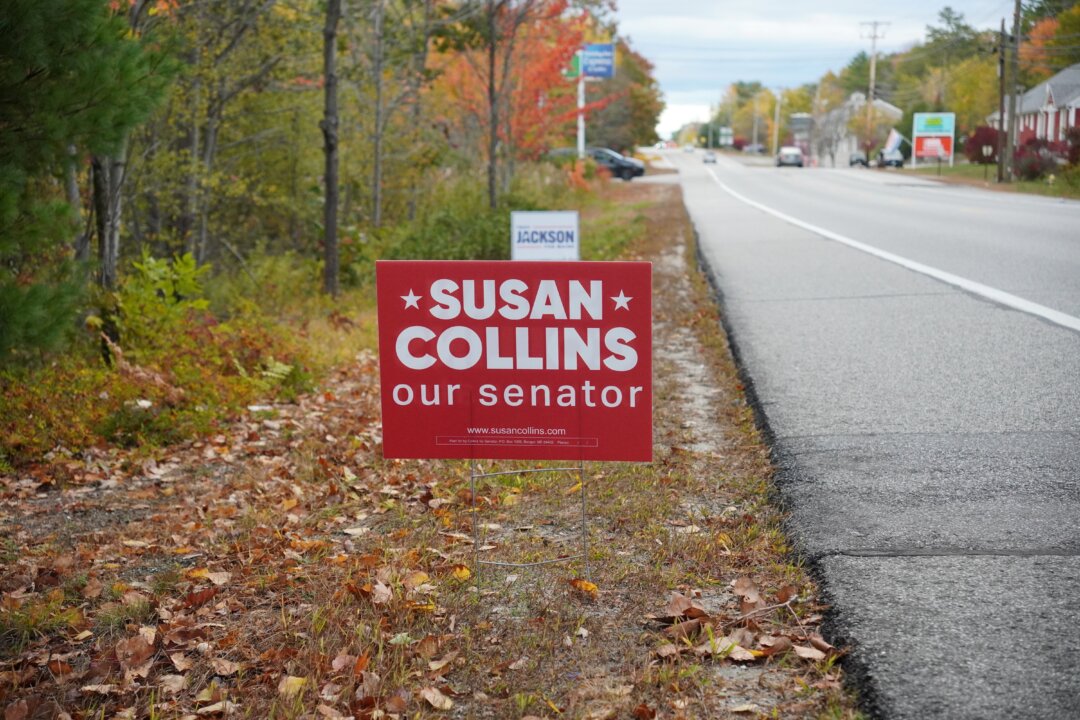
BANGOR, Maine—Across nearly three decades, Sen. Susan Collins (R-Maine) has proven politically resilient, winning repeat victories in a state that hasn’t backed a Republican presidential candidate since 1988.
Since her first Senate win in November 1996, Collins has survived multiple challenges from Democrats, culminating in her 2020 upset victory against Sara Gideon when polls showed the senator down significantly before election day. Then-candidate Joe Biden would win Maine by more than 9 percentage points, and Collins defeated Gideon by more than 8.
But Collins is facing a vastly different political environment in 2026. President Donald Trump’s approval rating is at historic lows, and surveys paint a picture of an electorate that is increasingly blaming him for rising gas and grocery prices after Trump started a war with Iran earlier this year.
Polling indicates that rising dissatisfaction with the administration’s policies and the Republicans in Congress who support them has created an opening for Democrats nationwide. Democrats lead by 8.7 percentage points in Silver Bulletin’s generic ballot advantage, and election forecasts have moved reliably red states like Kansas, Iowa, and Texas into “toss-up” territory.
Democrats need to flip four Senate seats from GOP control while defending Michigan, Minnesota, Georgia, and New Hampshire. Maine, which often backs Democrats statewide in major election cycles, could net them one of the four required if former state Senate president Troy Jackson can do what Collins’s previous challengers couldn’t.
But the race has seen major shakeups on the Democratic side since this summer’s primary. The party’s primary winner Graham Platner dropped out in July after facing allegations of physical and sexual abuse, which he denied. Jackson, who ran and lost in this year’s Democratic gubernatorial primary, was chosen overwhelmingly by party delegates at a statewide convention.
Polls have kept Jackson and Collins relatively close in the final days of the race. Jackson currently leads Collins by 1.4 percentage points in RealClearPolitics’ polling average. As of Oct. 28, a consensus rating by election forecasters has rated Maine a “toss-up” race.
“What keeps Collins competitive is her ability to be perceived as moderate from time to time, win cross-over voters, call out President Trump when she disagrees with him, and to take credit for the hundreds of millions of dollars directly benefiting Mainers throughout her tenure,” Suffolk University Political Research Center Director David Paleologos told The Epoch Times, referring to the Senator’s role as chairwoman of the Senate Appropriations Committee.
Race ‘Shake-Up’
Platner won with more than 70 percent of the vote in the June primary after Gov. Janet T. Mills, a Democrat, suspended her Senate campaign in April.

Several head-to-head matchup surveys put Platner ahead of Collins, including an early June poll from UMass Lowell/YouGov that had the Democrat leading 48 percent to 43 percent.
But after physical and sexual abuse allegations swamped Platner, a Z to A Research poll found that only 24 percent of Maine voters and 23 percent of “Base Democrats” wanted the oyster farmer to stay in the race. Only 21 percent of respondents in that poll viewed Platner favorably after the sexual abuse allegations came to light.
After Platner dropped out in July and state party delegates chose Jackson as their new nominee, Democrats, including their progressive ally Sen. Bernie Sanders (I-Vt.), began quickly coalescing around the former logger.

Many of Platner’s supporters in the primary jumped onto team Jackson. Kirsten, who lives near Portland and asked to go by her first name only, was one of those voters.
She said the race shakeup wasn’t an “ideal process” for Mainers like her who are tired of Collins. But she gave Jackson credit for stepping up to the plate and said he has a track record of supporting “folks who just want to be able to have a job and take care of their families.”
Kirsten said she isn’t interested in partisan politics and cares more about preserving values that matter to her most: shared humanity and taking care of other people.
“[Jackson’s] not polished, and in these days you almost need to be to be, you need to have a lot of money and be polished. But I think that he’s just speaking truth to power, and I appreciate that,” she told The Epoch Times while visiting Freeport.

She’s not the only Maine voter who’s now backing Jackson after Platner dropped out.
John Stewart, a clinical psychologist who lives close to Portland, called the process a “mess” and said, “I wish the hell we had better choices.”
Despite being a Democrat, Stewart said he thinks politics has become too divided and would vote for a “bright, thoughtful” Republican if given the chance.
He said his biggest concerns as a voter are protecting democracy, fighting corruption, and ending the war in Iran. Stewart called the Trump administration’s actions “troubling,” particularly the war causing energy and heating oil prices to rise this year, and sees Collins tied into those policies.
“She’s not a big thinker,” Stewart told The Epoch Times.
An Oct. 27 Marist poll found that personal family finances had worsened for 46 percent of likely voters in Maine. The number increased to 52 percent for independent voters and 59 percent for Democrats.
Policy Battle
Platner and Jackson share strikingly similar policy platforms. Platner ran on opposing corporate corruption, overturning Citizens United, and passing Medicare for All. He also emerged as a strong critic of Israel on the left, backing an end to arms sales, and floated abolishing Immigration and Customs Enforcement.
Jackson has followed roughly the same policy path, although he has focused less on criticizing U.S. support for Israel in the final weeks of the race and has spent more time relating to Mainers, particularly working-class people through the Pine Tree State.


“Susan Collins and her wealthy friends think I’m good enough to buy a cord of firewood from, but I’m not good enough to be the next U.S. senator; they say I don’t have the tools,” Jackson said in a recent campaign video.
“But look, Susan Collins’s tools are super PACs that are bankrolled by billionaires, dark money lobbyists, and shell companies. So look, I’ve never needed tools like that. I like my chainsaw and my splitting maul just fine.”
Collins is running largely on her nearly 30-year history in the U.S. Senate, highlighting her legislative achievements both within her party and across the aisle. She has emphasized her ongoing efforts to secure additional federal funding for Maine through the Low-Income Home Energy Assistance Program (LIHEAP), including a $38 million release earlier this month.
“With home heating oil costs soaring, many Maine families and seniors on limited incomes are facing the prospect of extraordinarily high heating bills this winter. That is why I urged the Administration to expedite the release of this critical assistance, and why I fought so hard to protect and increase funding for LIHEAP,” Collins said in a statement.
At a debate earlier this month, Collins pitched herself as the “most bipartisan member of the Senate” and argued that Mainers need representation that won’t “vote a straight party line” and instead will ask what is best for the state and the country as a whole.

Jackson challenged Collins’s independence and accused her of falling in line with Trump when he needs it the most.
“Senator Collins likes to have it both ways. I mean, the reality is that 100 percent of the time when Donald Trump needs her, Susan Collins is going to be there,” he said at the Oct. 15 debate, criticizing the senator for advancing Trump’s One Big Beautiful Bill Act, which made significant cuts to Medicaid and food stamps.
Some Republican senators facing “toss-up” races, including Ohio’s Jon Husted and Kansas’s Roger Marshall, have not cast a single vote against Trump this term, according to a CQ Roll Call analysis. Collins has voted with the president 92 percent of the time since January 2025, and 90 percent of the time in his first term.
Collins has argued that Jackson would not only fall in line with national Democrats but would also pursue tax increases across the board.
“One thing we need to do is to grow our economy, to not pursue policies as Troy would and as he has here in Maine that impose enormous tax burdens on the people of Maine,” Collins said at the Oct. 15 debate.
Demographic Advantages
In a poll from Suffolk University earlier this month, which had Jackson leading by 2 points, Paleologos said the cross-tabs showed that Collins was polling at 90 percent among all conservative Maine voters. She also scored 78 percent among those who said “religion is very important” and at 60 percent among gun-owning households.
Jackson polled at 95 percent among all Maine liberals, and at 62 percent among those who said they were planning to vote early.

Some analysts have argued Collins is favored to outperform poll expectations again, much like she did in 2020. But Paleologos cautioned against comparing a midterm year to a presidential cycle. Trump’s name is absent from the ballot, for one.
“Maine should be a state that any Democrat should win comfortably because there are far more registered Democrats than Republicans. That means that a Democrat needs only to split independents evenly in order to win,” he told The Epoch Times.
“Here, however, Collins has kept it close and, for the time being, has prevented the race from breaking open even with a disliked president who lost Maine three straight times,” Paleologos added.
Sam, a 29-year-old government employee who declined to give his last name due to his job, said he voted for Collins in 2020 but is considering Jackson this year. He said Collins’s position against congressional term limits was motivating his switch.
“It’s kind of a long time. It’s like longer than almost I’ve been alive,” Sam told The Epoch Times.

But Collins still has reliable support across the Pine Tree State.
Arthur Nickerson, who attended the Oct. 15 debate in Bangor, said one of the biggest reasons he supports Collins is her role as Senate Appropriations Committee chairwoman. It’s a position with significant influence in Congress, as that committee is responsible for funding the government and its programs.
“It takes years to get the respect she has through that committee, and through that committee, she’s bringing a lot of good back to Maine,” Nickerson told The Epoch Times.
For Nickerson, a Jackson victory would mean more taxes and corruption.
“We’ve got a 1.3 billion dollar deficit now. Yeah, we cannot afford to expand that hole,” he said.
We had a problem loading this article. Please enable javascript or use a different browser. If the issue persists, please visit our help center.