
Senate Republicans are seeking to overturn a court ruling that blocked the Trump administration from using a fast-track congressional procedure to dismantle California’s increasingly stringent vehicle emissions standards, which have influenced regulations across a large part of the United States.
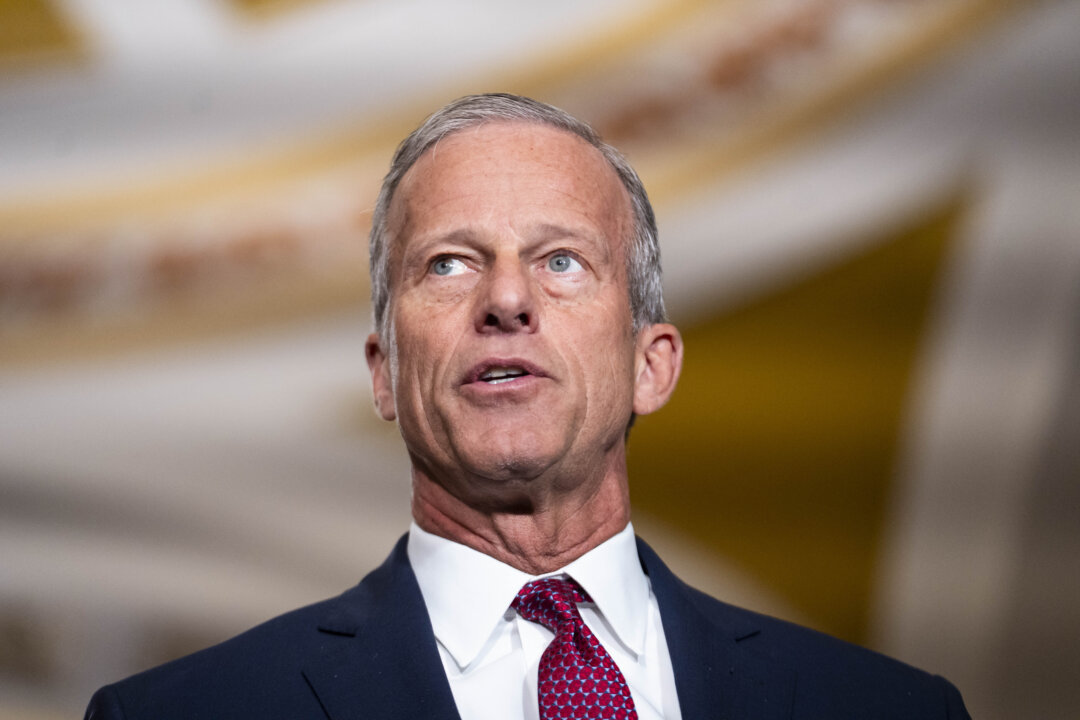
Senate Majority Leader John Thune (R-S.D.), joined by Republicans including Sens. John Barrasso (R-Wyo.), Tom Cotton (R-Ark.), and Shelley Moore Capito (R-W.Va.), argued in a court filing on Nov. 4 that a federal judge overstepped her authority by preventing the Environmental Protection Agency (EPA) from referring California’s emissions waivers to Congress for possible repeal.
The dispute centers on California’s special exemption under the Clean Air Act, which allows it to impose stricter emissions requirements on vehicles than those set by the federal government. Other states can adopt identical standards to California, giving the state’s regulations influence far beyond its own borders.
The EPA did not immediately return a request for comment by The Epoch Times.
Consumer Choice
Capito, who chairs the Senate Environment and Public Works Committee, has previously accused California of “forcing certain states and certain consumers to purchase a vehicle that they may not want or that they can’t find.”
California’s policies can affect what vehicles manufacturers must produce for a substantial part of the American automobile market, far beyond the Golden State’s borders.
Seventeen states and Washington have adopted at least some of California’s vehicle emissions standards. Together with California, they accounted for almost 40 percent of new light-duty vehicle registrations in 2023, according to the Congressional Research Service.
The EPA argues these requirements have driven up vehicle costs and restricted consumer choice by pushing manufacturers toward electric vehicles. The agency also says California’s rules for small off-road engines have made lawn and garden equipment more expensive and impractical for homeowners and small businesses.
‘Backdoor EV Mandate’
Sen. Pete Ricketts (R-Neb.) said last August that California had used its policies as a “backdoor EV mandate,” adding that officials had “even tried to control how we cut our grass.”
In June, EPA Administrator Lee Zeldin announced the agency was sending four California emissions waiver decisions to Congress for review under the Congressional Review Act. The four covered vehicle greenhouse gas emissions standards and requirements affecting small engines used in lawn and garden equipment.
The Congressional Review Act allows Congress to overturn certain agency rules through a simple majority vote, avoiding the 60-vote threshold normally required to overcome a Senate filibuster. It also prevents agencies from reintroducing substantially similar rules without further congressional authorization.

California challenged the EPA’s decision, arguing the waivers were individual administrative decisions rather than regulations and therefore could not legally be subject to the congressional review process.
On Sept. 2, District Judge Beryl Howell granted California a preliminary injunction, finding that the state was likely to succeed in showing that the EPA had acted unlawfully by reclassifying the waivers.
Howell criticized the agency for attempting to treat the waivers as regulations for the purposes of sending them to Congress while simultaneously arguing in court that no such reclassification had taken place.
‘Orwellian Doublethink’
Howell accused the EPA of inviting the court to engage in “Orwellian doublethink,” adding that such ”gamesmanship” undermines honest compliance with the law.
The Republican senators argue that Howell’s ruling improperly interfered with Congress’s authority to determine its own procedures.
The Senate had been expected to vote on the four proposed repeals in September but failed to do so before the relevant parliamentary deadlines expired.
The American Petroleum Institute and the American Fuel & Petrochemical Manufacturers, two trade associations representing the oil and fuel industries, have opposed California’s waiver system and joined the legal challenge against the state.
In her ruling, Howell noted that the organizations’ members had a commercial interest in opposing regulations designed to reduce demand for liquid fuels.
The wider battle over California’s emissions policy has already seen Congress overturn a separate set of waivers in 2025, including one underpinning the state’s plan to phase out sales of new gasoline-powered cars by 2035.
That earlier decision is being challenged separately in court.
We had a problem loading this article. Please enable javascript or use a different browser. If the issue persists, please visit our help center.