
At 9 a.m. on Sunday, Dec. 13, 1981, young Grzegorz Pawlik switched on the television in his family’s apartment in Lodz, Poland, expecting to watch his favorite children’s program, Teleranek. The screen was blank.
The televisions and radios in neighboring apartments were silent, too. Residents gathered in stairwells, speculating about what had happened. An elderly teacher said she had heard strange noises in the streets overnight. Someone suggested that Soviet leader Leonid Brezhnev might have died.
“We almost started to celebrate when we heard a voice coming from our television sets,” Pawlik recalled.
Then, Poland’s communist leader appeared on television, wearing a military uniform and dark sunglasses, to announce martial law. The teacher heard tanks entering the city.
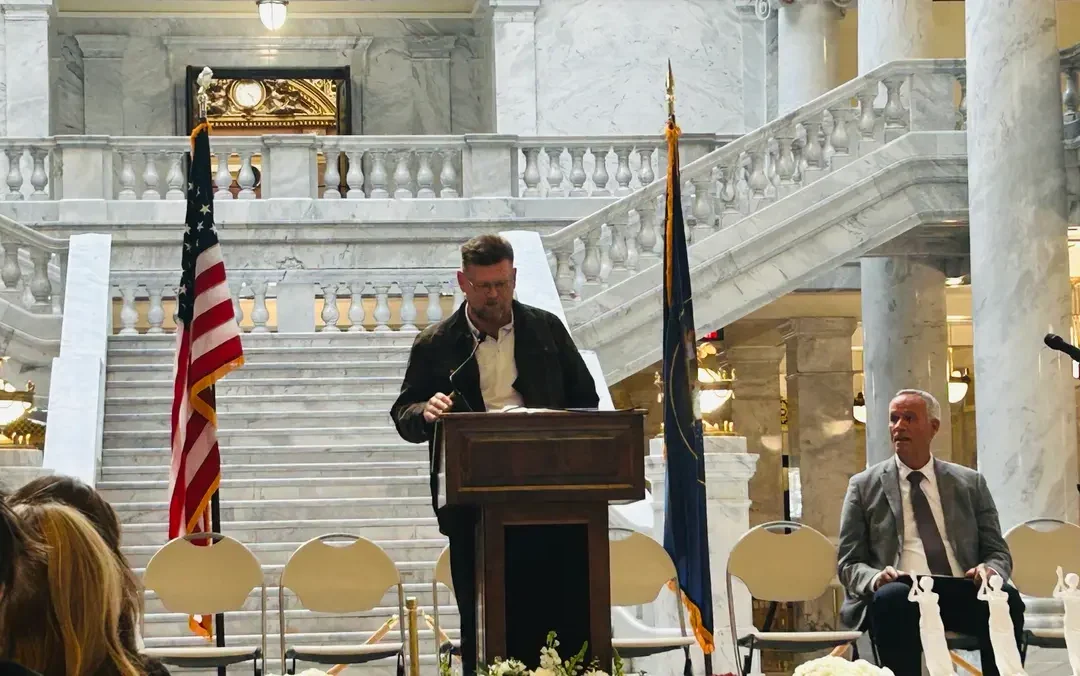
Forty-five years later, on Nov. 6, 2026, Pawlik stood inside the Utah State Capitol’s rotunda, recounting that morning to an audience that included American teenagers.
Now living in Vineyard, Utah, and working for a scented-wax manufacturer, Pawlik leads an ordinary suburban life. But seeing some young Americans embrace socialism worries him.
“I see the current fascination of mostly young people with the idea of Socialism,” he told The Epoch Times.
Pawlik spoke at Utah’s annual Victims of Communism Memorial Day observance, which Chinese teacher Lisa Fifield has organized since 2022. Utah designated Nov. 7 as the commemorative day in 2019 through legislation sponsored by state Rep. Kay Christofferson. This year’s event focused on Poland.
The gathering came amid renewed attention to socialist and communist movements in the West.
In December 2025, Poland’s Constitutional Tribunal ruled that the Communist Party of Poland violated the country’s constitution, which prohibits organizations that are based on totalitarian ideologies. Meanwhile, the Nov. 3 midterm elections in the United States saw six candidates backed by the Democratic Socialists of America win House seats.
Although democratic socialism pursues policies through elections rather than the one-party system Pawlik experienced, the growing visibility of socialist and communist movements has unsettled some who lived under communist rule.
Life Behind the Iron Curtain
After World War II, Poland came under Soviet influence and became a communist state known as the Polish People’s Republic. The Communist Party ruled for more than four decades, controlling the economy, media, and much of public life.
Pawlik grew up in a housing development in Lodz, where the government built hundreds of concrete apartment buildings in the 1970s to house factory workers.
His family lived in Building 333, Apartment 118.
“Every apartment was pretty much the same as the rest,” he said.
Visiting friends meant seeing the same sofas, tables, and inexpensive wall decorations. Families watched the same television programs and received the same version of the news.
Consumer goods were scarce and often poorly made. When available, toilet paper was coarse and dark gray. People repeatedly repaired appliances, while buildings deteriorated under industrial pollution and neglect.
For Pawlik, the decay reflected a broader systemic problem.
Because nearly everything belonged to the state, people felt little responsibility for maintaining it, he said. Workers did the minimum required, with little incentive to improve.
“There was no motivation to work hard or work well because we didn’t like the state; besides, no matter how we worked, we were always going to be poor, and unless we knew someone in the Party or the management, there was no hope for any advancement,” he said.
He also grew up between two competing belief systems. His parents and local priest taught Christian values, while schools and state television promoted Marxism.
Despite government propaganda, American movies gave Polish viewers glimpses of another way of life.
“[The movies] showed families living in houses attached to a garage, driving expensive cars, shopping in stores full of all sorts of products or flying airplanes,” Pawlik said. “We knew what it was like to live in a capitalist country.”
By the late 1970s, resistance to communist rule was growing. The election of Polish-born Pope John Paul II and strikes at the Lenin Shipyard in Gdańsk helped inspire the Solidarity labor movement, which became a major challenge to the government.
That opening ended on Dec. 13, 1981, when the government imposed martial law, arrested hundreds of Solidarity activists, and outlawed the organization. The government introduced curfews, monitored telephone calls, and canceled public performances.
“If you ask any Pole who lived at that time, he or she will tell you where they were that day and how they heard the news of the communists imposing Martial Law,” Pawlik said.
“That day the communist government forever lost the remaining traces of sympathy of the Polish people.”
In 1989, the government agreed to competitive elections following negotiations with Solidarity. The opposition won a landslide victory on June 4. On the same day, thousands of miles away, the Chinese Communist Party (CCP) conducted a violent crackdown on pro-democracy protesters in Beijing’s Tiananmen Square.

‘Who Defines What Is Legal?’
For another speaker at the Utah event, the consequences of communist rule were not merely historical.
Victor, who asked that his surname not be published, came to Utah from China in 2023 on a student visa. He said his decision to leave was driven by his religious beliefs, political views, and experience being detained by police over his participation in an underground Christian church.
“Nominally, you are told that you have religious freedom as a Christian, but there is a condition: You must conduct religious activities in a legally registered church,” he said.
“Then who defines what is legal and illegal? That power is not in the constitution. It is the CCP that decides who is legal and who is illegal.”
Now working in the education system in Utah, Victor believes many young Americans who display communist flags at demonstrations do not understand the ideology’s consequences.
“In some circumstances, young people simply want to treat communism as a fashion accessory,” he said. “But they have no idea how dangerous this ideology is.”

An Unknown History
Other attendees shared concerns that young Americans lack an understanding of communist history.
Alexander Hill, whose family left Poland during the 1970s and 1980s, said relatives had experienced persecution and been forced to abandon their homeland in search of better opportunities.
A book distributed to students at the event, “A Polish Girl in Siberia,” recounts the childhood experiences of a Polish woman deported to Siberia under communist rule. Written in Polish and translated by the author’s American granddaughter, it includes additional historical background.
Fifield, the event’s organizer, told The Epoch Times that students in Utah know very little about communism, a situation she believes has persisted for decades.
She recalled once asking friends whether Mao Zedong was a good or bad person and receiving mixed answers. After studying the history herself, she decided to speak out on behalf of victims of communism in China.
However, she has recently noticed more young people approaching her to express appreciation for the event.
Ninth-grader Grace Poulsen was among the students who had studied the subject in school. Before taking a class on communist history, she said, she knew almost nothing about the ideology.
Now, she said, she would share stories of communist victims with friends who expressed interest in the system. Poulsen and her classmates took turns speaking about First Amendment values and freedom of speech.
Christofferson, the state representative who sponsored the legislation establishing the memorial day, said he had also noticed growing interest in socialism among voters who believe socialism can solve problems. He believes education is essential to addressing the trend.

Winning Freedom Back
Pawlik’s life eventually took him far beyond communist Poland. He joined the Church of Jesus Christ of Latter-day Saints in 1991 and, the following year, came to the United States as a missionary. He later studied at Brigham Young University, where he met his wife.
The couple returned to Poland in 2000 and lived there for 23 years. Pawlik worked for an American company and supported efforts to teach high school students about economics and free markets.
In 2023, he obtained a green card and moved his family back to Utah. He recently completed a novel inspired by his teenage years under communist rule.
If he could, Pawlik said, he would take young Americans attracted to communism back to the Polish People’s Republic for a day.
He would show them polluted rivers, crumbling buildings, and parents with little hope for their children’s futures. He would take them to a concert where they censored songs simply for containing words such as “freedom,” “solidarity,” or “God.”
He would also show them what happened when a student asked an uncomfortable question in history class—two weeks later, the child’s father returned home having lost his engineering job.
“The first lesson is that regaining freedom is much harder than retaining it,” Pawlik said.
After World War II, young Polish resistance fighters continued fighting Soviet domination for years. He said many were inspired by accounts of the American Revolution. Those who survived endured Stalinist repression, and subsequent generations lived under an oppressive system until people finally found the courage to resist.
“All it takes to end this strange trend to follow the crowd is one person with some guts who dares to question his or her peers,” he said.
Pawlik listened from the audience. The students’ speeches gave him some hope that younger Americans were willing to learn about the past.
“Let’s have our eyes wide open and pray that America will never lose its freedoms and become a third world country,” he said.

Lin Yuhe contributed to this report.
We had a problem loading this article. Please enable javascript or use a different browser. If the issue persists, please visit our help center.