
Paraguay has become the 26th signatory to the U.S.-led Pax Silica initiative on artificial intelligence (AI) and supply chain security, drawing praise from a Florida Republican lawmaker who cast the partnership as a way to counter foreign adversaries.
Washington launched the Pax Silica initiative in December 2025 to strengthen cooperation among trusted partners on AI, semiconductors, energy, critical minerals, and advanced manufacturing.
U.S. Under Secretary of State for Economic Affairs Jacob Helberg and Paraguayan Foreign Minister Rubén Ramírez Lezcano formally signed the declaration at a State Department ceremony in Washington on Oct. 23.
“The United States and Paraguay affirmed their commitment to leveraging Paraguay’s critical minerals and hydropower to build super intelligence infrastructure in the Americas,” the State Department said in a statement.
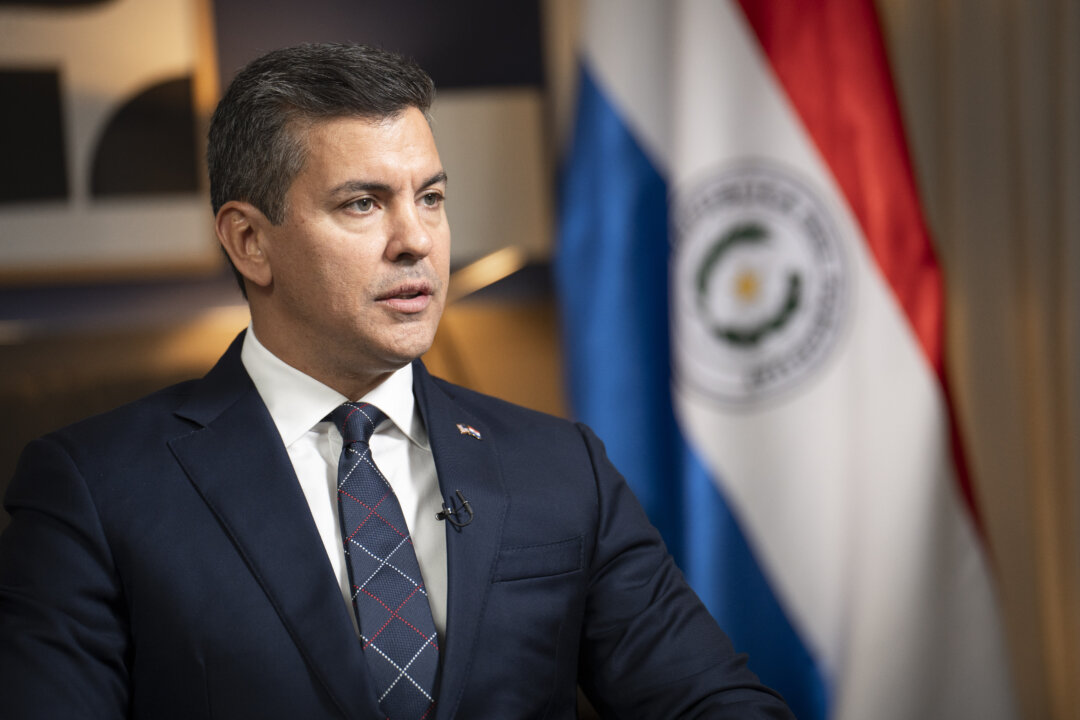
Paraguayan President Santiago Peña said joining Pax Silica would bring “more investment, more jobs and more opportunities for the people of Paraguay,” according to a translation of his Oct. 23 post on X.
“Paraguay no longer views the digital era from the outside: we have moved from being mere consumers of technology to becoming producers,” Peña added.
Rep. Mario Díaz-Balart (R-Fla.), vice chair of the House Appropriations Committee, applauded President Donald Trump and Secretary of State Marco Rubio for their leadership on this issue.
“Paraguay’s signing of the Pax Silica Declaration will also advance secure supply chains for critical minerals and advanced technologies, reducing our dependence on adversaries,” Díaz-Balart wrote in an X post on Oct. 26.
“The U.S. is resetting and right-sizing our relationship with Paraguay—a key regional partner that stands with Taiwan and pushes back against Communist China.”
Helberg has framed the Pax Silica initiative as part of Washington’s effort to build supply chains that can compete with China’s.
“We don’t want to recreate the kind of infrastructure or the kind of projects that China’s doing,” Helberg said during a February discussion at the Center for Strategic and International Studies. “We want to actually leapfrog the infrastructure of yesterday.”
The 26 signatories include the European Union, Germany, Italy, Japan, and Israel, as well as Latin American countries such as Argentina, Chile, Costa Rica, El Salvador, and Panama.
Díaz-Balart also applauded Peña for his leadership, saying that he has been “instrumental in strengthening ties with the U.S. and positioning Paraguay as a strong ally in countering our adversaries in the hemisphere.”
Earlier this month, Deputy Secretary of State Christopher Landau visited Asunción, Paraguay, where he met with Peña and Ramírez. Following the meetings, the State Department announced plans to provide $5.5 million in foreign assistance to bolster efforts to counter terrorist financing and $6.25 million in bilateral security assistance to combat transnational organized crime. The department also announced plans to establish an office of its Bureau of International Narcotics and Law Enforcement Affairs in Asunción, among other initiatives.
The new Asunción office “will strengthen cooperation against drug trafficking, organized crime, and terrorist financing,” according to Díaz-Balart.
“These steps recognize Paraguay’s strategic importance to U.S. national security. Partners who stand with America deserve our support,” he added.
Paraguay stands out among Pax Silica signatories as the only country that maintains formal diplomatic relations with Taiwan rather than China.
Taiwan, meanwhile, participates in the initiative as a non-signatory partner, having endorsed the declaration’s principles in a joint statement with the United States in January 2026.
China has stepped up its efforts to poach Taiwan’s diplomatic allies in recent years. Panama severed diplomatic ties with Taiwan and established relations with China in 2017, followed by El Salvador in 2018.
In January 2025, Peña spoke to EpochTV’s “American Thought Leaders” about Taiwan, with which Paraguay has maintained formal diplomatic relations since 1957. He said he had spoken with leaders of South American countries that switched diplomatic recognition from Taiwan to China and that they had felt misled by Beijing’s false promises.
“Many of them said: ‘Look, I thought five, 10 years ago, that if I was making this [diplomatic] move, my country will be much more developed. And the reality is not that. It’s quite the opposite,’” Peña said during the interview.
During the same EpochTV interview, Peña expressed optimism about working with the Trump administration to boost his nation’s alliance with the United States.
“We have more than 150 years [of] relations between Paraguay and the United States, but I think the next four years will definitely be the highlight,” he said.
We had a problem loading this article. Please enable javascript or use a different browser. If the issue persists, please visit our help center.