
KOROR, Palau—China’s July ballistic missile test in the South Pacific has prompted a largely united response from Pacific leaders in calling for a 24-hour advance notice for future tests.
Palau is hosting the Pacific Islands Forum (PIF) Leaders Meeting, a gathering of 18 Pacific nations, including Australia and New Zealand.
On Sept. 3, Palau, the Solomon Islands, and New Zealand—which serve as the PIF “Troika” as the current, outgoing, and incoming chairs, respectively—held a joint press conference to discuss the forum’s agreements and joint communiqué.
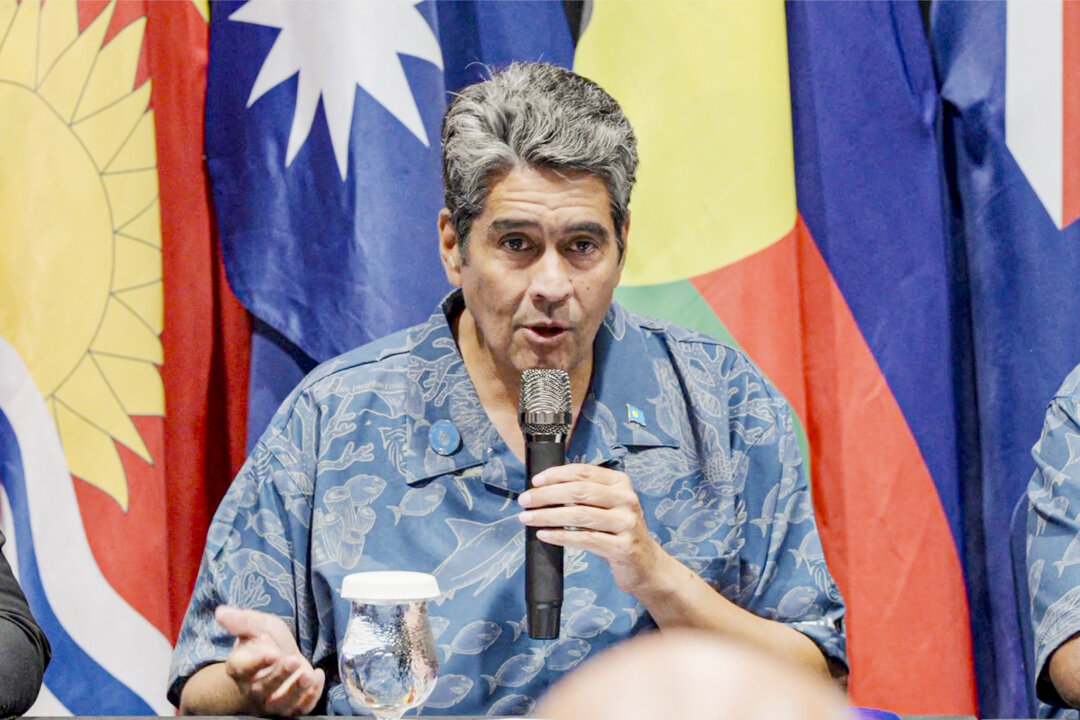
The missile-test advance warning appears as Item 29 in the communiqué, Palauan President Surangel Whipps Jr. said at the press conference, where he read the provision aloud.
“The leaders, in recalling the Blue Pacific Ocean of Peace Declaration, registered concern on the recent intercontinental ballistic missile (ICBM) test, which overflew a number of members without adequate notice,” Whipps said.
“Leaders call on all states undertaking ICBM testing to ensure transparency and reassurance, including through the provision of advance notification of a test at least 24 hours in accordance with international practice.”
Another part of the provision, read aloud by Whipps, calls on states conducting ICBM tests to “respect the sovereignty of the Forum members.”
Whipps then noted that Nauru had dissented from the provision.
Nauru’s dissent illustrates a history of members not agreeing with every provision in PIF communiqués. In 2025, Nauru disassociated itself from the communiqué’s section on the review of the regional architecture.
The divide over the missile test had surfaced earlier, when Pacific Island foreign ministers failed to reach consensus on a joint response at a meeting in August.
At the time of writing, the forum’s secretariat had not released the communiqué.
China’s July missile test came hours after Australia and Fiji signed a major defense agreement, marking Fiji’s first formal defense alliance. It was also China’s first known ballistic missile launch into the Pacific since September 2024.
Speaking to reporters after the press conference, Whipps said there was no need to mention China by name.
“It’s clear what the statement says. It says anybody firing missiles should do it in a transparent manner [and] give proper notice,” Whipps said. “Nobody should be firing without proper notice, and what happened was not acceptable.”
China’s July missile launch drew condemnation from Australia, Japan, and the United States.
“At a time when the United States is working harder than ever to prevent nuclear proliferation, China is doing the opposite,” U.S. State Department spokesperson Tommy Pigott said in a statement at the time.
Earlier on Thursday, Whipps and Australian Prime Minister Anthony Albanese held a joint press conference. Albanese rejected comparisons between U.S. and Chinese missile tests in the Pacific, saying China’s July launch was “different” and that the United States “gives proper notice” for its tests.
“We’ve made our position very clear, which is [that] we are opposed to the actions that China took. We made an immediate response to that. It’s a clear response. It’s unequivocal, and China has certainly heard that message,” Albanese said.
Whipps echoed Albanese’s remarks before adding, “We don’t want our backyard, our homes to be threatened, and really, disrespected.”
The Chinese regime’s influence in the region has also been a prominent theme at this year’s forum, alongside discussions involving Taiwan.
In mid-August, Beijing issued a travel warning discouraging Chinese tourists from visiting Palau over concerns about theft and robbery, despite Palau being one of the region’s safest countries.
In response, the U.S. Embassy in Koror stated that Beijing was attempting to “weaponize tourism to coerce Palau.”
Palau’s presidential office thanked the U.S. Embassy for its statement, saying Palau “remains a safe, peaceful, and welcoming destination for visitors from around the world,” according to a Facebook post on Aug. 28.
In an exclusive interview with The Epoch Times, Whipps said he pushed back against a Chinese diplomat who tried to pressure him not to invite Taiwan to the forum.
This year, Taiwan, a development partner of the forum, returned to the meeting in Palau at Whipps’s invitation, after being excluded from last year’s meeting in the Solomon Islands.
Palau—along with the Marshall Islands and Tuvalu—is one of Taiwan’s three remaining diplomatic allies in the Pacific, while the Solomon Islands switched recognition from Taiwan to China in 2019 and Nauru followed in 2024.
We had a problem loading this article. Please enable javascript or use a different browser. If the issue persists, please visit our help center.