
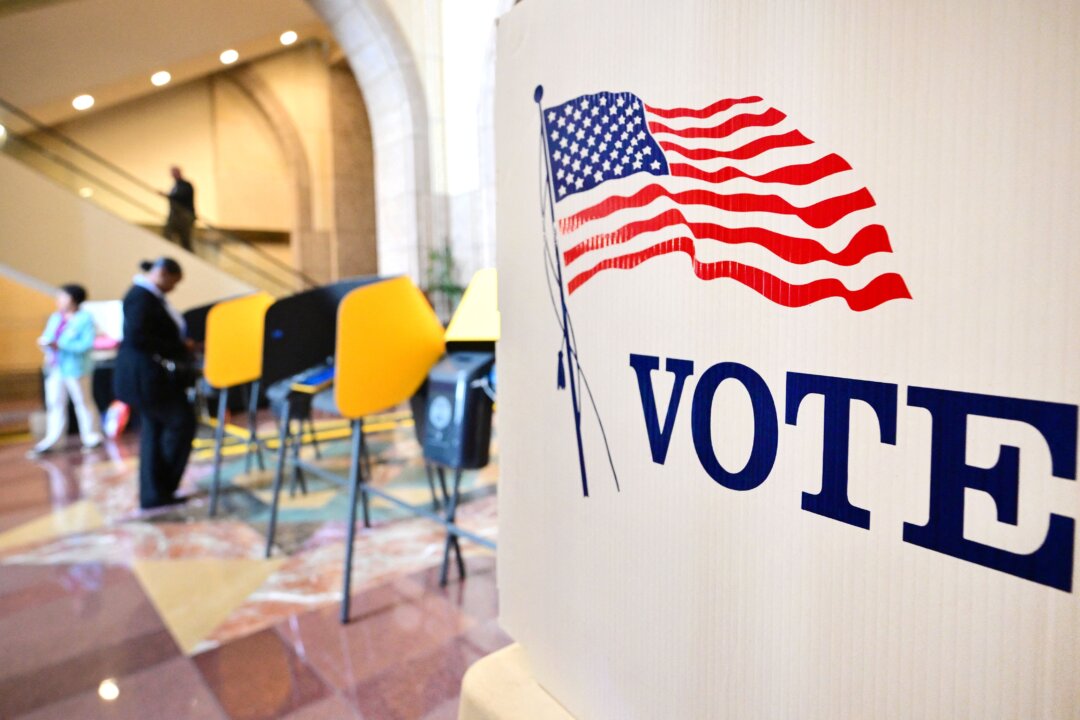
More than 27 million Americans have already cast ballots ahead of the Nov. 3 midterm Election Day, according to new data posted by the University of Florida’s Election Lab.
As of Oct. 25, 27.7 million have voted early across the United States in 47 states, the figures show. The only states to not report data are New York, New Hampshire, and Alabama.
Of that figure, 13.5 million in-person early votes have been cast, and more than 14.2 million mail-in ballots have been returned. So far, 59.4 million mail-in ballots have been requested.
In places where party affiliation is reported, 6.17 million early voters were registered as Democratic, 4.19 million were registered as Republican, and 3.2 million had no or a minor party affiliation, the figures show.
A slim majority, or 50.8 percent, of those who voted early or returned a mail-in ballot were aged 65 or older, according to the lab. Around 34.7 percent were between ages 41 and 65, 10.1 percent were between 26 and 40, and 4.4 percent were between 18 and 25. Those figures encompass states and jurisdictions where age was reported.
Around 53.9 percent of early voters are women, and 44.4 percent are men, the data show, with the sex of around 1.7 percent marked as unknown.
More than half of the people who have already cast ballots are white, at 59.6 percent, according to the lab. Another 28.3 percent are black, 2.7 percent are Hispanic, 1.9 percent are Asian, 0.5 percent are Native American, and 7 percent are other, multiple, or unknown.
What is at stake during the midterm elections is whether Democrats or Republicans control the House of Representatives, Senate, or both. The GOP currently has small majorities in each congressional chamber.
Republicans hold a 218–214 majority in the House, where there are two vacancies and one independent who caucuses with Republicans. Democrats must achieve a net gain of four seats to win control.
Democrats also are fighting to win the Senate, where Republicans hold a 53–47 majority. The minority party must net four additional seats to gain control. Ten races, including those in Maine, Ohio, North Carolina, Iowa, and Georgia, could decide the outcome.
In recent years, midterm elections sometimes produced major shifts in the political landscape in Washington. For example, Republicans netted 63 additional House seats during the 2010 midterms under the presidency of Barack Obama.
Democrats lost their majority in that year, but in the Senate during that contest, Democrats held onto control despite losing six seats.
Democrats returned the favor in 2018 in the House, with Trump in the White House during his first term. They gained a net total of 40 House seats, but lost a net two Senate seats.
There are also races for governor in 36 states as well as voting in 46 states for seats in state legislatures.
Counted among those who voted early is President Donald Trump and First Lady Melania Trump, who both cast their ballots in Palm Beach County, Florida, on Saturday. While Trump has voted early in recent elections, he has been a critic of widespread mail-in ballots.
After he voted, the president was asked if he voted for Republicans, and said “very much so.”
Trump has embarked on a series of campaign rally-style events in a number of states to boost Republican candidates, telling voters to pretend he is on the ballot. He has also promised a $5,000 “Trump dividend” payment that he announced last month at a rally in Dallas that would be sent only if the GOP retains Congress.
Last week, he told reporters that he would “veto everything” sent by Democrats if they win Congress. “I think the Republicans are going to win—but if there was gridlock, what happens is I veto everything, and then the Democrats come and want to make a deal,” he said.
When he was pressed further, Trump responded by saying presidents have historically engaged in a strategy of “veto, veto, veto,” prompting the opposition party to seek to “make a deal.”
Reuters contributed to this report.
We had a problem loading this article. Please enable javascript or use a different browser. If the issue persists, please visit our help center.