
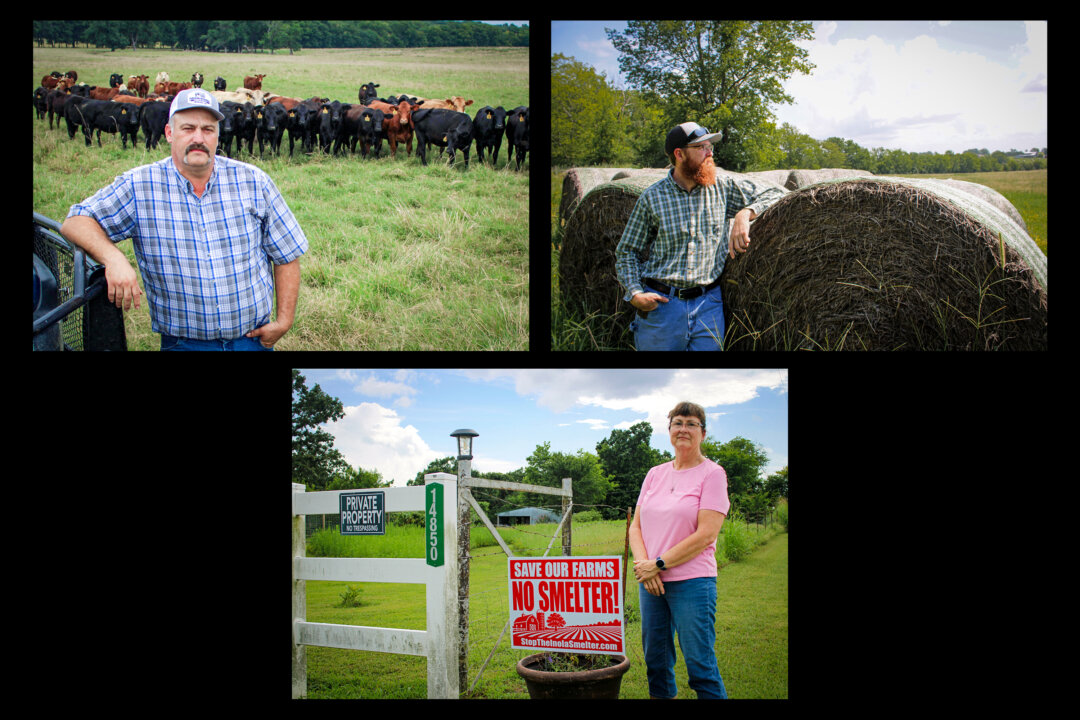

INOLA, Okla.—Carl Day’s family has raised cattle and hay in Rogers County since before Oklahoma was a state. Bluestem prairie hay has been an economic mainstay for so long that the small river port town of Inola, east of Tulsa, bills itself the “Hay Capital of the World.”
But Day and many of his neighbors are concerned that an aluminum smelter planned for the Port of Inola may destroy their livelihoods and the pastoral life they enjoy.
The $4 billion primary aluminum smelter will be the first new smelter built in the United States in almost 50 years. It’s part of a $200 billion package of commercial deals between the United Arab Emirates and the United States announced on May 15, 2025.
Oklahoma Primary Aluminum will be operated by Emirates Global Aluminum, based in the UAE, and Chicago-based Century Aluminum. Emirates Global will own 60 percent of the plant, while Century will own 40 percent.
The plant’s projected annual capacity of 750,000 metric tons will make it the largest primary aluminum production plant ever built in the United States, more than doubling U.S. aluminum production, according to the Oklahoma Department of Commerce.
It’s expected to create up to 4,000 construction jobs when work begins later this year and 1,000 direct jobs once the smelter is in operation, the Oklahoma Department of Commerce said. The direct jobs will have an average annual salary north of $80,000, according to a report issued by Tulsa Ports, the town of Inola, and the Center for Economic Development Law in Oklahoma City. That’s approximately $11,000 more than the current average annual salary in the state, according to data from the Bureau of Labor Statistics.
An Economic Score
According to the town of Inola report, when all is said and done, the project could represent a total initial investment of more than $5 billion.
John Budd, Oklahoma Department of Commerce CEO, said the project is a major economic score for the state of Oklahoma.
“This will be basically a 10 percent bump to the GDP of the state on the order of $26 billion,” he told The Epoch Times.


Day says he isn’t opposed to economic development. However, there are many small, family-owned farms, ranches, and other businesses that will have to deal with the smelter’s potential environmental impact.
He visited a Century Aluminum smelter in Kentucky where he took soil and grass samples, which he sent to Tulsa’s Accurate Labs and Training center. According to the lab report, which The Epoch Times reviewed, the grass samples showed high levels of fluoride— an average of 669 milligrams per kilogram.
According to the lab report, livestock eating those samples would be at risk for chronic fluorosis, a debilitating condition that can result in “permanent dental and skeletal damage, impaired growth, lameness and poor welfare.”

The report states the maximum acceptable level for grazing calves is 40 milligrams per kilogram.
“I’m concerned that the people making the decisions only see the big numbers that are being proposed, economic growth. They are not looking at the potential damage that it could be doing to the already existing businesses here,” Day told The Epoch Times.
Modern Technology
A representative with Emirates Global Aluminum said the more-than-50-year-old U.S. smelters can’t be fairly compared to the facility planned for Inola.

Simon Buerk, a senior vice president for corporate affairs at Emirates Global Aluminum, said the company has two state-of-the-art smelters in the United Arab Emirates that use technology that didn’t exist when the Kentucky smelter was opened.
One of the company’s smelters is in Jebel Ali, UAE—a prosperous port, industrial center, and free trade zone that hosts many foreign manufacturers on the main highway between Dubai and Abu Dhabi.
According to Google Earth images provided by Buerk, the plant is across the highway from shopping areas, employee housing, and a high-dollar gated community.

Buerk said Emirates Global Aluminum monitors the emissions around its plants, and that at .06 micrograms of fluoride per cubic liter of air, they are consistently below the World Health Organization’s recommended limit of one microgram.
He said modern air scrubber technology makes the smelting process cleaner and more cost efficient. Fluoride is a necessary part of the smelting process, Buerk said in an email to The Epoch Times.
Old air scrubbers released some of the fluoride to the atmosphere, but new scrubbers run the emissions through a series of filter bags that gather the fluoride particles to reroute them back into the smelter, he said.
“A good analogy for this is the inside of your vacuum cleaner,” Buerk stated in an email.

But some local residents aren’t convinced.
Steven Flathers operates a 100-acre ranch. He is leery of the foreign owners, and he doesn’t accept the rosy employment predictions. Overall, he said, he is concerned that once the smelter is in place, he will be forced to give up the agrarian life he loves and work in the smelter, or move.

He said the state, or the aluminum interests, should provide some sort of guarantee for cattle and hay producers who may be put out of business by the smelter.
“I love living here, but if I couldn’t ranch and farm, I don’t know why I would continue living here. But also, the cost of moving is prohibitive,” Flathers said.
President’s Plan
The cattlemen say they are in an uphill fight against an adversary bigger than state economic development officials.
They are taking on companies backed by the White House.

The Trump administration views the smelter as vital to the president’s plan to reshore and revitalize American industry. President Donald Trump touted the project during a roundtable discussion with mining industry CEOs on Aug. 7.

“We’ve announced the construction of the first new aluminum smelter since 1980,” Trump told the miners. “It’s going to be a big one.”
According to Trump, previous administrations drove companies offshore through environmental regulations and fiscal policies that could not compete in markets manipulated by foreign governments, especially the Chinese Communist Party.
Secretary of Commerce Howard Lutnick said those days are over.
“We lost critical minerals not because of free markets [but] because of foreign subsidies, market distortion, export restrictions, stockpiling,“ Lutnick told the miners during the roundtable. ”These adversaries have just cheated their way to market strength, and we are back, and we’re fighting it. So, we’re not going to accept dependence on foreign supplies.”
Since the smelting process was developed in 1888, aluminum has become ubiquitous. The light, strong, malleable metal can be found in everything from fighter jets and missiles to pickup trucks, electric appliances, and residential construction.

However, those in the industry say most of the country’s aluminum needs are fulfilled by imported metal.

Industrious Labs, which researches ways to increase industrial production in environmentally friendly ways, said the United States uses 5 million metric tons of aluminum annually. Of that, 670,000 metric tons are produced domestically, according to the World Population Review.
The rest is imported, with Canada being the largest supplier.
Matt Aboud, senior vice president of strategy and business development for Century Aluminum, said many industries would grind to a halt and national security would be compromised if the supply of aluminum were severed.
For example, Aboud said the Ford F-150 pickup truck uses more aluminum than any vehicle in its class. Production of that vehicle would halt without aluminum—but this problem affects not just automotive production.

“What happens when we can’t produce that Apache attack helicopter? What happens when we can’t … provide the aluminum powder [for] rocket propellants? Then the military is compromised,” Aboud told The Epoch Times. “So that’s the thing that we can’t have.”
Opposition
Oklahoma Attorney General Gentner Drummond opposes the smelter. Drummond filed a lawsuit in state court last June which was later transferred to a U.S. district court and then moved back to state court in September—a decision Drummond lauded.
The attorney general is asking the court to issue a permanent injunction against the smelter based on environmental concerns, and the fact that the majority owner will be a foreign government.

Drummond pointed out that Century Aluminum plants in Kentucky and South Carolina have been fined for environmental infractions. With most of the plant owned by foreign interests, Drummond said it’s possible that once the smelter is in operation, local complaints will fall on deaf ears.
“They’re big polluters. They say, ‘Trust us, we’ll take care of you,’ and then they don’t,“ Drummond told The Epoch Times. ”Now, you couple that with a foreign majority ownership, [and[ my concern is they’ll just flip their nose at us.”
Day said he is concerned that the people of Rogers County are being asked to sacrifice their main industry to benefit another.

The lifelong cattleman said that at any time he has up to 3,000 cattle grazing on several thousand acres of pasture around the county. He said that in 2025, his cattle business brought in about $8 million, and that his concerns are not about the environment as much as they are about business.
“But this whole deal to me has been a property rights issue from the start,” Day told The Epoch Times.
Day said he is fine with the company producing fluoride on its property. He just wants Oklahoma Primary Aluminum to be held to the same standard as farmers and ranchers.
“I am liable if I spray a herbicide on my property and it drifts off because of the wind, and it kills somebody’s garden, somebody’s trees,” Day said.
Homeowner Christine Roam agrees with Day and Flathers, though she doesn’t own any cattle or hay.
The former Los Angeles County sheriff’s deputy and her husband left California in 2019 looking for their retirement spot. They found it in Rogers County.
“Oklahoma was a very wonderful place to retire to,” Roam told The Epoch Times.

Sitting in her new home’s kitchen, Roam is concerned that the smelter may ruin the pastoral life she has come to love.
“They say smelters have a life expectancy of about 30 years. It’s going to spew its pollution, and then what? It’s going to be done, and we’re left with the scar,” Roam told The Epoch Times.
“We’ll never get that land back. It’ll never go back to farming and ranching.”

In an email to The Epoch Times, the White House said left-wing activism had “done enough damage to America’s industrial base.”
“The Trump administration is committed to reshoring critical manufacturing and strengthening our national and economic security,” it said.
We had a problem loading this article. Please enable javascript or use a different browser. If the issue persists, please visit our help center.