
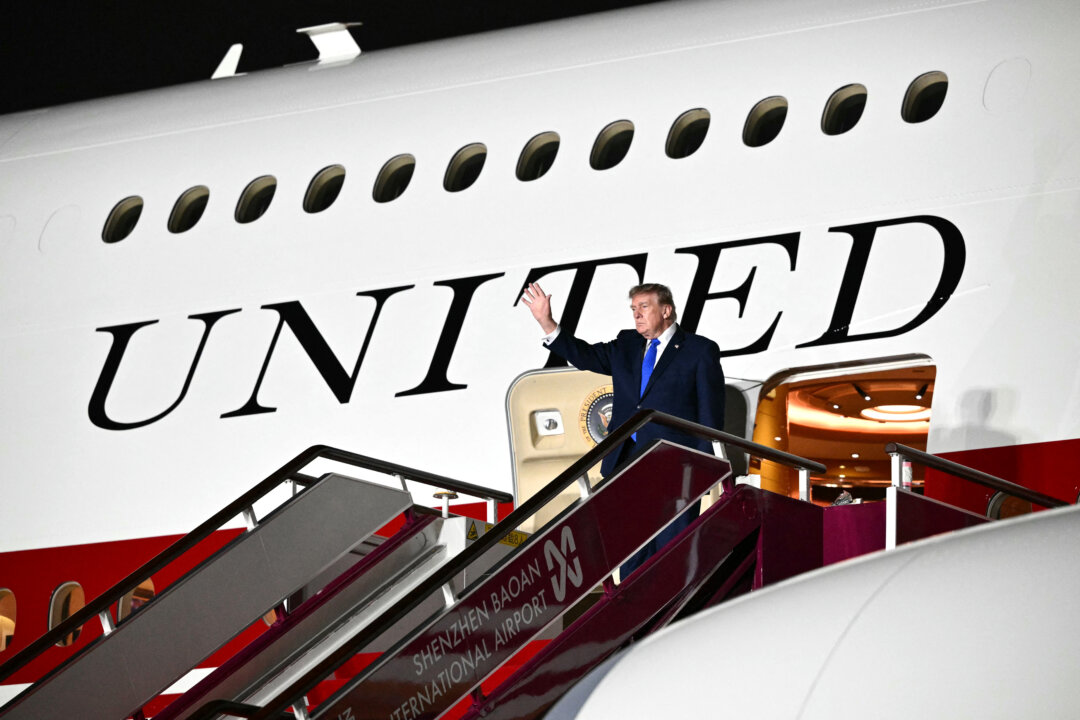
President Donald Trump wrapped up a three-day visit to Asia on Nov. 19 with stops in the Philippines and China, a trip he called “highly consequential.”
While in Shenzhen, China’s tech hub, Trump held a historic trilateral meeting with Chinese leader Xi Jinping and Russian President Vladimir Putin. Throughout the trip, Chinese media censorship remained a constant concern for American journalists.
Trump announced a White House news conference for Nov. 20 to share details about his trip and trade deals with Thailand, the Philippines, and other countries.
Here are the key takeaways from Trump’s visit.
Trilateral Summit Ends With Pledge for Dialogue
Trump, Xi, and Putin held their highly anticipated three-way summit on Nov. 19 on the sidelines of the Asia-Pacific Economic Cooperation gathering in Shenzhen and agreed to a four-point peace declaration.
The meeting took place at Kylin Villa, a secluded government reception complex that hosts senior Chinese Communist Party (CCP) officials and foreign dignitaries.
Following the meeting, the three leaders issued a joint statement, agreeing to start dialogue about lowering nuclear risks and preventing the proliferation of nuclear weapons.
“The three heads of state reaffirmed that a nuclear war cannot be won and must never be fought,” the joint statement reads.
However, the leaders didn’t announce concrete plans for arms control or stockpile reduction.
The Stockholm International Peace Research Institute reported that China has nearly 620 warheads, while the United States has 3,700 and Russia has 4,400. China’s arsenal is growing faster than any other country’s, according to the institute’s latest assessment.
The three leaders also called for reform of the United Nations to ensure that the organization better aligns with its core mission, according to the joint statement.
All three countries also agreed on the importance of immunity for state officials, while calling on the International Criminal Court and other similar bodies not to abuse their jurisdiction.
The leaders also said they plan to boost the production and supply of refined petroleum products.
Before the summit, Trump said he would raise the topic of the Iran war with the two leaders. China and Russia have maintained close ties with the regime in Tehran. Before the U.S. naval blockade cut off Iranian crude exports, China was Tehran’s top trading partner, taking in nearly 90 percent of its oil.
US Reporters Ordered to Hand Over Phones
One detail that made headlines on Nov. 19 was that reporters traveling back to the United States with Trump were told by U.S. staff to surrender their phones just before boarding Air Force One. While journalists are not typically required to hand over their devices, the White House appeared to take precautions to reduce the risk of surveillance, hacking, or data theft by Beijing.
Similar security measures were implemented during Trump’s visit to China in May. Before departing on that trip, White House staff collected all badges, pins, and burner phones and discarded them in a bin at the bottom of the stairs before reporters boarded the plane.
‘No Freedom of the Press Here’
A press crackdown stole the spotlight during the historic trilateral summit.
Chinese officials barred Bloomberg TV reporter Annmarie Hordern from covering the trilateral summit in Shenzhen after she shouted a question at Trump during an earlier event.
The incident happened on Nov. 19 during the bilateral meeting between Trump and Xi, where Hordern asked the U.S. president whether former Nvidia CEO Jensen Huang had been disloyal to the United States. Neither leader responded to the question.
Later, Chinese officials blocked Hordern from the U.S.–China–Russia summit, calling her behavior rude. They also rejected White House efforts to grant her access.
During the China visit, White House reporters frequently witnessed censorship by the CCP.
“There’s no freedom of the press here,” said Fox News reporter Bill Melugin while reporting live from Shenzhen.
He said that in the past few days, whenever another network made critical comments about China, the CCP, or Xi, the broadcast feed was cut and replaced with color bars until the segment was over.
The CCP censored CNN’s live broadcast feed inside China on Nov. 17 when the network reported on alleged Chinese espionage targeting Huang.
Epoch Times staff were also denied visas to enter China to cover Trump’s visit as part of the White House press corps.
Putin Leaves Trump Meeting in ‘Excellent’ Mood
Trump held a bilateral meeting with Putin on Nov. 19 before the trilateral meeting on the sidelines of the Asia-Pacific Economic Cooperation summit in Shenzhen.
“We’ve had a great relationship for many years,” the U.S. president told reporters at the beginning of the meeting. “We knew each other for a long time, and I think a lot of wonderful things can come out of this, or at least start.”
The two leaders discussed the war in Ukraine and bilateral relations during their nearly 40-minute meeting, Kremlin foreign policy adviser Yuri Ushakov told reporters, according to Russian news agency TASS.
Putin left the meeting in an “excellent” mood, Ushakov said.
The United States mediated working-level peace talks between Ukraine and Russia on Nov. 10 and Nov. 11 in Abu Dhabi, United Arab Emirates, to address postwar security concerns and territorial issues.
Speaking after the Shenzhen summit, Putin said Kyiv and Europe are not ready to make compromises to end the war in Ukraine.
Trump Avoids Insulting Beijing
Before departing for China, Trump signaled that he might raise allegations of Chinese espionage targeting U.S. tech giant Nvidia.
Speaking to reporters on Nov. 16, Trump struck a cautious tone.
“We’re heading to China—I don’t think you want to insult China just before you get there,” he said.
It remains unclear whether Trump pressed Xi on the spying allegations.
In a Nov. 18 interview with Fox News, Trump confirmed that the two leaders discussed artificial intelligence over dinner in Shenzhen, though he said he largely avoided the controversy involving Nvidia and Huang.
“We did not discuss it,” Trump said. “I might have referred to it just briefly because it’s such a tragedy. It’s a tragedy. He’s such a brilliant man.”
An alleged affair between the AI developer’s cofounder Huang and a woman whom a New York Times report alleged to be a Chinese spy has heightened national security concerns. Huang stepped down on Nov. 12 after admitting that he “was unfaithful” to his wife.
We had a problem loading this article. Please enable javascript or use a different browser. If the issue persists, please visit our help center.