
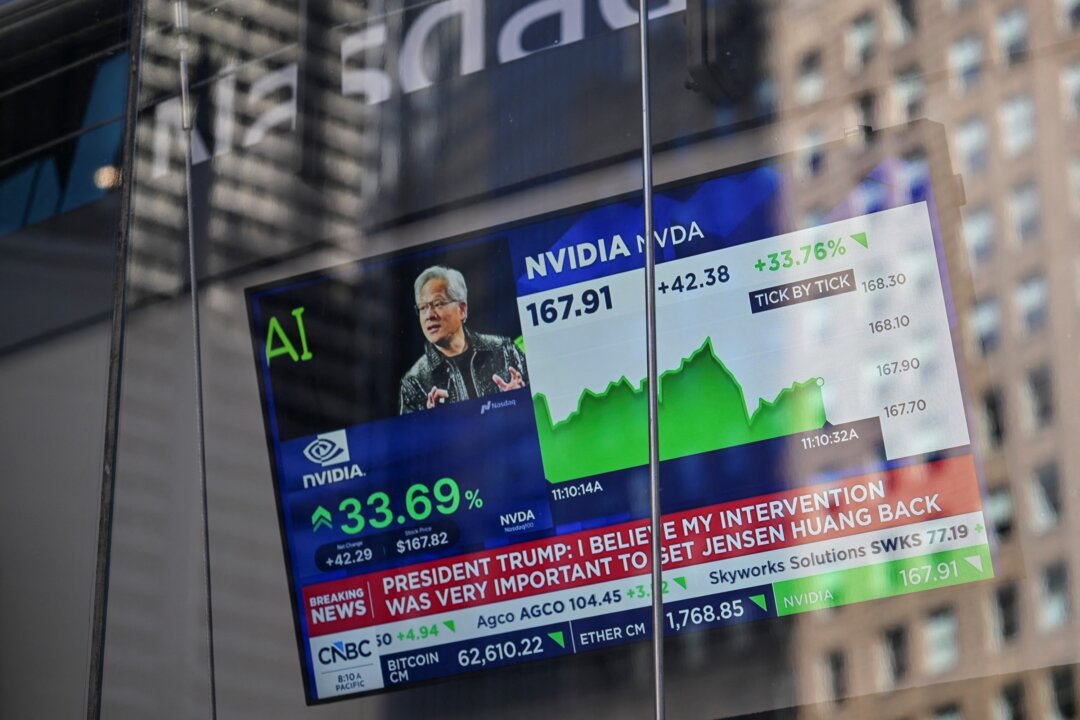
The reinstatement of Nvidia founder Jensen Huang as CEO reflects Washington’s determination to protect U.S. leadership in AI, even as U.S. authorities are still investigating allegations related to Huang that have raised national security and corporate accountability concerns, according to analysts.
Analysts told The Epoch Times the decision underscores Nvidia’s strategic importance to the American economy and its tech competition with China, but also raises questions about the extent to which political and market pressures can influence corporate governance.
President Donald Trump confirmed on Nov. 23 that he had personally intervened with Nvidia’s board to encourage Huang’s return. Trump said the board had sought assurances from the government about potential national security risks and that officials had provided them based on available information.
Trump also said losing Huang could pose a greater threat to the United States than allowing him to remain at the helm of Nvidia, expressing concern that Chinese companies might try to recruit him.
Huang had resigned as Nvidia CEO on Nov. 11 after admitting to being unfaithful to his wife, after media reports, including those from The New York Times and Financial Times, alleged he had an affair with a suspected Chinese spy.
Nvidia has become central to the global AI industry, with its advanced processors and CUDA software ecosystem underpinning much of the computing infrastructure used by major technology companies and data center operators.
Shen Ming-shih, a research fellow at Taiwan’s Institute for National Defense and Security Research, told The Epoch Times that Huang’s reinstatement would have a “very positive” effect on the stock market and AI industry.
Shen said Washington needs to stabilize Nvidia, the broader AI sector, and financial markets to prevent further economic disruption. Otherwise, he warned, the fallout “could cause major economic turmoil or even a financial crisis.”
Wang He, a U.S.-based China current affairs commentator, told The Epoch Times that the United States needs business leaders such as Huang, who can bring together technology, capital, and market resources, to maintain its advantage in the competition with China.
Tighter Controls on China’s Access to AI Computing
Huang’s return does not signal a relaxation of U.S. restrictions on China’s access to advanced semiconductors, the analysts say. Rather, they expect Washington to pursue two objectives simultaneously—strengthening its domestic AI industry while limiting Beijing’s access to critical computing technology.
The U.S. Department of Commerce’s new semiconductor export rule, which took effect on Nov. 19, extends restrictions to certain overseas data centers providing substantial computing capacity to companies headquartered in China and Macau. It also introduces licensing requirements for advanced semiconductor exports to Indonesia, Malaysia, Singapore, Thailand, and Brazil to reduce the risk of technology being diverted to restricted destinations.
The measures address potential loopholes in existing controls, including the use of third-country intermediaries to access computing resources.
Shen said that the United States is likely to strengthen oversight of advanced chips and critical tech to prevent the Chinese Communist Party (CCP) from obtaining them through intelligence networks or third parties. He added that U.S. authorities would continue investigating potential intelligence concerns but would not directly link Huang to CCP espionage without concrete evidence.
Wang said Huang’s reinstatement and tighter restrictions on China’s access to chips were not contradictory.
For Chinese tech companies, further restrictions could increase the cost and difficulty of obtaining advanced computing resources needed to train large AI models. China’s domestic semiconductor industry has yet to develop an equivalent high-end chip supply chain, potentially widening the technological gap between the two countries.

National Security Concerns Remain
Despite the board’s decision, the national security concerns surrounding Huang remain.
The controversy emerged following reports of Huang’s relationship with Chinese businesswoman Alice Huang, a former executive at Singapore-based Megaspeed, which has been investigated by U.S. and Singaporean authorities over allegations that it helped divert U.S.-restricted semiconductors to China.
The Department of Commerce and Department of Justice confirmed on Nov. 17 that the investigation into Megaspeed began in 2024 and that Nvidia had been asked to provide records concerning direct or indirect sales to the company. Authorities said the investigation is ongoing.
Nvidia has also established a board-level National Security and Export Control Oversight Committee to oversee trade compliance and national security risks. The company said an independent investigation into reports that Huang had been the target of a foreign intelligence effort would continue.
Li Haoyue and Yi Ru contributed to this report.
We had a problem loading this article. Please enable javascript or use a different browser. If the issue persists, please visit our help center.