
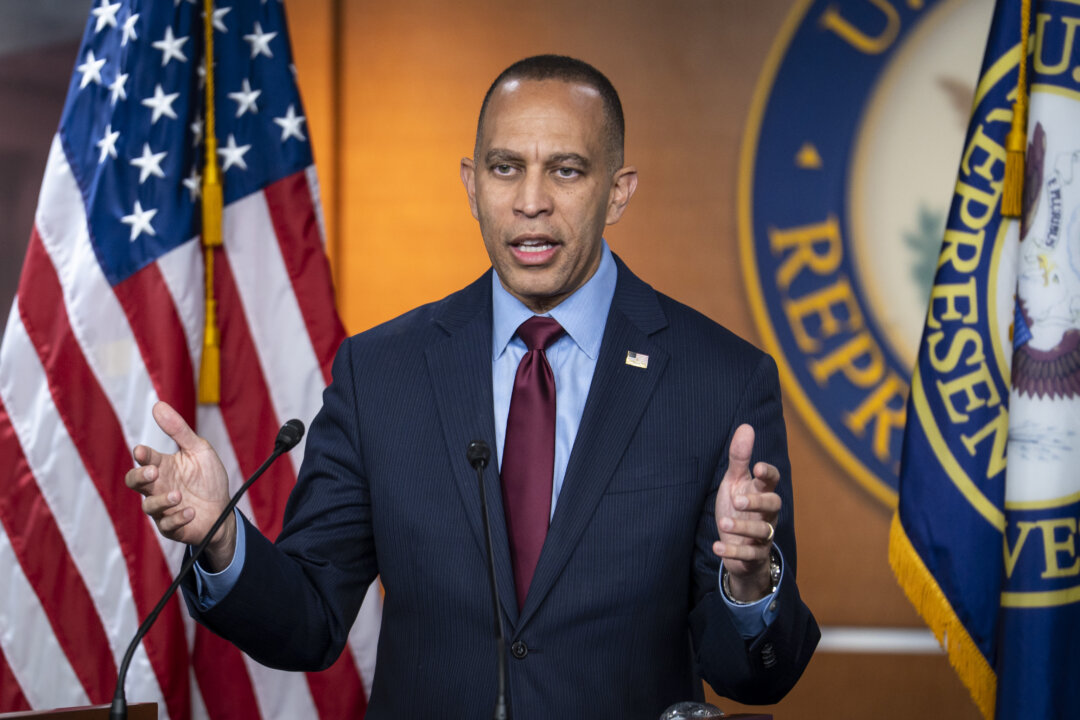
House Democrats will meet behind closed doors on Nov. 18 to choose their nominee for speaker and the rest of the team that will lead their new majority, with House Democratic Leader Hakeem Jeffries (D-N.Y.) running for the top job without a declared opponent.
Jeffries told reporters at his weekly news conference on Nov. 17 that he plans to ask for a recorded vote in the caucus. He said Democrats took the same approach in 2018, when they last won back the House, and that it would give every member a chance to weigh in on who is best positioned to lead in the new Congress.
“Caucus is going to be able to work its will, and we’ll see what the outcome is tomorrow,” he said.
Asked about members who may oppose him, Jeffries said reporters would have to ask them. He said he would meet later in the day with leaders of the Congressional Progressive Caucus, the New Democrat Coalition, and the Blue Dog Coalition, and that he was still talking with incoming members.
“We take nothing for granted,” he said.
Jeffries announced his bid in a letter to colleagues on Nov. 4, the day after Democrats won control of the chamber. A win in the caucus and then on the House floor in January would make him the first black speaker.
The caucus vote is the first of two steps. A nominee needs only a majority of House Democrats this week and then a majority of the members who vote for a candidate by name when the new Congress convenes on Jan. 3.
That would be 218 if all 435 members vote for a named candidate. Members who are absent or vote “present” lower the number needed. Jeffries has said the Democratic majority is likely to top 260 seats.
Asked on Nov. 9 whether he had the votes locked down, Jeffries said, “I guess we’ll find out next Wednesday.”
Several incoming progressives have not committed to him. Rep.-elect Adam Hamawy (D-N.J.) told reporters on Nov. 9 that he and other new members were not withholding votes and were undecided. Rep.-elect Melat Kiros (D-Colo.) said the group wants to know what priorities and floor votes the caucus will pursue.
“What we’re demanding is an agenda,” Kiros said. Asked that day whether the group would object if the caucus tried to elect Jeffries by unanimous consent, she said it was important to “at least have a conversation first.”
A Change.org petition urging members to vote against Jeffries had more than 1.2 million signatures as of Nov. 17. Protesters also interrupted him at a Democratic gathering in Denver on Nov. 13.
Below Jeffries, House Democratic Whip Katherine Clark (D-Mass.) is running for majority leader and would be the first woman to hold the post. Caucus Chair Pete Aguilar (D-Calif.) is running unopposed for whip and would be the first Latino in that job, Caucus Vice Chair Ted Lieu (D-Calif.) said on Nov. 10.
Lieu announced a bid for caucus chair in a Nov. 5 letter to colleagues, and the race to replace him as vice chair pits Rep. Sara Jacobs (D-Calif.) against Rep. Lauren Underwood (D-Ill.). Rep. Joe Neguse (D-Colo.), now the assistant Democratic leader, announced on Nov. 5 that he is running for assistant speaker.
Rep. Suzan DelBene (D-Wash.) is stepping down as chair of the Democratic Congressional Campaign Committee, the party’s House campaign arm.
Aguilar has said the new majority will focus on lowering costs, protecting healthcare, and rooting out corruption, and that Jeffries will decide with the caucus which bills get the first 10 bill numbers.
House Republicans elected Rep. Jim Jordan (R-Ohio) as minority leader on Nov. 10. Speaker Mike Johnson (R-La.) did not run for the post.
We had a problem loading this article. Please enable javascript or use a different browser. If the issue persists, please visit our help center.