
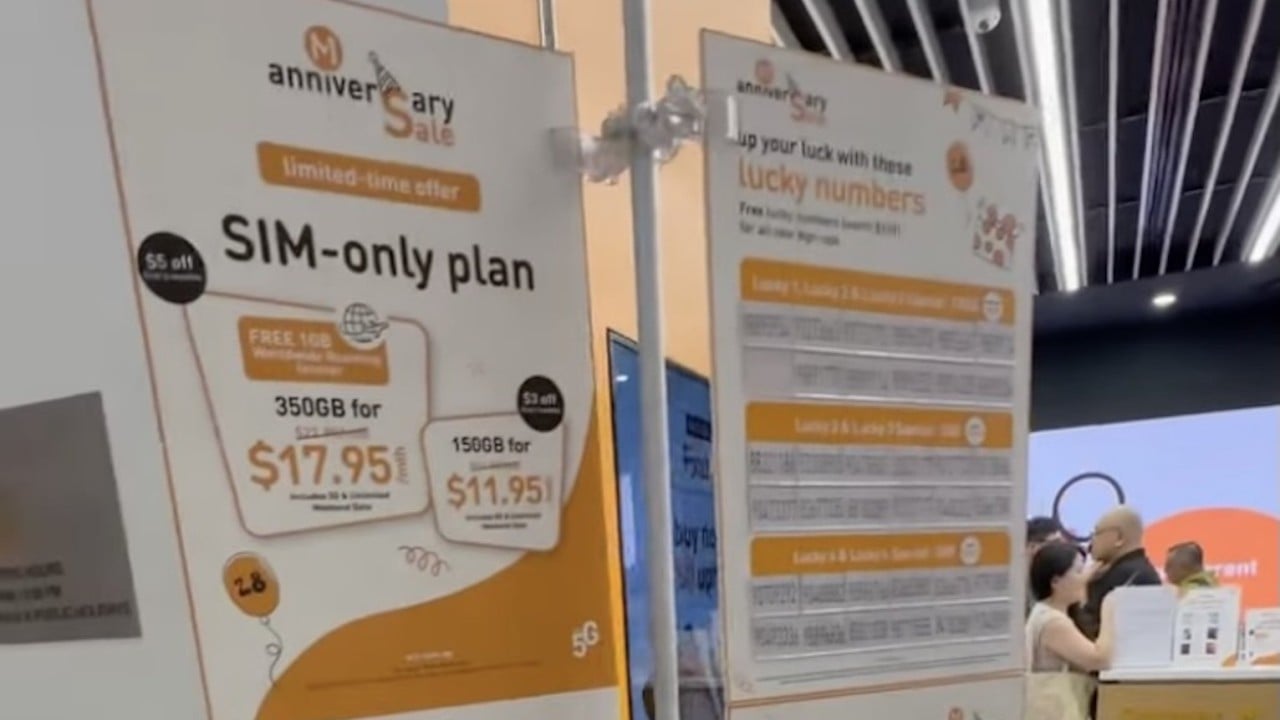
The unravelling of a S$1.43 billion (US$1.12 billion) merger between Singapore mobile operators M1 and Simba has highlighted the city state’s brutally competitive telecoms market, revealing a potential regulatory minefield around scarce radio spectrum.
The foiled deal would also mean Singapore’s mobile network operators – Singtel, StarHub, M1 and Simba – will continue to operate in a cutthroat price war environment while M1’s owners look for new ways to divest, according to experts.
Singapore has nearly 10 million mobile subscribers, exceeding its population of about 6.1 million, with operators and mobile virtual network operators jostling for market share.
Advertisement
Asha Hemrajani, a senior fellow at the S Rajaratnam School of International Studies, said: “Due to Singapore’s small size, the saturated market here and deep price-cutting, mobile network operator market consolidation has to happen, otherwise it is not sustainable.”
If M1 and Simba consolidated, they could have pooled resources to strengthen their investment in capacity, coverage, cybersecurity and artificial intelligence, Hemrajani added.
Advertisement
The consolidation of M1 and Simba would have been the first since the government eased regulations in the telco industry in 2000, removing limits on the number of licences and foreign ownership.
M1 and Simba, through their parent companies Keppel and Tuas respectively, jointly announced the consolidation deal in August 2025.