
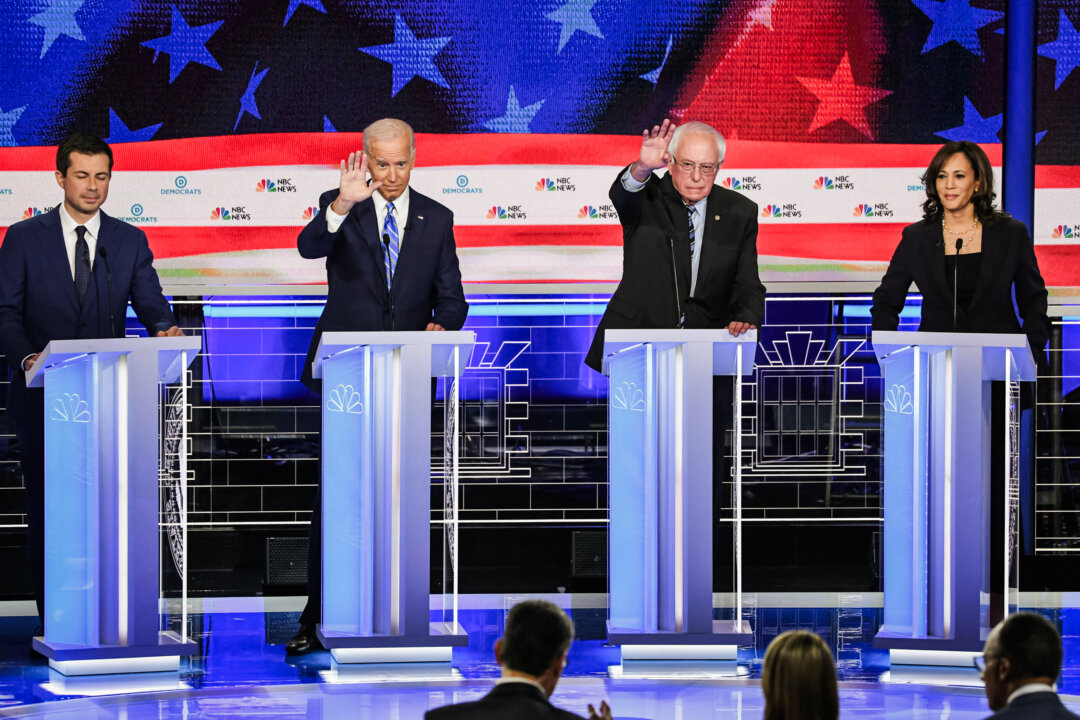
The Democratic National Committee (DNC) on Nov. 23 announced 12 debates for the 2028 presidential primary. It also revealed that to qualify, candidates must sign a pledge committing to denouncing outside spending in the selection contest.
The DNC said five debates will be held in 2027 and seven in 2028. The first two are set for June and July 2027, and the final debate is planned for March 2028. The party said it will announce dates, locations, media partners, and qualifying criteria for the first two debates in January.
Debates in the early-voting states will all take place in 2028. Under the calendar that the full DNC approved in August, South Carolina votes first on Jan. 22, 2028, followed by Nevada, New Hampshire, New Mexico, Michigan, and Virginia.
DNC Chairman Ken Martin said the process would keep the party united and strengthen its eventual nominee.
“Democrats are on offense after our historic victories in the midterms, and the DNC is keeping our foot on the gas as we head into the 2028 cycle,” Martin said in a statement.
Democrats won majorities in both the House and Senate in the Nov. 3 midterm elections, including the largest House majority of any party in the 21st century.
The DNC said candidates will qualify through polling and other measures of support, such as grassroots fundraising, similar to the 2020 process.
If the field is large, early debates may be split over two consecutive nights, and candidates will be assigned to a night at random. Participation will be capped at 20 candidates across both nights.
To qualify, candidates must also sign the DNC’s Fair Campaign Practices Pledge related to “dark money.” Dark Money refers to “spending meant to influence political outcomes where the source of the money is not disclosed,” according to fundraising tracker OpenSecrets.
The pledge covers ads that a super PAC or a 501(c)(4) group runs on TV, radio, digital platforms, billboards, or mail promoting a candidate or attacking a Democratic opponent. If another primary campaign reports that spending to the DNC and the party notifies the candidate, the candidate must denounce it.
A candidate who fails to do so by the debate qualification deadline is barred from that event and every one after it until the candidate denounces the spending. The DNC says denunciations will be made on a standard statement the party provides to each campaign, and it does not apply to the general election.
Candidates must also agree not to enter joint fundraising agreements with any Democratic Party committee. They also may not request or approve party committee ads at a state, county, or local level that promote them or attack an opponent until a presumptive nominee emerges.
The DNC cited the importance of party neutrality during the nominating process. Under the pledge, a campaign that accepted authorized party spending must refund it, and a prohibited fundraising agreement must be ended and its contributions refunded.
Progressive lawmakers backed the pledge and said it should go further. In a joint statement the DNC released, Reps. Greg Casar (D-Texas), Maxwell Frost (D-Fla.), and Pramila Jayapal (D-Wash.), co-chairs of the Congressional Progressive Caucus PAC, called the pledge a first step and said Congress must ban all super PACs by law.
“We urge all 2028 candidates to take this pledge and reject dark money,” they said.
Sen. Bernie Sanders (I-Vt.) congratulated Martin and said the same approach should be expanded to Senate and House races. Sen. Elizabeth Warren (D-Mass.) said she hoped candidates would not just take the pledge but embrace it.
Candidates may appear at town halls and forums one at a time. A candidate who joins an event where two or more candidates share a stage and answer questions—in person or virtually—will be barred from future DNC debates.
Candidates also can’t campaign in a state that holds an early contest without the party’s approval. Those who do will lose any delegates they win in the early states and be barred from the debates. They must also denounce anyone campaigning for them there.
Which states vote first has been a fight in recent cycles. Iowa led off the Democratic race from 1972 until 2024, when the DNC moved South Carolina to the front at then-President Joe Biden’s request. The party had started rethinking the order after Iowa’s 2020 caucus results were delayed for days.
New Hampshire, whose state law requires it to hold the first primary, went ahead of South Carolina in 2024 anyway. The DNC threatened to strip its convention delegates but restored them after the state party held a second, party-run primary. Rules the party adopted in June bar it from easing penalties after the fact. For 2028, New Hampshire is scheduled third.
States made their case for an early spot in May. South Carolina argued to stay first, backed by letters from five Southern state party chairs and Rep. Bennie Thompson (D-Miss.). Nevada and New Mexico pitched their Latino voters, whom New Mexico pollster Michelle Mayorga said “shifted 12 points to [President Donald] Trump” in 2024.
The party said it will try to maximize viewership, including by bringing creators and influencers into the debate process.
The DNC’s debate planning committee is led by Minyon Moore, the party’s senior adviser for debates, and Roger Lau, its executive director. Its members include former advisers and staff from the 2020 campaigns of Biden, Sanders, Warren, and Sen. Amy Klobuchar (D-Minn.).
It also includes alumni from the campaigns of former President Barack Obama, former Secretary of State Hillary Clinton, and former Vice President Kamala Harris.
Moore said she is committed to a fair, transparent process that also sets up the nominee to win the general election.
We had a problem loading this article. Please enable javascript or use a different browser. If the issue persists, please visit our help center.