
[The content of this article has been produced by our advertising partner.]
For modern-day businesses, effective AI adoption is increasingly seen as make or break if they are to stay competitive. Executives do see this potential but frequently reduce it to little more than a tool for drafting reports or creating slides.
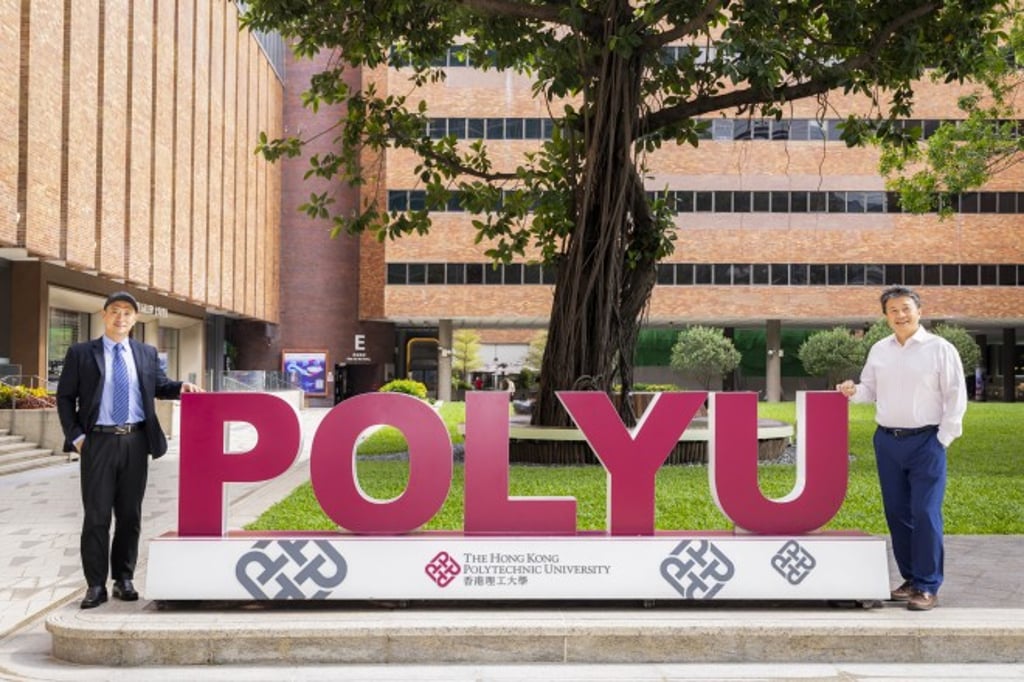
As Hong Kong’s first professional doctorate at the meeting point of AI, business intelligence and generative AI, the course consists of taught modules, residential workshops and a major applied thesis.
Advertisement
The goal is to give senior professionals the insight required to weave the technology into strategy, operations and organisational culture from the outset.
“The real gap is AI strategic leadership. Many companies today have AI pilots, but not AI transformation. They have tools, but the way these tools is deployed is not strategic. They have technical teams, but not always board-level AI judgement,” said Prof Michael Xu, who directs the programme, of the major shortfall the DBAI seeks to tackle.
Advertisement
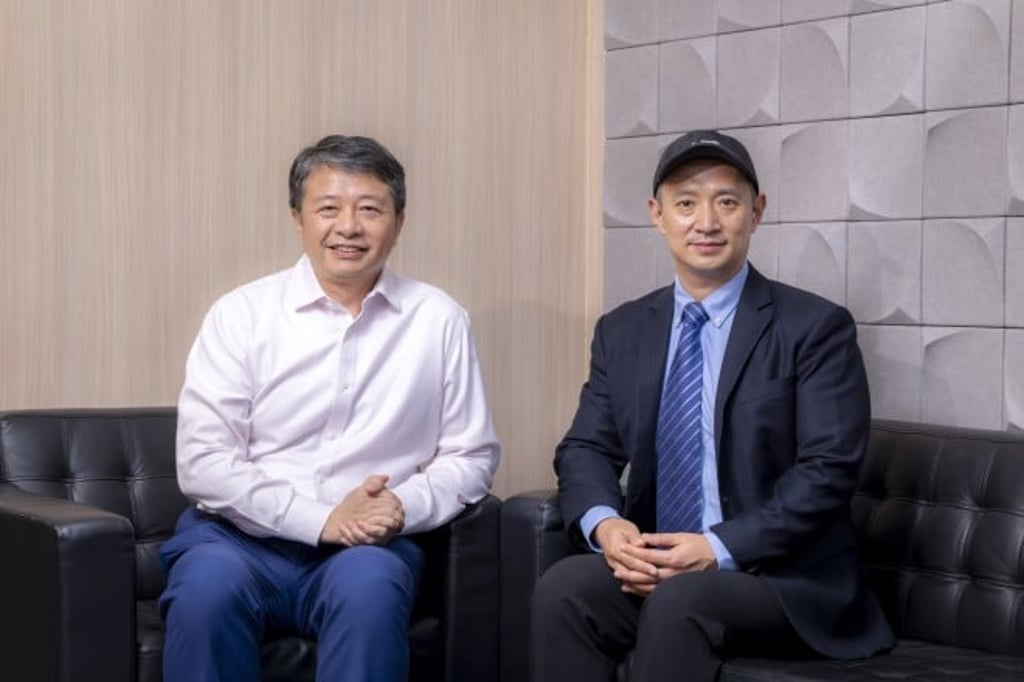
John Li, a participant with more than 20 years in ICT leadership roles at HP, PCCW and IBM, and founder of the cybersecurity firm eWalker Solutions, chose to enrol at this point in his career.
“If you don’t want to be replaced by AI, the only way is to understand it deeply,” he said, acknowledging that the speed of change in the sector left him with few alternatives.
Prof Xu’s own path, from civil engineering to psychology, an MBA at Wharton, global investment work and chief technology officer positions, feeds directly into the design of the curriculum.
Advertisement
“AI transformation is never only a technical issue. It is simultaneously a strategic issue, an organisational issue, a governance issue, a human issue and ultimately a leadership issue,” he said.
The programme encourages participants to move away from “AI-first” methods, where AI is added onto existing operations, towards truly AI-native models in which the technology forms part of the core infrastructure from the start.
“AI-native leadership means treating AI not as an add-on, but as part of the enterprise’s core operating system,” he explained.
Advertisement
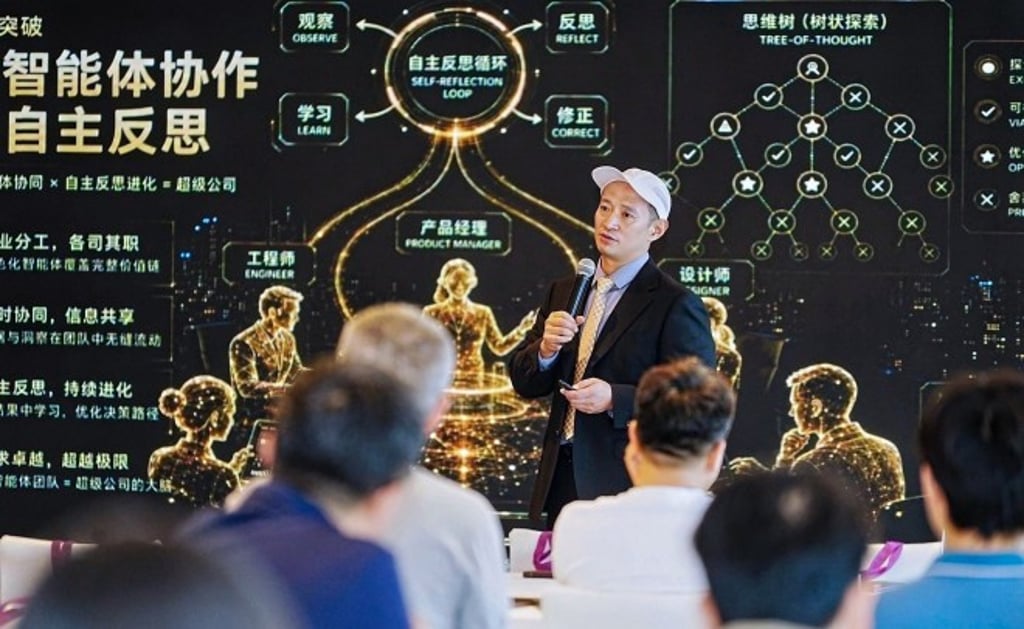
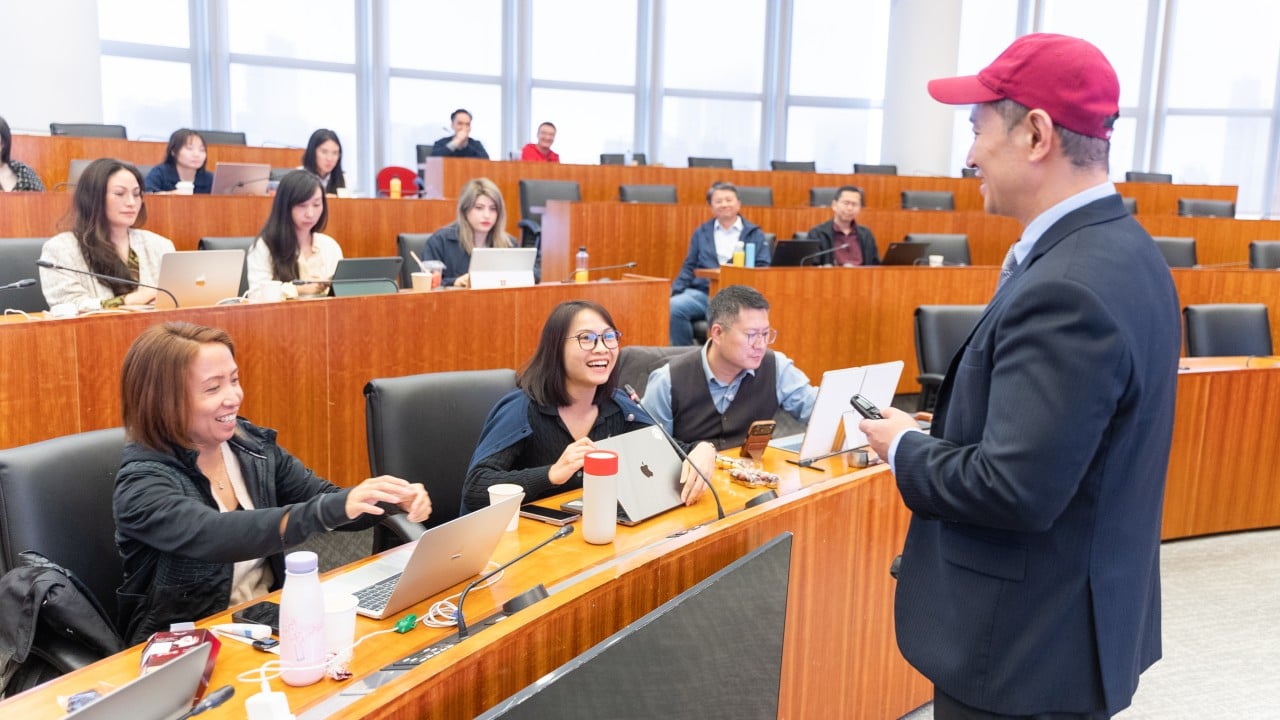
Students are required carry out applied research and industry-based projects. The substantial thesis component, Prof Xu noted, forces senior executives to move beyond slogans.
“They must define a real business problem… test assumptions and evaluate measurable outcomes.”
One student has developed virtual avatars for teaching and customer service, while others in cybersecurity use AI to run red-team and blue-team simulations that uncover system vulnerabilities.
Advertisement
Li described such work as useful. He has seen how AI can model both attacks and defences, enabling companies to test their setups far more quickly. At the same time, he warned against over-reliance on the technology. “You cannot just fire people and rely only on AI,” he cautioned. “Human judgment remains indispensable.”
Prof Xu took a comparable view on jobs. He cited the example of a media organisation that introduced AI automation but also retrained its staff, resulting in business growth by a factor of ten.
“AI does not necessarily mean massive layoffs,” he remarked. “But the requirements for skills and talent have changed.”
The programme appears at a time when the Hong Kong government has allocated new resources to AI. The 2026-27 budget includes HK$50mn for public training courses, seminars and competitions in the field, as well as HK$2bn for digital and AI education in schools.
Advertisement
As chairman of the Hong Kong AI Foundation, Prof Xu regards the DBAI as a necessary counterpart to these initiatives by focusing on the top end of the talent pyramid – the senior decision-makers who decide how AI investments are communicated, governed and converted into business value.
“Hong Kong cannot become an AI hub only by buying hardware or training more users,” he said. “It also needs leaders who can translate AI capability into sector-level transformation.”
The course draws students from not only mainland China but also Singapore and increasingly the so-called Belt and Road countries, from Asean to the Middle East. This mix yields concrete advantages for all participants.
Advertisement
Li recalled classmates from oil trading and fintech who described uses unfamiliar in Hong Kong. Such exchanges have prompted talk of possible collaborations.
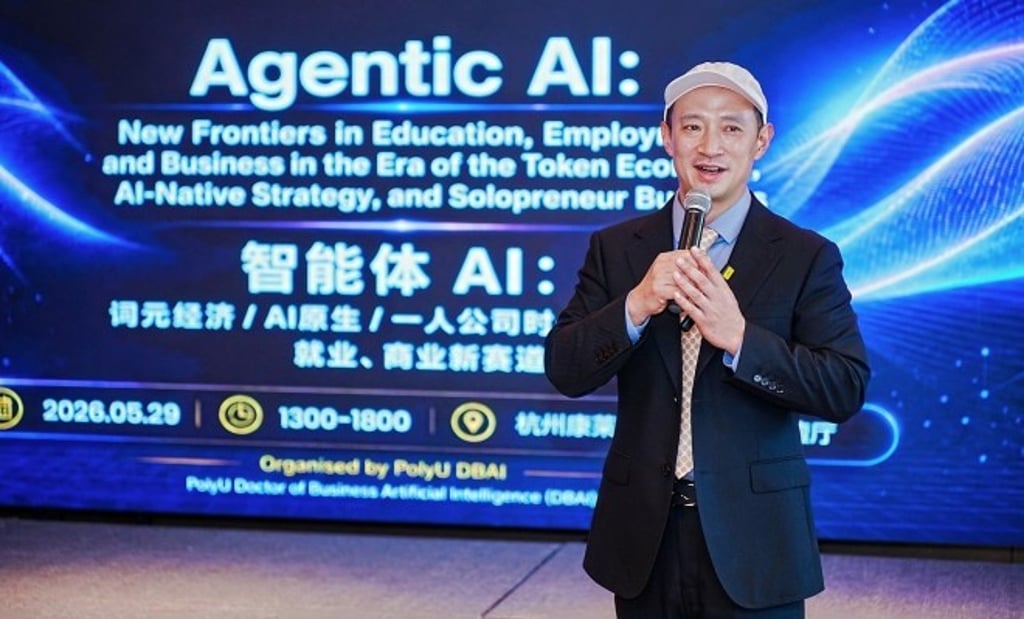
Prof Xu noted that leaders must learn to think architecturally by designing workflows, controlling data access, establishing approval processes and maintaining accountability.
“The risks are equally real,” he added, “including cybersecurity, data leakage, biased decisions and unclear responsibility.”
Advertisement
For organisations, the implications could include flatter structures. Prof Xu said this would fuel the growth of the “one person company” or “one person department”, a tectonic shift in how businesses may operate in the AI era, and that this model gives businesses a whole new level of agility and flexibility.
“It means one highly capable individual, supported by multiple AI agents, can now perform work that previously required a much larger team,” he said. Traditional enterprises should respond by redesigning teams around AI agents and empowering high-judgment staff.
The course is built for people in full-time roles, with sessions held at weekends. Participants gain access to computing facilities, including government-backed GPU resources. Li applied for funding to pursue AI-related projects and received assistance through the university.
Advertisement
Both men accepted that difficulties remain. AI systems can generate mistakes or hallucinations, and detection methods struggle to match the speed of improvements.
“The truth is usually not as dangerous as the most conservative people estimate, nor as risk-free as the most optimistic ones believe,” said Prof Xu, noting that the task for leaders consists in keeping risks within controllable, auditable and ethical limits.
“The biggest challenge is moving from AI awareness to AI-native execution,” he said.
Advertisement
Success in this transition, Prof Xu added, would allow Hong Kong to build a new generation of high-value, globally relevant service capabilities in finance, professional services and beyond.
Advertisement