
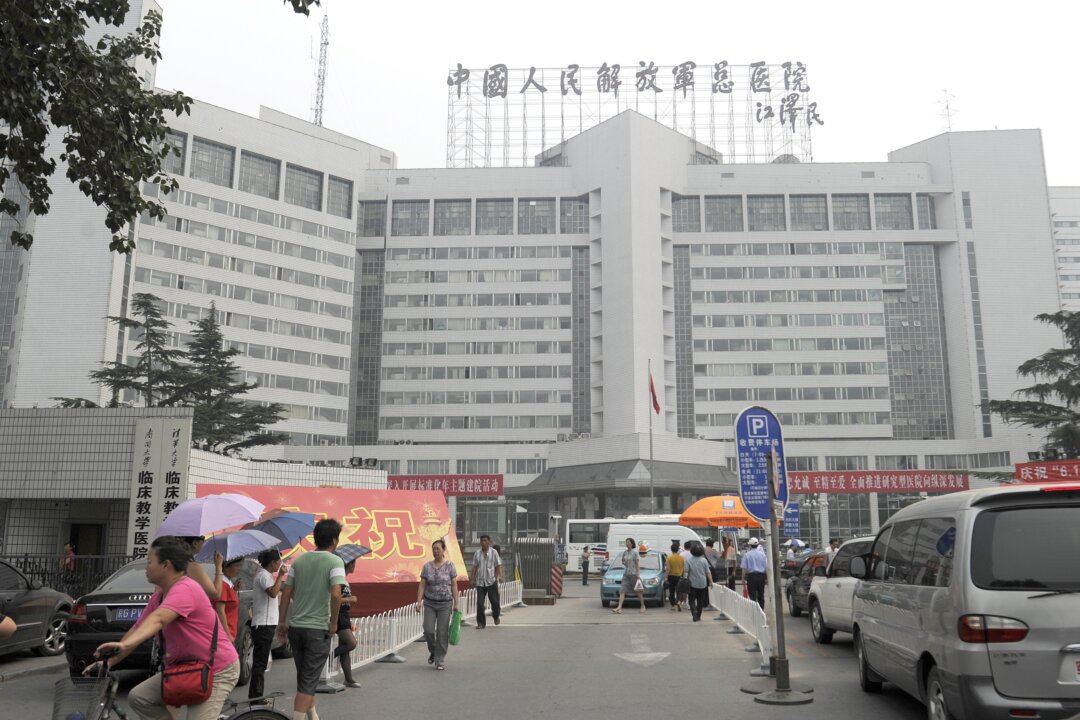
A doctor running a drug trial at a Chinese military hospital demanded that a U.S. Food and Drug Administration inspector endorse the Chinese Communist Party’s (CCP’s) claim to Taiwan before checking his work, according to a report the House Select Committee on the CCP released on Nov. 23.
The form the inspector was told to fill out was apparently titled “Visitor’s Attitude Towards China,” the report says. The inspector declined, and the FDA recorded the 2021 attempt as the doctor’s refusal to allow an inspection. When the agency tried again in 2024, the doctor set the same conditions.
The committee called it a particularly flagrant case of Beijing blocking U.S. inspectors. The report describes the doctor as a Chinese government representative and calls the demand an affront to patient safety.
The episode is laid out in “Prescription America,” the committee’s report on China’s push to dominate the development of new medicines. It opens by imagining an American cancer patient in 2040 who cannot refill a prescription because Beijing has cut off shipments during a diplomatic dispute.
The report’s 12 recommendations include restricting the FDA’s acceptance of clinical trial data from China, banning data from hospitals run by the People’s Liberation Army (PLA) and from trial sites in Xinjiang, and pushing to temporarily suspend China from the International Council for Harmonization, which sets global standards for drug trials.
New drugs are tested on patients at hospitals around the world, and drugmakers submit the results to the FDA when they seek approval to sell in the United States.
Inspectors visit trial sites to check whether the study followed its plan, patients knowingly agreed to take part, and the results sent to regulators match the hospital’s records.
If inspectors can’t enter, the FDA says it will not rely on that site’s data to approve a drug. FDA officials told the committee in July that China is the only country where the agency has been refused access for clinical trial inspections.
The report identifies the doctor as Xu Jianming, head of gastrointestinal oncology at the 5th PLA Medical Center in Beijing. The hospital dropped the Taiwan form only after months of talks involving the trial’s sponsor, and the FDA finished its inspection in January 2025.
It was the agency’s first completed clinical trial inspection at a PLA hospital since 2018, and only its sixth since 2009.
The 5th PLA Medical Center was formed partly from a hospital affiliated with the PLA’s Academy of Military Medical Sciences, which the U.S. Commerce Department has placed on its trade blacklist. All five major U.S. drugmakers the committee investigated have run trials there or at the hospitals that preceded it.
The FDA inspects few trials in China. From 2017 to 2026, it conducted 5,208 clinical trial inspections in the United States and 226 in China, according to agency data cited in the report.
The FDA did not inspect a single clinical trial site in Xinjiang from 2009 through 2025, the committee found.
The U.S. government has determined that the CCP is committing genocide against Uyghurs and other minorities in the region.
FDA officials told the committee they cannot send inspectors there because the U.S. Embassy in China will not allow it. State Department officials said they approve such trips case by case, and any inspection must be reported to the local CCP foreign affairs office, which can refuse it.
One drugmaker told the committee that a 2021 audit at a Xinjiang trial site found unclear signatures on consent forms, suggesting some patients may not have understood what they signed.
The report says the FDA still accepts trial data from Xinjiang and PLA hospitals. The FDA said in October that it is drafting policies on whether such data should count.
In response to letters Rep. John Moolenaar (R-Mich.), who chairs the committee, sent in June, AbbVie, Bristol Myers Squibb, Eli Lilly, Merck, and Pfizer said they have no plans to start new trials at PLA hospitals. All but AbbVie said the same about Xinjiang.
Merck told the committee that contract talks with PLA hospitals had become difficult over language about regulatory inspections.
AbbVie, the maker of the anti-inflammatory drug Humira, said it has a duty to offer potentially lifesaving treatment to patients in Xinjiang, most of them critically ill with cancer. Moolenaar said the company “should immediately join its peers in ending this practice.”
The Epoch Times reached out to AbbVie and the FDA for comment but did not hear back by publication time.
Moolenaar and Rep. Ben Cline (R-Va.) urged the FDA in August to reject Chinese trial data unless the agency had inspected the site within the previous 12 months.
Moolenaar said in a statement that any facility that blocks FDA inspectors cannot be trusted to develop medicines for Americans.
“The FDA should never accept data from sites controlled by the PLA,” he said.
We had a problem loading this article. Please enable javascript or use a different browser. If the issue persists, please visit our help center.