
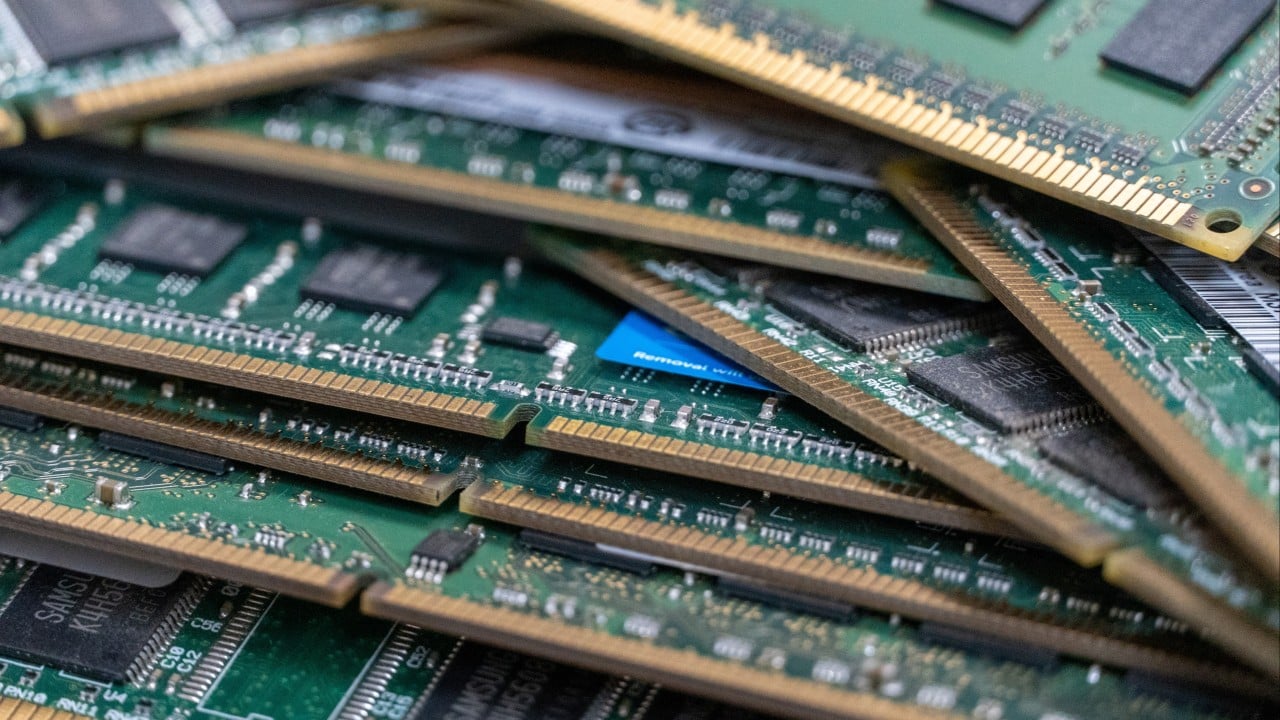
South Korea has emerged as a rare bright spot among East Asian economies trading with China, as booming demand for memory chips pushes its balance with its largest trading partner back into a surplus.
The country’s trade position with China had strengthened steadily this year, swinging from a US$764 million deficit in December 2025 to a US$1.1 billion surplus in February, before widening further to US$3.8 billion in May, according to data from South Korea’s Ministry of Trade, Industry and Resources.
The turnaround has been driven largely by semiconductor shipments to China, as the global AI boom fuels demand for memory chips. The surge had tightened supply and sent prices sharply higher, with 16GB DDR5 memory chips up 682 per cent and NAND flash memory prices up 807 per cent, according to Morgan Stanley.
Advertisement
In May, South Korea’s semiconductor exports to China jumped 243 per cent from a year earlier, the ministry’s data showed.
South Korea’s improving position stands in sharp contrast to that of other East Asian economies, where rising Chinese competitiveness and shifting technology supply chains have put trade balances under increasing pressure.
Advertisement
Japan’s export volumes to China had fallen by 10 per cent since 2022, while the post-pandemic surge in imports from China had largely been sustained, according to Marcel Thieliant, head of Asia-Pacific at Capital Economics. As a result, Japan’s trade deficit with China had risen to a record 1.2 per cent of gross domestic product.