
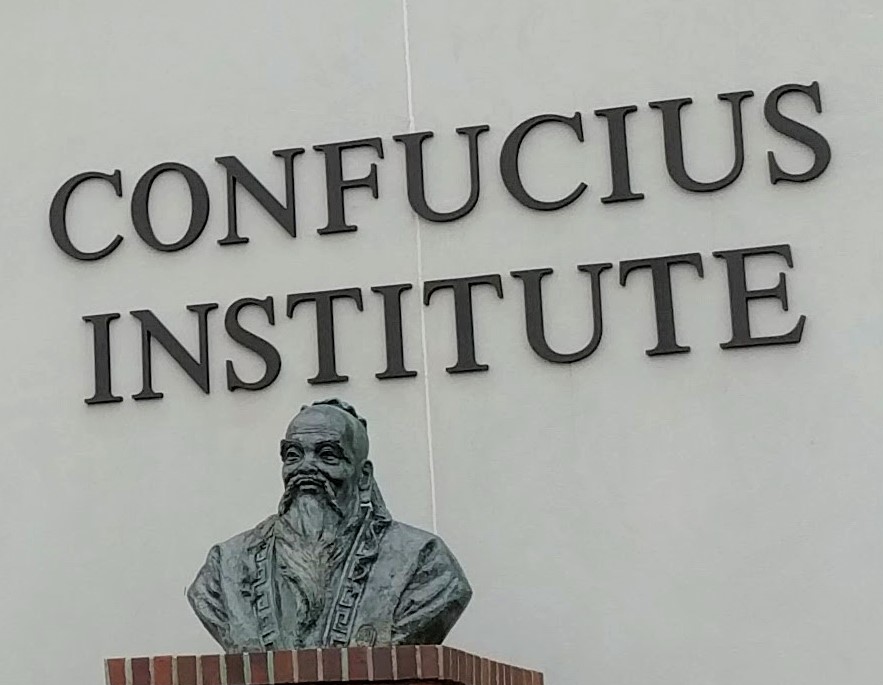
The Chinese regime has been using Confucius Institutes and their rebranded offshoots as its own enclaves on American soil to manipulate the nation’s beliefs and values, analysts warn.
Confucius Institutes are cultural exchange programs tied to the Chinese Communist Party (CCP).
Rep. John Moolenaar (R-Mich.), chairman of the House Select Committee on the CCP, said on Oct. 28 that War Secretary Pete Hegseth and the Trump administration “have made the right decision” to call Confucius Institutes a national security threat.
“The designation helps raise awareness about the threats posed by CCP propaganda in all its forms,” he said.
Moolenaar’s remarks followed Hegseth’s Oct. 23 announcement on X, which designated the institutes and accused them of stealing intellectual property and infiltrating the minds of American students.
Shen Ming-shih, research fellow at Taiwan’s Institute for National Defense and Security Research, said the Pentagon’s latest move shows the United States can no longer tolerate the Chinese regime’s defense intelligence gathering within its borders.
“China has used Confucius Institutes and related organizations to slip intelligence officers into America to win people over and carry out ‘united front work,’” Shen told The Epoch Times.
“Essentially, Washington now brands the CCP as the top threat, one that will use all manner of tactics to sway American values.”
The regime’s united front work is a strategy of courting, monitoring, and infiltrating people and institutions abroad through a web of groups to advance the regime’s interests.
Tseng Chien-yuan, an adjunct associate professor at Taiwan’s National Central University, said the problem with Confucius Institutes is not the Chinese classes they offer but their course materials, which are steeped in the regime’s ideology.

“Their lessons must stay within the political lines drawn inside the PRC, which infringes on academic freedom and university autonomy in democracies,” Tseng told The Epoch Times, using the acronym for China’s official name, the People’s Republic of China.
Tseng said this makes Confucius Institutes the regime’s “enclave” or academic colony in free societies.
“Beijing forces its ideology on the China specialists it cultivates in other countries,” he said.
Tseng said the greater danger is that foreign scholars of China and its language can end up serving as the CCP agents.
“Universities in the U.S., Canada and elsewhere have been cutting ties as those countries come to see how Confucius Institutes erode academic freedom,” he said.
Confucius Institutes numbered 510 in 164 countries and regions at the end of 2025, according to China’s state-run People’s Daily Online. But in the West, countries have been closing them one after another since concluding that they push Beijing’s political agenda.
Hegseth said in his announcement that Confucius Institutes had returned to U.S. campuses under different names, and that the Pentagon had “systematically dismantled” all 80 such groups across 30 universities over the past two months.
In response, Chinese Foreign Ministry spokesperson Guo Jiakun said on Oct. 26 that Beijing rejects “vilification and smears” against Confucius Institutes, and that educational exchanges between China and the United States should continue.
Punitive Measures
Tseng said Beijing could retaliate, with U.S.-run language, cultural and academic centers in China among the possible targets.
“The CCP has its so-called ‘seven taboos.’ Teachers there may actually discuss those topics, since Washington places no restrictions on their teaching materials,” he said.

“Their ideas could shake how Chinese people think more than China’s own classrooms do. Beijing’s most likely payback would be shutting these centers down.”
The “seven taboos” refer to topics a 2013 CCP document asked Chinese university instructors to avoid: universal values, press freedom, civil society, citizens’ rights, the Party’s historical aberrations, the “privileged capitalistic class,” and judicial independence.
Shen Ming-shih, research fellow at Taiwan’s Institute for National Defense and Security Research, said the CCP could abruptly cut off exchange programs with the United States.
“These activities give China a prime channel to co-opt American youth. But if they have run for a long time and Washington has come to rely on them, Beijing may halt them as a punitive measure,” Shen told The Epoch Times.
Chinese leader Xi Jinping proposed in 2023 to invite 50,000 young Americans to China over five years, a target met ahead of schedule in 2026. During a state visit to Washington on Sept. 24, he announced a new invitation for 100,000 over the next five years, according to China’s official Xinhua News Agency.
Beijing’s Next Moves
Antonio Graceffo, a national security analyst and Epoch Times contributor, said Beijing always looks for a way around restrictions and will keep rebranding and repackaging Confucius Institutes while expanding into K-12 schools.
“Those are not covered under any kind of a ban or even an investigation by the Department of Defense,” Graceffo told The Epoch Times.
Tseng said that even if the regime tries to bring the institutes back under new names, shutdowns across the United States are already blunting its indoctrination of promising young Americans.
“Any similar body can easily make U.S. universities suspect it is simply the old institute restored,” he said.
“Even if every closure leaves schools short of Mandarin teachers, Taiwan could fill the gap.”
Taiwan and the United States have stepped up language cooperation since launching an education initiative in December 2020. Taiwan now has 93 Taiwan Centers for Mandarin Learning worldwide, offering foreign students “free and democratic alternatives” for learning Mandarin, Taiwan’s Overseas Community Affairs Council says.

Tzeng Wei-feng, an associate research fellow at the Institute of International Relations at National Chengchi University, said that after stiff pushback in the West, the regime will keep growing its Confucius Institute network across the Global South, including Southeast Asia, Africa, the Middle East and Latin America.
“These countries don’t really resist or object to them. They care about ties with Beijing and don’t see such institutions as engaged in espionage,” Tzeng told The Epoch Times.
“China will focus on places it sees as strategically important, mainly to extend its soft power, so these countries’ support matters to it.”
We had a problem loading this article. Please enable javascript or use a different browser. If the issue persists, please visit our help center.