
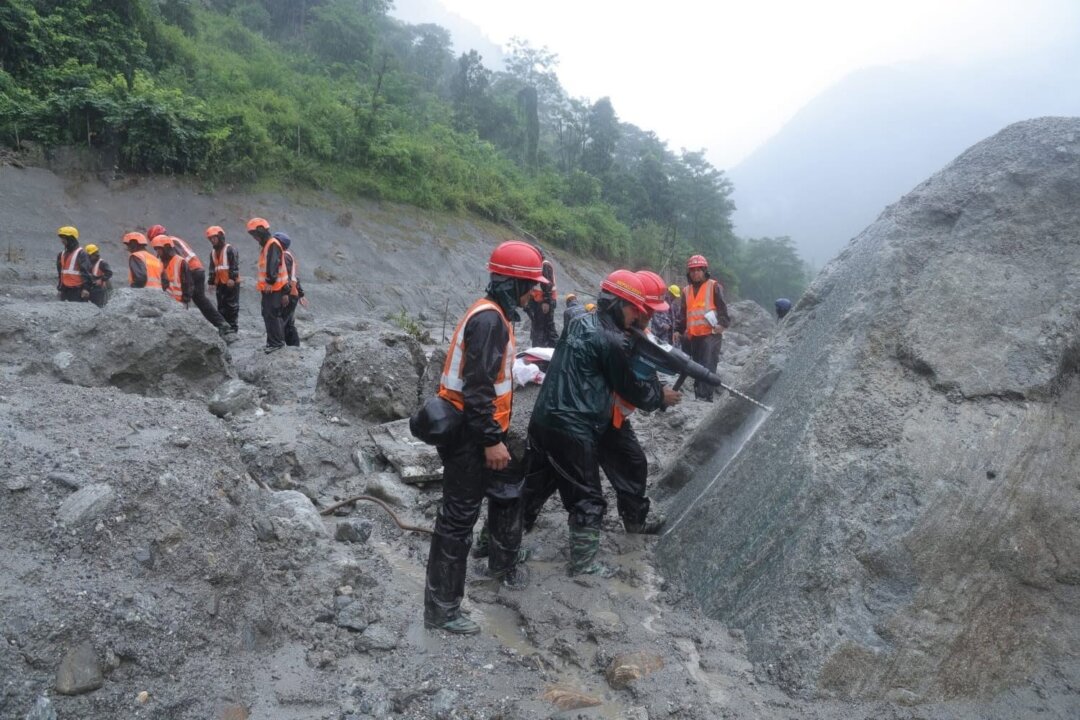
The reported death toll from the Nepal–Tibet flood rose above 800 on Aug. 30.
The Nepal Police reported 788 deaths. Chinese authorities separately reported 16 deaths and 546 people missing on the Tibetan side in Gyirong, bringing the reported cross-border death toll to 804.
Nepal’s disaster authority has listed 2,502 people missing as of Aug. 30, including 933 people connected to hydropower projects and 592 foreign nationals.
Preliminary figures from Nepal’s education authorities also put 238 students and 18 teachers from three affected districts among the missing.
The Bhotekoshi River in Rasuwa rose again early Aug. 30, prompting Nepal’s disaster authority to urge rescue workers and riverside communities from Rasuwa to Chitwan to remain alert, according to Nepalese news outlet OnlineKhabar.
Meanwhile, on the Tibetan side of the border, Chinese police have forced local residents to delete allegedly false online comments they posted under Chinese media reports about the disaster. With independent journalists barred from accessing the affected area in Tibet, limited information is available to the international community about the impact of the flood in Tibet.
The Chinese Communist Party (CCP) has a documented record of censoring information and withholding casualty details during major disasters, such as during the COVID-19 pandemic, when official death tolls drew international criticism.
Tibet has been under CCP rule since 1951, and the regime formally established the Tibet Autonomous Region in 1965. Its restrictions on religion, speech, movement, and foreign access in Tibet have drawn longstanding criticism from the United States, the United Nations, and human rights groups.
Rescuers Search Tunnels in Nepal
At Nepal’s Chilime Hydropower Project, a specialized Indian tunnel rescue team working with the Nepal Army entered a tunnel and recovered two bodies, OnlineKhabar reported, citing Army spokesman Brig. Gen. Rajaram Basnet.
The team reached about 330 feet into the roughly 820-foot tunnel while searching for workers believed trapped inside. The project operator said six employees were believed to have been in the tunnel when the flood struck.
At the Langtang Hydropower Project, a Nepal Army–Indian team began searching inside another tunnel on Aug. 30, according to OnlineKhabar.
The project operator said about 25 people were believed trapped inside. Crews were removing water, mud, and debris before the search was halted after dark and scheduled to resume the following morning.
Rescue work was also continuing at the Trishuli 3A Hydropower Project in Rasuwa, where people were trapped deeper inside a tunnel.
The Nepali Prime Minister’s Office said in an Aug. 29 Facebook post that crews had spent two days clearing mud and debris from the tunnel entrance.
A joint team of 82 rescuers—62 Nepal Army personnel and 20 members of the Nepal Police and the Armed Police Force—had been working continuously since the previous night, the office said.
Bad weather was making the operation particularly difficult.
An Indian rescue team had also reached the Trishuli area and conducted aerial reconnaissance over Chilime and Langtang in preparation for further rescue work.
Nepal authorities reported on Aug. 30 that 279 people had been rescued by helicopter from hydropower tunnels over Aug. 28 and Aug. 29—191 on the first day and 88 on the second.
Among foreign nationals, 15 Chinese and seven Indians were rescued from hydropower sites on Aug. 30.
China Watching New Upstream Hazards
Water hazards left by the Aug. 26 disaster were being monitored upstream in Tibet, according to Chinese authorities.
Late Aug. 29, China’s Emergency Management Ministry said its monitoring drones detected another landslide that created a new blockage in Tibet that was forming a second lake, in addition to a lake that had formed near the confluence of the Cuojian River and Purepuqiang Zangbo. Rescuers near the China-Nepal Gyirong border port were temporarily moved to safer ground while authorities assessed the new threat.
By Aug. 30, China’s Emergency Management Ministry said the newly formed landslide lake had begun draining naturally and was essentially empty. Separately, China’s Water Resources Ministry said a water-filled impact crater about 3.5 miles farther upstream still held about 1.4 million cubic meters—roughly 370 million gallons—and remained a risk, along with three smaller downstream pools, according to state media China National Radio.
Gyirong Port remains inaccessible by land. Chinese state media CCTV reported on Aug. 30 that crews had advanced only about 164 feet along the damaged G216 China National Highway after three days of work.
In a separate report, CCTV, said the debris flow had raised the Gyirong Zangbo riverbed by about 16 to 20 feet, sharply reducing its flood-carrying capacity, citing contractor China Aneng Third Engineering Bureau. Portions of the original G216 highway remained under about seven to 10 feet of water, leaving the road impassable.
We had a problem loading this article. Please enable javascript or use a different browser. If the issue persists, please visit our help center.