
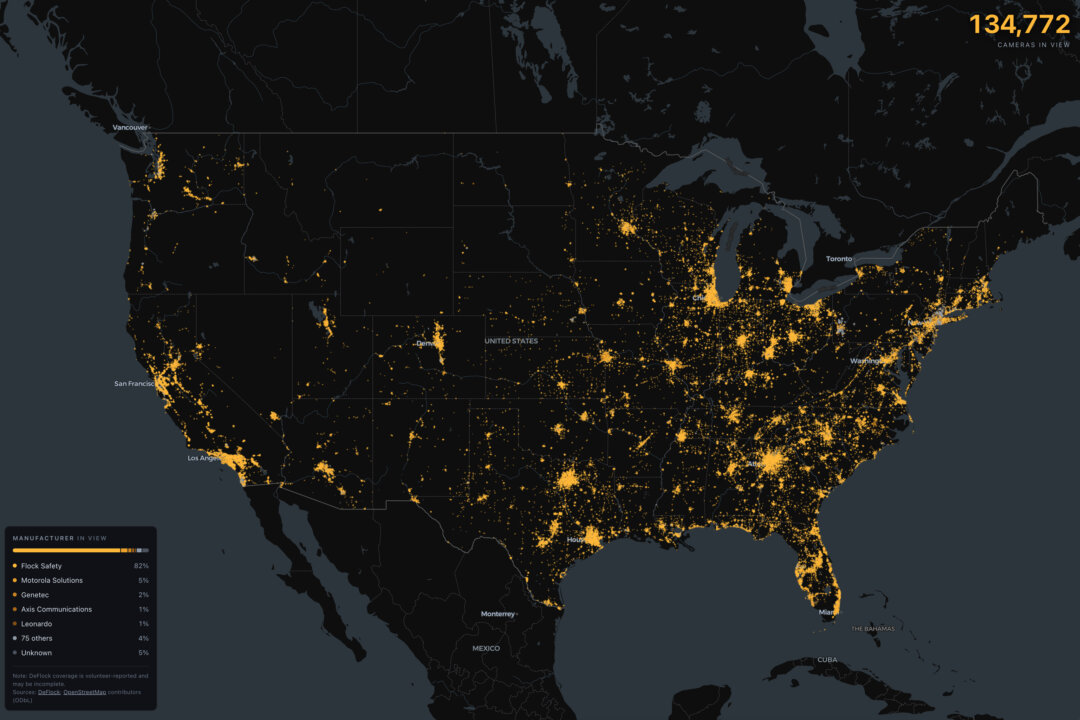
Its cameras are installed on poles at street corners, in parks and residential communities, and near countless businesses, tracking vehicles and private citizens across a growing surveillance network accessible by thousands of U.S. law enforcement agencies.
Now Flock Safety’s cameras—designed to monitor and catalog motor vehicles by license plate and physical characteristics—are facing scrutiny from lawmakers and private citizens alike, and acts of vandalism from activist vigilantes.
In several incidents, activists cut cameras down with reciprocating saws, hit them with trucks and baseball bats, and defaced lenses with spray paint.
In a more peaceful statement of protest, one Florida resident braves the heat for hours each day, holding a sign that reads ‘Down with the Flock’ in front of a Flock camera near his home in St. Petersburg.
What has led to such a visceral reaction to the Atlanta-based company’s camera rollout?
Beyond concerns of mass surveillance and loss of privacy, there are dozens of reports of mistaken traffic stops, in which innocent motorists were pulled over, jailed, or held at gunpoint after a Flock automated license plate reader gave law enforcement a false vehicle match.
There are also cases of officers allegedly using Flock’s camera database to stalk romantic interests, ex-partners, or relatives. A former Sarasota, Florida, police officer is facing felony charges for allegedly using Flock Safety technology to search for a single license plate hundreds of times.

Some legal scholars have argued that the technology violates the Fourth Amendment of the U.S. Constitution, specifically in how personal data is stored in the company’s databases so it can be accessed by a growing network of law enforcement agencies contracting with Flock.
“When you start getting into a surveillance economy, when you start expanding it beyond the purview of safety into true greed, it crosses a lot of lines,” Harry Maugans, cybersecurity expert and CEO of Privacy Bee, told The Epoch Times.

“I believe privacy is a human right. … Flock crosses that ethical boundary.”
Others believe Flock cameras present humanity with a worthy tradeoff, where a camera on every street corner could solve cold cases and prevent future crime at a level that surpasses what police officers could achieve without them.

Flock has touted anywhere from 90 percent to 99 percent accuracy rates on its license plate reading cameras, but an analysis from a California police department over its own use of the technology—based on 2023 and 2024 data—gave it a 71 percent failure rate on vehicle matches for stolen or felony-linked vehicles.
“My biggest worry is that we are not prepared systematically for any of the amount of data that’s being collected, either to process its consequences and actually use it in the right way, if there is a way to do that: to hold, retain, and secure it,” Suraj Mirpuri, a tech engineer and founder of AI firm Lowdown Labs, told The Epoch Times.
“That’s a big anxiety.”

Types of Flock Cameras
Flock offers a variety of products in its surveillance tech suite, including license plate readers, both fixed and mobile security cameras on trailers, and audio detectors designed to listen for gunfire and other “critical sounds.”
The license plate readers don’t just track vehicles by their plate numbers; they catalog their makes and models, trim colors, and other definable characteristics before storing that data in Flock’s digital network.

More than 5,000 law enforcement agencies nationwide contracted with the company have access to Flock’s database, according to the company.
With the ability to run on solar power, the cameras are also used by more than 1,000 U.S. businesses, according to Flock Safety’s website.
While Flock Safety does not offer a map showing the location of its cameras, DeFlock, a citizen-led organization that raises awareness of Flock cameras, has a live and interactive open-source map of Flock cameras nationwide, with the disclaimer that it does not “guarantee the accuracy, reliability, or completeness” of the crowd-sourced map data..
Flock Safety cameras, which usually feature a matte black, hooded camera with a solar panel, are easy to spot. But what makes a Flock camera different from a traditional security camera or older license plate reader?
It’s all about data retention and artificial intelligence.
Rather than storing camera and audio data locally, or in a segregated cloud account for each customer, Flock boasts a massive interconnected digital database that can be shared among its thousands of law enforcement clients.
And due to the sheer volume of that data, the company uses AI models to parse through and interpret it. When an officer is looking for a suspect and knows the target vehicle, it’s a combination of AI and Flock’s stored data that creates a match, allowing authorities to make a traffic stop.

Previously, Flock retained files for its large network of cameras and audio sensors for 30 days, but on Aug. 13 it announced it would shorten the retention window to seven days.
Police can still access some data longer for “exceptional” or cold cases, which allows officers to access the data longer using what Flock now calls “evidence mode.”
Do They Actually Work?
After growing reports of false positives from Flock’s license plate readers, private citizens have called on local governments to cancel contracts with the company.
Activists and lawmakers alike have questioned how accurate the technology is at solving investigations and preventing crime.
But when that question has been posed directly to Flock, company representatives have given varying answers, and the company has indicated lower levels of accuracy during nighttime hours.
Flock has stated on its website that its cameras accurately match vehicles 95.6 to 96 percent of the time, while this rate can drop to 90 percent at night.

In a lawsuit filed in 2024 against the City of Norfolk, Virginia, and its police chief over its use of Flock cameras, plaintiffs’ lawyers cited a litigation exhibit stating that the company’s cameras read license plates accurately 93 percent of the time.
But as recently as July, Flock Chief Communications Officer Joshua Thomas told automotive news outlet The Drive that the company’s cameras have a 99 percent accuracy rating.
Even if Flock’s cameras reached 99 percent accuracy, that would still mean hundreds of millions of misreads every single month, based on the more than 20 billion monthly scans the company says its cameras conduct.

Some data scientists are arguing the technology is incapable of the performance levels Flock is selling to countless law enforcement agencies nationwide.
“It is very naive to just say this is going to get better, because we as scientists know that there is a deep trade-off there,” Mirpuri said.
He remembers working in the early AI industry in the 2010s, when companies would tout new algorithms as capable of detecting cancer in tumor images with 99 percent accuracy.
“I say, ‘Great. What happens with the 1 percent when you tell someone they have cancer and they didn’t and they sell everything in their life?’” Mirpuri said.


“[Flock] could create a national security and also public safety risk greater than its speculative benefit, and you can quantify it by looking at the number of missed calls.”
In addition to the reported misidentifications, less than 1 percent of cars scanned by automated license plate readers end up being connected to crimes, according to an analysis from the Electronic Frontiers Foundation. Independent research group IPVM found that one in 10 plates scanned by Flock had misreads of the state of origin.
Legal Implications
An August analysis by the American Civil Liberties Union noted that Flock has installed more than 120,000 cameras throughout urban and rural communities, including on highways, in front of businesses, and in public spaces such as parks and waterways, allowing them to potentially track people’s daily routines, church, or political affiliation.

Flock has faced criticism that its camera network, particularly its retention of personal data, violates citizens’ Fourth Amendment rights under the U.S. Constitution.
Amy Peikoff, an attorney with the Pacific Legal Foundation and an expert in property rights, told The Epoch Times that the way Flock catalogs, stores, and serves this data to clients encroaches on constitutional rights.
In a law article published Aug. 17 titled “The Record, Not the Lens: ALPR Retention, Property, and the Fourth Amendment,” Peikoff argued that Flock violates the Constitution through its data ledger. “The wrong lies in the record, not the lens,” she wrote.

If the cameras were simply observing public thoroughfares in real time like a police officer, as well as using a digital network to check vehicle plates against lists of stolen cars, missing persons, and other law enforcement alerts, there would be no Fourth Amendment violation, according to Peikoff.
But as soon as Flock begins making a “timestamped, plate-indexed, queryable record” of U.S. citizens’ movements without probable cause, it violates the Constitution, she wrote.
The making of that record constitutes “a standing general warrant, executed in advance, the fruits of which are held against future need,” she argued.
Since a vehicle is personal property, and a license plate is a limited personal property easement by the government, Flock may be violating the Fourth Amendment by taking that identifier and turning it into a “24-7, 365 [days a year] tracking device,” Peikoff told The Epoch Times, calling that a “trespass” on a citizen’s car.
“Unless the information that the government is getting is something that is supported by the proper level of cause or suspicion, preferably a warrant … then you have violated the Fourth Amendment because you’ve conducted an unreasonable search,” she said.
Regulations and Canceled Contracts
Efforts to regulate Flock, or scale back its implementation in U.S. cities, are underway.
Rep. Thomas Massie (R-Ky.) said in late July that he would soon announce a bill withholding federal money from any law enforcement agencies or municipalities that deploy Flock and Flock-style cameras “to surveil law abiding citizens.”
Florida gubernatorial candidate Rep. Byron Donalds (R-Fla.) has called for a pause on Flock-style cameras, raising concerns of potential Fourth Amendment violations.

Florida Gov. Ron DeSantis said recently that he believes the use of license plate reading cameras has gotten “out of control.”
“No one’s been stronger on law enforcement than me—but I don’t want to have this become a surveillance state,” he said.
Some municipalities are already canceling their contracts with the mass surveillance company.
Earlier this year, one of Flock’s largest government clients, the Los Angeles Police Department, ended their relationship, citing “serious concerns” about civil liberties and civil rights issues around how data is collected and stored.
Between August 2021 and May 2026, Flock lost 82 contracts across 28 U.S. states, with 39 occurring this year alone.

Officials in Tempe, Arizona, said on Aug. 26 that they have shut down their Flock system and will end their contract with the company.
“While the cameras have helped Tempe Police solve crimes, recent misuse of automated license plate reader systems in Arizona and nationwide has raised concerns about the risks that come with the technology,” the city said.
Despite the cameras helping officers stop crime, “the risk of misuse is too great,” said Tempe Mayor Corey Woods.
“We have to be able to provide public safety in a way that maintains the trust of our community,” he said. “For Tempe, that means taking these cameras down.”
Despite these actions, Maugans doesn’t believe Flock will fundamentally change without federal regulations that include enforceable penalties.
“[Otherwise] it’s just their promise. They’re a private company. You can’t audit their books. You can’t prove the cloud systems are being deleted properly, and you can’t prove there are no loopholes,” Maugans said.
Is Flock Worth the Risk?
While Flock’s core technology could be a benefit if it’s able to catch a single murderer, Maugans said his main contention is with the company’s data retention.
What if a Flock-style camera network avoided violating the Fourth Amendment by nearly instantaneously deleting all video or audio data “except in the case where it has identified a crime,” as University of Houston law professor Peter Salib suggests?


That could not only reduce crime, Salib told The Epoch Times, but also limit the need for increased intrusive policing by officers in many U.S. cities, including “stop and frisk” efforts.
“As with many technologies, it has the potential to do a lot of good, and of course, there are risks, and we should be really interested in how big the risks are and how we should mitigate them,” Salib said.
“I think this technology has the chance to make us both safer and freer at the same time.”

Peikoff said Flock’s technology does potentially “provide real value” for solving crimes if it’s properly used and doesn’t encroach on constitutional rights.
This would require safeguards and “checks and balances” from the government, as well as changing the way Flock catalogs and categorizes citizens’ personal data, she said.
However, the way in which Flock has been deployed has gone far beyond that, Peikoff explained.
“I mean, you could just implement the entire surveillance apparatus of [George] Orwell’s ‘1984,’ and probably you would reduce crime, but you would not be having anything like what our founders envisioned. You know, an alternative dystopian 24-hour-367 surveillance—you’re never alone,” she said.

As a privacy professional, Mirpuri said he doesn’t believe there is a way to retain the potential “benefits” of Flock’s technology while imposing guardrails.
He said he disagrees with the idea that more cameras and more data will solve more murders, arguing it will merely “increase the surface by which cops have to analyze,” straining budgets as police departments hire and add resources to deal with the extra data.

“This is a company making a profit by selling safety to people, but actually creating more risk, in my opinion, because there is no way to secure a surface that large to an adequate degree,” he said.
“Imagine a insert-bad-state-actor-here hacking Flock …and being able to see the movements of every American, [including] high-profile Americans.”
He pointed to the situation earlier this year when the Iranian military was able to see U.S. Navy movements on ships heading to the Strait of Hormuz after exploiting data in a popular fitness app.
“Imagine Flock on that scale, doing that for U.S. senators, potentially tracking their vehicles, because if it’s available for some unit of police to look at or other people to look at, it’s available for bad actors, too. That’s dangerous,” he said.
Flock Safety did not respond to a request for comment.
We had a problem loading this article. Please enable javascript or use a different browser. If the issue persists, please visit our help center.