
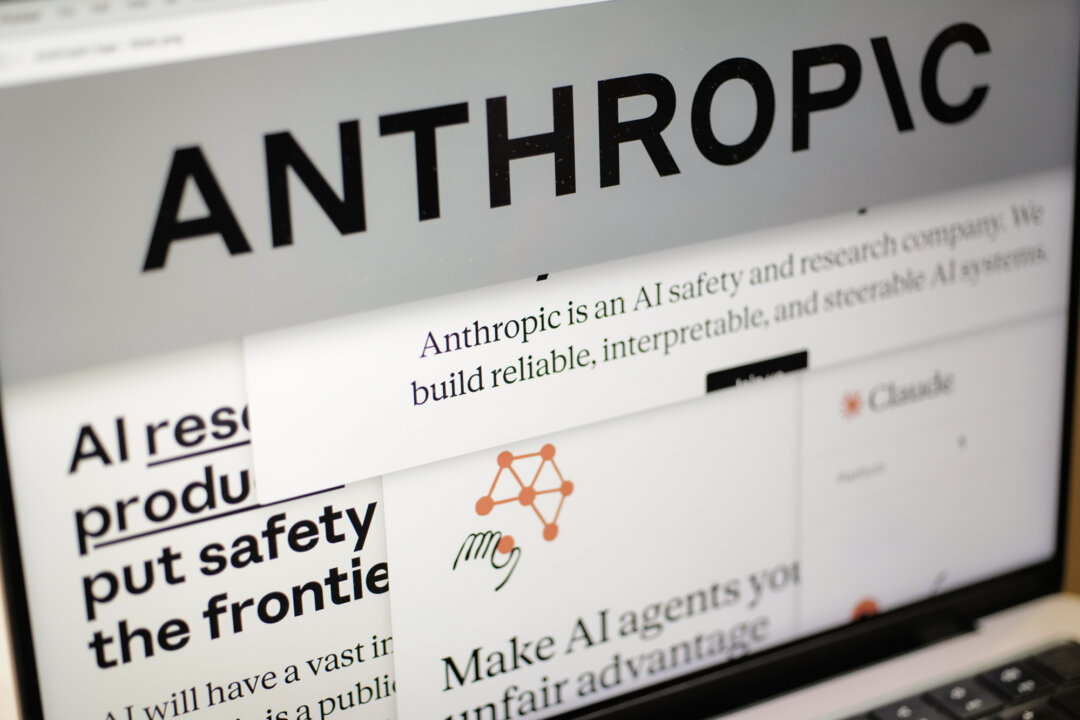
A federal appeals court on Sept. 25 upheld the Pentagon’s designation of Anthropic as a supply-chain risk, rejecting the artificial intelligence company’s claims that the label exceeded the law and punished protected speech.
The Department of War cut Anthropic off after the company declined to let the military use its Claude AI product without limits that the company wanted on autonomous weapons and domestic surveillance. The Pentagon has said it does not intend to use Claude for those purposes.
The Department of War began using Claude for various military purposes in 2024, but on March 3 of this year, Secretary of War Pete Hegseth determined that procuring AI goods or services from Anthropic presented a supply-chain risk. He invoked Section 4713 of Title 41 of the U.S. Code—known as the Federal Acquisition Supply Chain Security Act (FASCSA)—to bar Anthropic from supplying goods or services to the department after the company declined to contractually authorize Claude’s use for mass domestic surveillance or autonomous weapons.
The designation of the company, under that federal law designed to protect military systems from foreign sabotage, functions as a blacklist, preventing it from doing business with the federal government and its contractors. The federal boycott of Anthropic directed federal agencies, contractors, and suppliers to end ties with the company.
Government officials said no private company gets to set the rules for war.
Anthropic said the government was punishing it for speaking up, not stopping a genuine security threat.
Two courts went in different directions. A federal judge in San Francisco previously threw out one version of the ban in August, calling it unlawful retaliation.
On Sept. 25, the U.S. Court of Appeals for the District of Columbia Circuit voted 2–1 to deny Anthropic’s petition to review Hegseth’s March determination. The panel held the Pentagon had sufficient reason to be concerned that Claude’s built-in limits could freeze up in a real operation.
“The department had ample support for its conclusion that the continued integration of Claude into the department’s information systems, by the department or its contractors, presented a statutorily covered national-security risk,” U.S. Circuit Judge Gregory Katsas wrote for the panel.
Anthropic encodes restrictions into Claude that prevent the model from performing tasks the company wishes to prevent. “On more than one occasion, these restrictions have stopped Claude from performing tasks requested by government users,” the judge said.
Katsas said that at one point a dispute arose over whether the contractual prohibitions barred the use of Claude in an ongoing overseas military operation, “leaving the department uncertain whether Claude would perform as needed and intended.”
Katsas acknowledged the concerns of both sides, saying the case “raises profoundly difficult questions about the appropriate military uses of an almost unimaginably powerful new technology.”
He then laid out the two dangers the parties argued in court: Hegseth’s fear that tightly constrained models could shut down without warning and leave operations incomplete, and Anthropic’s fear that unconstrained models could invent the wrong targets for lethal force. Both, the judge said, raise clear national security concerns.
“But in our Republic, it is the President and the Secretary of War who must determine how best to balance the competing risks.”
Katsas rejected Anthropic’s due process claim, saying the department gave the company a fair chance to contest its exclusion.
The judge rejected the company’s First Amendment claim because, in his words, the department removed the company from its supply chain “based on the company’s refusal to assent to a contract term that the Department deemed essential.”
U.S. Circuit Judge Neomi Rao concurred.
U.S. Circuit Judge Karen LeCraft Henderson dissented.
She said FASCSA was written to meet the threat of “hostile nation states and other bad actors” infiltrating federal systems, not “a contractor’s honest and upfront enforcement of restrictions” the government dislikes.
We had a problem loading this article. Please enable javascript or use a different browser. If the issue persists, please visit our help center.