
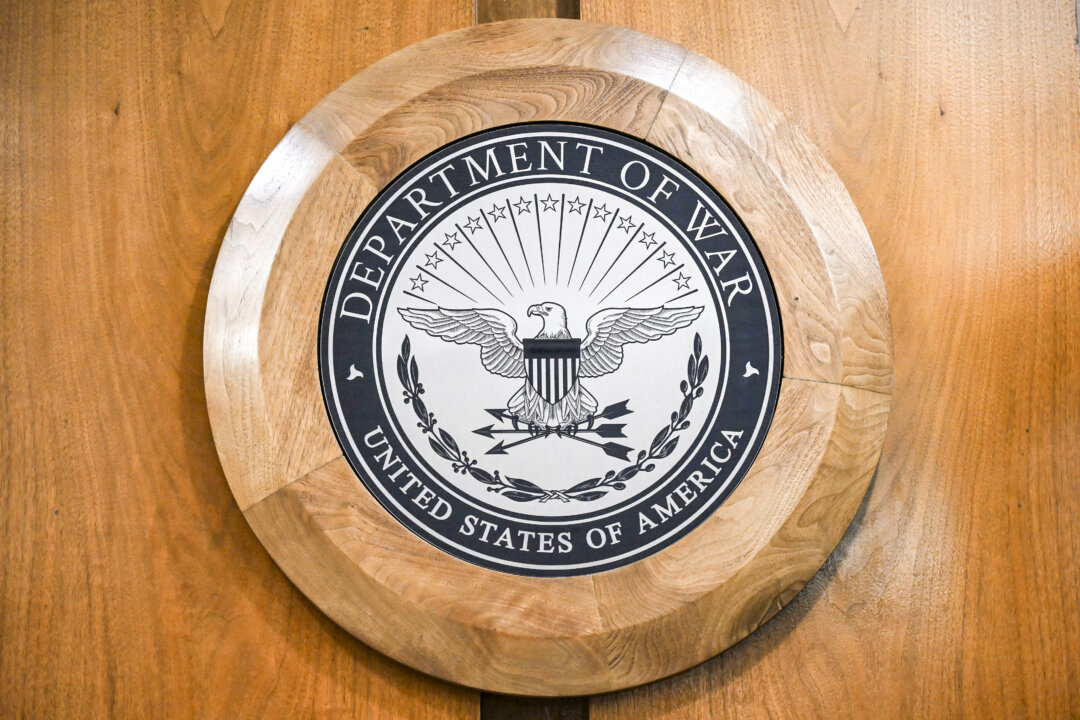
A federal appeals court heard oral argument on Nov. 16 in a clash between the Pentagon and The New York Times over press access.
The newspaper says a new escort rule left reporters worse off than journalists without credentials. The federal government says what it did was permitted.
The hearing took place before a three-judge panel of the U.S. Court of Appeals for the District of Columbia Circuit.
The Department of War, also known as the Department of Defense, tightened its rules for the media in October 2025 after officials said reporters enjoyed unrestricted movement inside the Pentagon. The department took the position that the restrictions were reasonable and designed to protect national security.
The new rules stated that soliciting non-public information from department personnel or encouraging employees to break the law “falls outside the scope of protected newsgathering activities.” They also provided that reporters would be denied press passes if officials determined they posed a safety or security risk.
Most members of the Pentagon press corps declined to sign an acknowledgment of the new policy and lost their press passes. Some, including The Epoch Times, signed it.
In December 2025, The New York Times sued, arguing that the policy violated longstanding practice and the U.S. Constitution’s First Amendment by restricting “journalists’ ability to do what journalists have always done—ask questions of government employees and gather information to report stories that take the public beyond official pronouncements.”
Judge Paul L. Friedman of the U.S. District Court for the District of Columbia issued an order on March 20 blocking the Trump administration’s media access policy at the Pentagon.
Friedman held that the Pentagon press policy ran afoul of both the First and Fifth Amendments.
On March 23, the department rolled out an interim policy that required credentialed reporters to be escorted by department personnel at all times while inside the Pentagon. They could no longer move freely through the halls, drop into press offices, or have unplanned conversations. Access was limited to scheduled briefings and interviews arranged in advance. The New York Times filed a separate lawsuit claiming the new escort rule was retaliation for its victory in the first case.
On July 16, a D.C. Circuit panel stayed Friedman’s escort-requirement injunction. As a result, the escort rule has remained in force during the ongoing appeals process.
The department is appealing Friedman’s later order that enforced the March 20 ruling that required restoration of the reporters’ passes. In the companion case, the newspaper is defending Friedman’s separate ruling that the escort requirement was unconstitutional retaliation for its victory in the first case.
At oral argument, U.S. Circuit Judge Judith Rogers pressed the Justice Department on the limits of its position, repeatedly returning to whether the government could effectively close the Pentagon to credentialed reporters while still claiming to have complied with the district court’s order.
Rogers said the Supreme Court has endorsed the view that having reporters roaming the halls of government “helps the public understand, but also helps aid the security of this nation and of our democracy.”
Justice Department attorney Sean Janda argued that the escort rule was permissible because the Pentagon is a nonpublic forum.
“The cases are exceedingly clear that the government can close a non-public forum to all expression if it’s doing so on an even-handed basis.”
Janda also argued that the escort requirement was not retaliatory because it applied equally to all credentialed reporters.
U.S. Circuit Judge Patricia Millett questioned a provision of the March 23 policy that treated a reporter’s offer of anonymity to a source as evidence the reporter was a security risk. She asked how a journalist could overcome that presumption without disclosing the source.
New York Times attorney Theodore Boutrous argued that under the March 23 policy, every article relying on an anonymous or background source could trigger the presumption that the reporter posed a security risk, forcing journalists to prove they weren’t. He said the Pentagon would effectively be putting reporters on trial for not disclosing their sources.
The attorney asked the panel to reinstate the district court’s order blocking the escort requirement.
It is unclear when the panel will rule.
We had a problem loading this article. Please enable javascript or use a different browser. If the issue persists, please visit our help center.