
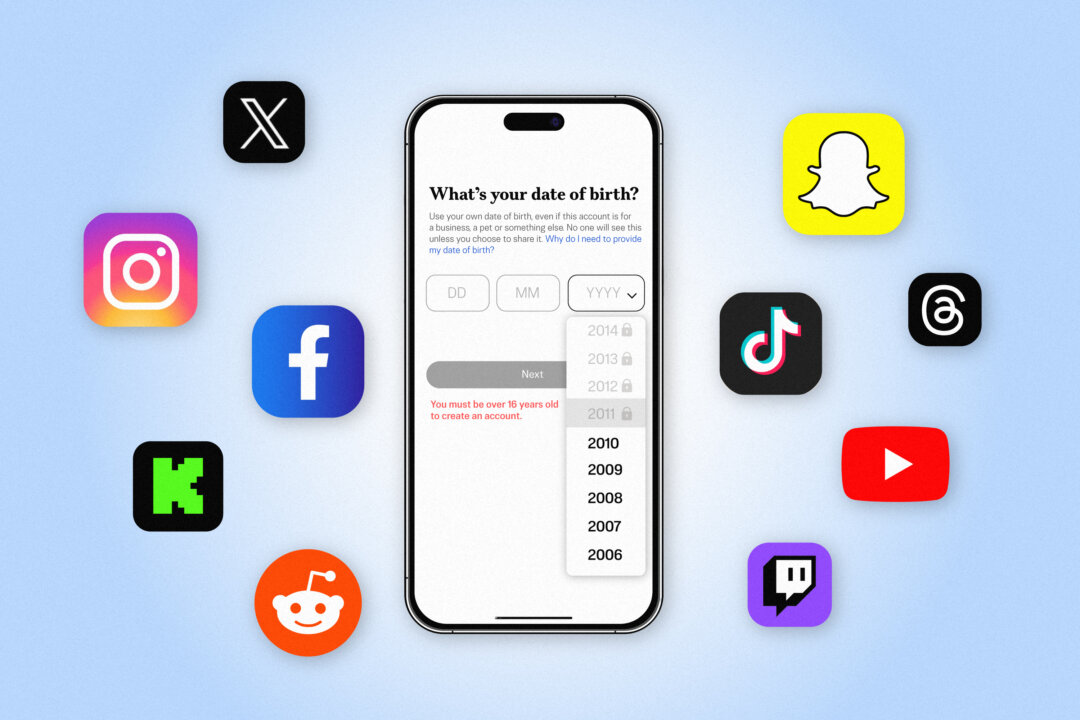
The United States and other nations are looking to the Land Down Under for guidance on curbing youth social media use, but experts and parents caution that government regulation is only part of the solution.
Australia’s law, implemented in December 2025, raised the age for opening and using social media accounts on 10 major platforms, including TikTok, Instagram, Snapchat, and X, to 16. This measure, the first in the world, immediately removed access to about 4.7 million accounts, according to the government’s eSafety commissioner.
Nations in South America, Asia, and Europe have since imposed or proposed similar regulations, while widespread evidence of compliance and the effectiveness of Australia’s law remains to be seen.

The United States, which is a leader in research on the harmful effects of social media use, has experienced a series of stops and starts with legislation at state and federal levels as Big Tech pushes back. It won prior fights on First Amendment rights but suffered a setback on Aug. 26, when Meta agreed to a $17 billion settlement with 29 states that filed a lawsuit stating that the company knowingly attempted to get children addicted to its Facebook and Instagram platforms.
The Ethics and Public Policy Center think tank and advocacy organization called the settlement a monumental step forward in building an age-appropriate internet, “but not a silver bullet.”
“Nevertheless, it does nothing to raise the age for social media use in the U.S.,” the organization’s Aug. 28 statement said.
“Other countries, like Australia and the UK, have raised the age to 16. Even the new two-hour-daily time limit for Meta’s apps won’t protect young brains from addiction, because in those two hours a minor is getting constant hits of dopamine to his or her brain. In addition, the settlement applies only to one platform, Meta, and expires in 10 years. Broader legislation is still necessary.”
The latest American legislation was announced by Sen. Ruben Gallego (D-Ariz.) on Aug. 4. His bill would require parental consent for social media accounts opened and maintained by children under 16. The legislation’s predecessors, the Kids Online Safety Act and Kids Off Social Media Act, remain stalled in Congress.
Here’s a look at the situation:

Australia’s Findings
Australia’s eSafety commissioner surveyed Australian parents with children between the ages of 8 and 15 after its law took effect.

Nearly 70 percent of respondents said, despite the law, their child still had accounts on Facebook, Instagram, Snapchat, and TikTok, while about half reported that their child still had an account on YouTube. As to why these accounts were open, the most common response was, “they had not yet been asked by the platform to verify their age,” the commissioner’s report reads.
“Other reasons for ongoing account use—such as inaccurate age assessments during platform age check processes or children bypassing restrictions using circumvention methods—were also reported and varied across platforms,” the report reads.
Kosta Theochari, an Australian parent who regularly speaks with other parents at his MTD Design jewelry business in Melbourne, says he and other adults feel the legislation is a great first step toward combating a societal problem, but there’s a long way to go.
He said children are easily able to use an incorrect date of birth or access a parent’s details or device to enter otherwise restricted social media platforms.

“The barriers aren’t always difficult to overcome,” he told The Epoch Times. “Stronger age verification and ideally better enforcement by social media companies, I feel, are needed.”
“More important than this, ongoing parental monitoring and involvement are essential if the goal is to genuinely limit underage access to be able to create a safer online environment for all Australian kids.”
The law imposes fines up to AU$54.6 million against social media companies that don’t take reasonable steps to prevent underage users from having accounts on the restricted platforms, but it does not penalize parents who help their children access the otherwise prohibited sites.

The restricted sites cannot rely on an honor code where the user is simply asked if they are under 16, nor can they collect and maintain personal information. Acceptable verification mechanisms range from artificial intelligence tools that can determine age by the user’s image, to voucher systems where a third-party provides a statement verifying the user is old enough.
The eSafety Commissioner’s office also launched a community awareness campaign for children, parents, and educators. The Australian government will review the “operation of the law” in December 2027.

American Legislation
Gallego’s bill, unlike the Australian law, would allow parents to authorize a social media account for their under-16 child if they choose. It also calls on tech companies to provide parent-supervised accounts for overseeing and managing a child’s use of the platform.
“Every study tells us the same thing: Social media is poisoning our kids’ developing minds,” Gallego said in an Aug. 4 news release. “When unsupervised online, they can be exposed to explicit material, recruited by drug or sex traffickers, or cyber bullied. Meanwhile, Big Tech is profiting off of that very screen time. It’s more than time we set a federal policy to protect our children.”
The Kids Off Social Media Act, introduced last year, would set social media age restrictions at 13 and prohibit platforms from using algorithms that feed addictive content to users under 17. The Kids Online Safety Act, also introduced last year, calls for an age-verification system.

“It has been absolutely so frustrating that Big Tech has fought us every step of the way, on any of this legislation,” Sen. Marsha Blackburn (R-Tenn.) said during a Senate committee hearing in January. “There are laws in the physical world that prohibit you from endangering children in any way, shape, or form, but in the virtual space it’s the Wild West.”
Members of Congress are watching their state legislatures closely.

As of July, 20 states have laws on restricting youth access to social media or addictive feeds, but most are currently blocked by litigation citing infringement of First Amendment rights.
“The current overall trend is that rapid and evolving legislative momentum is outpacing constitutional clarity and associated challenges,” reads a summary of state laws and litigation from the Age Verification Providers Association.
Most of the legal challenges were brought by NetChoice, a trade association representing Meta, Amazon, OpenAI, Google, YouTube, Netflix, and several other technology companies. Its website has several press releases noting federal court victories across the country.

On Aug. 6, NetChoice issued a statement criticizing five Senate bills that it says would “impose sweeping age verification requirements, vague duty of care liability standards, and rigid AI design and data-use mandates” while doing little to address the actual sources of harm to young people.
“Going after bad actors requires collaboration between lawmakers, parents, educators, and the companies building these platforms, not adversarial legislation built on the assumption that industry is the enemy,” the statement said.

Beyond Regulations
While compliance with Australia’s law remains to be seen, most adults surveyed in that country provided early indications of public confidence.
About 61 percent said the restrictions will reduce cyberbullying, 63 percent said it will limit exposure to harmful or inappropriate content, and 57 percent said it’s a positive step for improving youth mental health, according to a March 17 survey administered by YouGov global research group.
“The findings suggest that while the public sees early signs of effectiveness, there is a strong appetite for continued evaluation, transparency, and policy evolution to ensure the ban delivers meaningful, long-term improvement to children’s online safety and wellbeing,” YouGov’s report said.
Stephen McKenzie, who heads the psychology and counseling departments at Torrens University in Australia, has witnessed the youth mental health epidemic in his experience as a professor, researcher, and parent of a teenage daughter. He applauds his nation’s effort to combat this growing crisis but says adults must do more to help.

McKenzie challenges parents to ask the less obvious questions. “Social” media can actually cause young people to be anti-social and reduce their capacity to form relationships. How much time are children spending alone in their own rooms? How much sleep are they really getting after lights out? Is a sudden, or even gradual loss of interest in sports or physical activity really just a phase that’s otherwise considered normal for adolescents?
If parents get “too militant” and order a blanket ban on internet browsers and/or social media, children often react by going underground to get access. It’s better to lay down some rules and modifications and wait patiently for improved behavior, he said.
“It’s important to have a middle path in terms of response,” McKenzie told The Epoch Times.

It’s also important to recognize the benefits social media can provide to young people, he added. A child who has trouble making friends at school due to lack of common interests or personalities may find “members of their tribe” on social media.
This is a great time for people of all ages to think about their own social media use, take it upon themselves to read the research and learn about the government’s policy, and look to improve their well-being, he said.
“Engage deep inquiry,” he said. “It’s a challenging time in human history for young people, but it’s also an exciting time.”
We had a problem loading this article. Please enable javascript or use a different browser. If the issue persists, please visit our help center.